

[비즈한국] “And yet, it rotates!” It is famously said that Galileo whispered these words to himself as he left the courtroom. (There is no actual evidence he said this.) Truly, everything in the universe rotates. The Earth rotates, the Moon and the Sun rotate, and our galaxy rotates. Every object in the universe must possess at least a minuscule amount of angular momentum from the very beginning. When averaging the motion of all particles that make up a system, it would actually be stranger if the total angular momentum perfectly canceled out to zero in every direction. Furthermore, all celestial bodies in the universe are formed as particles that were once widely dispersed gather together due to gravity. As they do, the radius of rotation shrinks, and the speed of rotation inevitably increases to conserve total angular momentum. That is why everything in the universe is spinning.
Then, what about the entire universe? In this way, could the entire universe we live in also have a non-zero angular momentum?
In fact, this question has persisted in the history of astronomy for a very long time. We do not have a definitive answer. However, we have yet to see any sign that our universe is rotating. But if we accept the bold assumption that our universe might be rotating, one of the most annoying, unsolved mysteries of modern cosmology might be elegantly solved. If the universe is truly rotating, the "Hubble Tension"—a challenge where the expansion rate of the universe varies depending on the observation method—can be explained simply.
The idea that the entire universe might be rotating was first proposed by an extraordinary mathematician in 1949. Kurt Gödel, also well-known as a philosopher and mathematician, used Einstein’s field equations to find a highly unusual solution. He assumed the universe was filled with a medium like a transparent fluid. Gödel called this medium "dust." He then created a model of a universe that rotates as a whole.
According to Einstein’s theory of relativity, a massive object distorts the surrounding spacetime. Adding the effect of a rotating mass creates even more dramatic consequences. Imagine placing a bowling ball on a blanket and spinning it. The blanket will twist along with the rotation of the ball. In reality, all rotating objects in the universe drag the surrounding spacetime along with them as if pinching it. This is called "frame dragging." This effect has been confirmed in pulsars in binary systems and the trajectories of probes performing flybys near Jupiter.
If the universe were truly rotating as Gödel imagined, the frame-dragging effect would naturally be occurring throughout the universe. As spacetime itself is dragged by this rotation, a difference arises in the degree of spacetime distortion between the far universe and the near universe as we perceive it. Accounting for this effect allows for a more accurate assessment of the universe’s expansion rate—the Hubble constant—from the distant universe to the nearby one.
Recently, a remarkable paper was published that actually tests Gödel’s bold imagination. One of the headaches for astronomers in modern cosmology is the Hubble Tension. Hubble Tension refers to the issue where the Hubble constant, which represents the expansion rate of the universe, yields different values depending on the observation method.
According to observations comparing the recession speed of galaxies based on distance, the Hubble constant is approximately 73 km/s/Mpc. This is the most traditional and direct way to determine the expansion rate of the universe. Many astronomers believe there is no fatal flaw in this method itself. While there can be significant errors in measuring distances to galaxies—and some recent studies have raised such concerns—large-scale observations using the Hubble and James Webb Space Telescopes have consistently shown similar levels for the Hubble constant.
The expansion rate can also be determined through the faint radio signals left across the universe as the high-temperature, condensed early universe expanded uniformly and cooled down. These radio signals, which correspond to the remnant heat of the Big Bang, are called the Cosmic Microwave Background (CMB). According to the most recent observations from the Planck satellite, the Hubble constant is around 67 km/s/Mpc. This is smaller than the value estimated from direct observations of galaxy recession. In other words, the expansion observed through galaxy recession appears faster than the expansion estimated from the remnants of the cooling universe.
Twenty years ago, when the discrepancy between these two observation methods first began to be discussed, astronomers weren't too concerned. At the time, both methods had large margins of error, and the measured values overlapped within those margins. It was expected that as errors gradually decreased and observation methods became more precise, the values would converge. However, what happened over the next 20 years was the opposite. The margins of error for both methods have shrunk significantly, but the difference between them has become more pronounced. This perplexing problem, where we are tracking the same expansion of the universe but seeing two different worlds, is called the Hubble Tension.
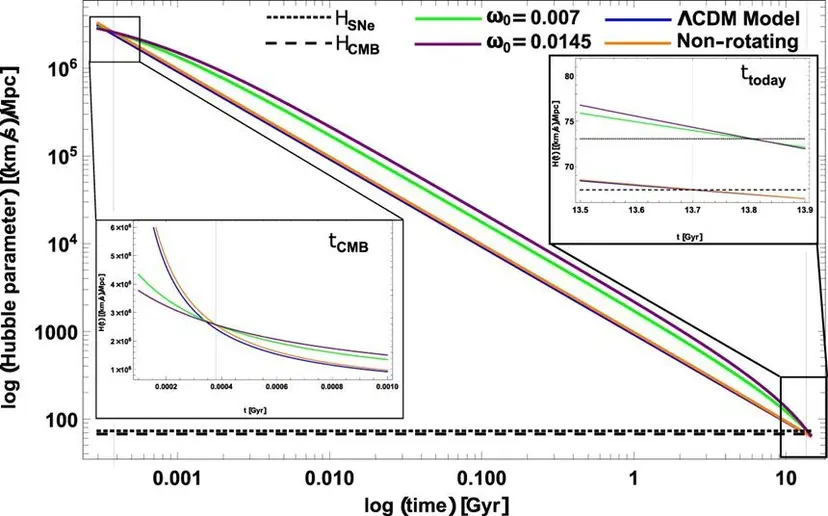
This new paper suggests an interesting possibility: the Hubble constant could be observed differently in the nearby versus the distant universe precisely because the universe is rotating as a whole. The graph containing the key results of the paper is quite intriguing. The x-axis represents the time elapsed since the Big Bang, and the y-axis shows how the Hubble constant has changed as the universe evolved.
The two black dotted lines at the bottom of the graph show the two Hubble constant measurements based on supernova-based galaxy observations and the Cosmic Microwave Background, respectively. One can see a slight difference. This difference is the aforementioned Hubble Tension. Both values represent the expansion rate of the universe at the current point in time.
However, as the universe expanded, the Hubble constant also changed. The blue line in the graph shows the change in the Hubble constant based on the ΛCDM model, the standard model of the universe that astronomers trust most today. It is the gold-standard model that incorporates dark matter and dark energy. The green and purple lines in the graph show how the Hubble constant changes when assuming different rotation speeds in the rotating universe model proposed in this paper.
In particular, the inset images drawn in detail on the left and right sides of the graph show how well each model matches actual observational results in the extremely early universe, when the CMB began to spread, and in the universe today. In the extremely early universe—the moment when particle density decreased and the first light began to spread, creating the CMB—the existing ΛCDM model and the rotating universe model both yield similar Hubble constant values.
But as we reach the present, the difference widens significantly. The blue line (ΛCDM result) and the green and purple lines (rotating universe models) clearly diverge. The ΛCDM result passes through 67 km/s/Mpc, which exactly matches the Hubble constant estimated from CMB observations. However, the result from the rotating universe model passes through the 73 km/s/Mpc range, which exactly matches the Hubble constant estimated from direct observation of galaxy recession! The paper speculates that this is because the expansion rate estimated from direct galaxy observation reflects the appearance of the relatively nearby universe, while the universe seen through the CMB reflects the appearance of the universe reaching much farther distances.
If the universe is rotating as a whole like in Gödel's model, the appearance of the universe we see could truly differ depending on distance. In other words, the Hubble Tension might be a result of us seeing slightly different universes depending on our observation methods!
If so, to explain the currently observed Hubble Tension—that is, for the expansion rate of the universe viewed through galaxy recession to be observed at around 73 km/s/Mpc—how fast would our universe have to be rotating as a whole? Very slowly. If the universe is rotating very, very slowly, at a rate of one rotation every 500 billion years, the current Hubble Tension can be sufficiently explained. We can easily understand why we haven't felt the rotation of the entire universe through actual observations until now.
Are you disappointed that the rotation speed of the entire universe suggested by this paper is so incredibly slow? There is an even more surprising story. The rotation speed of one turn every 500 billion years matches the maximum speed limit a rotating universe could have! If the universe were to rotate at an angular velocity faster than this, spacetime would become tangled, causing problems where time flows backward and all physical laws collapse. When assuming that the universe happens to be rotating at the theoretically fastest speed it can have, many of the remaining mysteries of cosmology are neatly resolved! It is a result that makes one prick up their ears, too suggestive to dismiss as a mere coincidence.
This interesting coincidence brings to mind the 'Black Hole Cosmology' introduced previously—the hypothesis that our universe might be a world trapped inside another massive black hole. This idea started from the fact that the post-Big Bang universe and a black hole are physically identical as singularities where all mass is gathered at a single point. All black holes in the universe have rapid spins; likewise, if our universe is trapped inside a black hole, it should naturally have a spin as well. There is another coincidence hidden here: if you assume the universe is truly trapped in a black hole and calculate how large the event horizon of such a massive black hole would be given the total mass of the current universe, it is roughly similar to the size of the observable universe we have identified so far!
Whether it is the size of the entire cosmic horizon or the rotation speed of the entire universe, everything seems to fit perfectly if we assume our universe is a world trapped inside a black hole. Unfortunately, however, verifying through observation whether our universe is truly rotating as a whole is very difficult. This is because we are inside the universe. If we are rotating at a similar speed along with the surrounding spacetime, no matter how much we examine our surroundings, there is no way to tell if the universe is truly spinning.
Also, the theoretically suggested rotation speed of the universe is extremely slow. Even if this hypothesis is correct, it takes 500 billion years for the universe to complete one rotation. However, the current age of the universe as we know it is only 13.8 billion years. It would need to spend another 36 times the lifespan it has already lived to barely complete one rotation. No matter how much we keep watching galaxies in the distant universe, we cannot discern in just a few years of observation whether those celestial bodies are subtly shifting in position.
We can think of indirect methods. If the angular momentum of the entire universe is not zero, then averaging all the galaxies created in the universe should reveal a shared component of rotation in a specific direction, however minute. We can statistically check whether the rotation directions of all galaxies in the universe are randomly distributed or if they indeed have a specific orientation. Recent research has also focused on this possibility (Related article: [Science] Why the Universe Rotates Clockwise).
Honestly, until recently, astronomers were very skeptical of such claims. Traditionally, it has been thought that the universe does not have any particular orientation and that everything is simply distributed evenly. In astronomy, this perspective is called the Copernican principle—the view that no place in the universe is special.
However, even this perspective is being questioned little by little. Recent discoveries include super-large structures where galaxy density is noticeably higher or lower across scales too vast to ignore compared to the size of the entire observable universe. Furthermore, observations of the Cosmic Microwave Background reveal suspicious orientations that are difficult to understand. It appears as if half of the universe is moving toward us and the other half is moving away. Even after subtracting the movement of our own solar system, this incomprehensible orientation remains. These circumstances, coming to light recently, raise questions about whether our world truly follows the Copernican principle, being fair and uniform to everyone without a single error.
“And yet, the universe rotates.” 400 years after Galileo’s trial, humanity stands once again before a new courtroom regarding the rotation of the universe. In those 400 years, the size of the universe we must contemplate has become much larger. After all, this time it is the rotation of the entire universe.
Reference
https://academic.oup.com/mnras/article/538/4/3038/8090496
Who is the author, Ji Ung-bae? He loves cats and the universe. After watching 'Galaxy Express 999' as a child, he dreamed of making the beauty of the universe known to the world. He currently researches the evolution of galaxies through interactions at the Center for Galaxy Evolution Research and the Near-Field Cosmology Lab at Yonsei University, and engages in various science communication activities such as lectures and writing. He is the author of books such as 'The Observatory for썸', 'Thinking About the Universe All Day', and 'Stars, the Science of Light'.