

[비즈한국] The "shadow war" between Israel and Iran has finally become a reality. Decades of indirect friction have turned into armed conflict, causing global financial markets to fluctuate. While U.S. President Donald Trump and Russian President Vladimir Putin have expressed willingness to mediate, the reality is that neither side is in a position to easily seize control. Although investor anxiety is rising, experts advise that this situation should be viewed as an "investment opportunity."
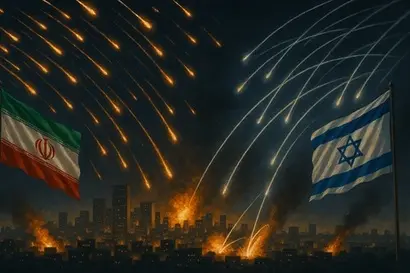
Kim Yong-gu, an analyst at Yuanta Securities, stated, "For Trump, who is busy focusing on keeping China in check, the two wars in Ukraine-Russia and Israel-Iran are a headache." He added, "Trump, who hopes for a resolution led by Russia and Israel, is highly likely to remain a bystander unless there is use of nuclear weapons or an expansion of the conflict across the entire Middle East." The analysis suggests that while it will not escalate into an all-out war, the potential for limited, ongoing conflict remains high. Ultimately, geopolitical risks are expected to persist, and market instability will likely continue for the time being.
The asset that reacted most sensitively immediately following this situation was international oil prices. West Texas Intermediate (WTI) rose to the mid-to-high $70 range amid concerns over supply shocks, before paring some of those gains and continuing to fluctuate in the low-to-mid $70 range. With fears growing over supply disruptions at Middle Eastern production facilities, oil prices are under pressure to rise in the short term. Kim Dae-jun, an analyst at Korea Investment & Securities, said, "Recently, speculative positions in crude oil have been increasing in the futures market," adding, "If the Middle East conflict does not end, speculative capital could further stimulate the rise in oil prices."
In the short term, there may be secondary benefits for raw material-related assets such as oil refining stocks and energy ETFs. However, caution is advised as this could lead to concerns about an economic slowdown in the medium to long term. Furthermore, rising oil prices lead to inflation concerns, which in turn becomes a factor that causes the U.S. Federal Reserve to delay decisions on interest rate cuts. Of course, there is also the observation that if prices rise, Trump will not overlook the expansion of Middle East risks that drive up oil prices.
The stock market also reacts quickly to such uncertainty. In fact, major indices including those in South Korea and the U.S. all fell on the 13th, and investor sentiment has cooled. However, this is precisely the time to remember the historical pattern that "geopolitical risk is a short-term event." The financial market is highly likely to continue repeating cycles of adjustments and rebounds for some time.
The recent KOSPI index saw rapid gains following the launch of the new administration, which makes Middle East-related geopolitical risks an inevitable factor for short-term profit-taking. Na Jeong-hwan, an analyst at NH Investment & Securities, said, "Geopolitical risks could last for one to two weeks, but considering that Trump wants low oil prices and interest rate cuts, the Middle East situation is likely not the worst-case scenario." With the new administration's momentum still in place, the domestic stock market remains undervalued in terms of valuation. With earnings and policy expectations present, external shocks can actually become buying opportunities.
Heo Jae-hwan, an analyst at Eugene Investment & Securities, advised, "Despite the anxiety following Israel's air strikes on Iran last weekend, foreign investors have begun buying since the end of April," adding, "At a time when there may be short-term burdens regarding stock price gains, it is worth considering interest in sectors that have risen less, such as shipbuilding, utilities, retail, and hotel/leisure."
Additionally, safe-haven assets such as the weakening Korean won, gold, and the yen are likely to gain prominence for the time being. Choi Ye-chan, an analyst at Sangsangin Securities, pointed out, "Due to the geopolitical nature of being a divided country, South Korea has shown vulnerability with the exchange rate spiking even during conflicts with low direct relevance, such as the Middle East or the Russia-Ukraine war," and added, "It is necessary to be mindful of the upward volatility of the KRW/USD exchange rate and oil prices in the short term." Analyst Choi also forecasted, "In such a risk-prone landscape, an influx of capital into safe assets like gold and the yen is expected, so the price appreciation of these assets will likely continue."
For investors, geopolitical risk is not a predictable variable. It is a part of investing that one must endure over a lifetime. Ultimately, it is up to each individual to decide whether to overreact whenever such events occur or to use uncertainty as an investment opportunity.
Ha Keon-hyung, an analyst at Shinhan Securities, said, "Even in April last year, major events that determined the pattern of the war occurred in the month following the outbreak of the war," adding, "During this period, rather than preemptively judging the expected situation, it is time to gauge the impact on the real economy and financial environment when events occur and make rapid portfolio adjustments."