

[비즈한국] It has been one year since hy launched its delivery app, 'Knock'. Knock entered the market with promises of the industry's lowest commission rates and free delivery, drawing significant attention; however, one year later, the business has seen little progress. hy stated that it is carefully monitoring market conditions while reviewing the business's viability.

To enter or not? A pilot operation limited to Gangseo-gu, Seoul
In June of last year, the delivery industry's attention was fixed on hy. This was because hy, having secured roughly 20,000 delivery riders through its acquisition of the delivery agency platform 'Vroong', jumped into the delivery market with the launch of its app, 'Knock'. Despite the handicap of being a latecomer, there were expectations that the company could grow its market influence given that it offered the industry's lowest commission rate (5.8%).
Although Knock marked its first anniversary this month, it has failed to establish a notable presence in the delivery market. Since beginning its pilot operation in Gangseo-gu, Seoul, last June, it has been unable to expand its service area. hy maintains a cautious attitude toward expanding the business, given that the delivery market is already dominated by the "Big 3"—Baemin, Coupang Eats, and Yogiyo.
An official from hy explained, "We believe there is no competitive advantage in offering the same services as existing players. We don't think it's too late to expand our service area once we've showcased various services to customers and received positive feedback. We are currently conducting various tests. While there is a possibility of regional expansion in the future, nothing is set in stone."
With services limited to Gangseo-gu, growth has been minimal. According to Mobile Index, a data platform by IGAWorks, Knock's monthly active users (MAU) were recorded at approximately 20,000 last month. This is a slow growth rate compared to the 12,000 MAU recorded in July of last year, one month after the launch. HiKnock, the hy subsidiary operating the app, saw its revenue stay at around 80 million KRW last year, while it posted a net loss of 4 billion KRW.
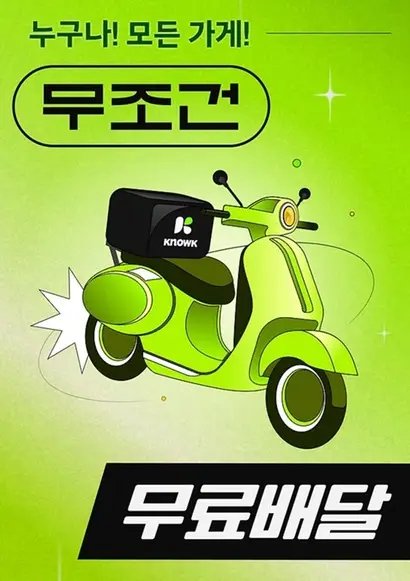
Recently, hy added a 'Local Shopping' feature to the Knock delivery app. This move is interpreted as an attempt to increase the number of partner merchants and expand the user base by adding quick-commerce functionality. In particular, hy introduced 'unconditional free delivery' as a benefit for its Local Shopping service. Knock subsidizes the entire delivery fee, allowing both users and merchants to utilize the service for free. Concerns have been raised, however, that this could increase the burden of business costs. In February, hy injected 2.5 billion KRW into HiKnock.
An official from hy stated, "It feels like a startup, so we expect investments to continue until it becomes profitable. Local Shopping is also a type of service aimed at differentiation for our customers. The number of partner merchants has currently grown to about 1,500. We will continue to test features that are not available in other apps."
10 out of 16 subsidiaries in the red; when will new businesses yield results?
There is a reason why hy is taking a cautious stance on its delivery business. The losses generated by the new businesses it has been pursuing are significant. hy has been attempting to diversify its business to reduce its heavy reliance on fermented dairy products, but it has failed to create a stable profit model for several years.
As of 2024, hy has a total of 16 subsidiaries, 10 of which are operating in the red. With its core business competitiveness weakening and the poor performance of its subsidiaries, the burden on hy is growing. Last year, hy's consolidated revenue was 1.6826 trillion KRW, a 10.8% increase from the previous year (1.5191 trillion KRW), but its operating loss was 64.5 billion KRW, more than double the previous year's loss (27.4 billion KRW).

The largest losses occurred in the medical business sector. In 2019, hy established an intermediate holding company, 'HYSG PTE LTD', in Singapore for its overseas medical business. Its subsidiary includes the overseas medical company Think Surgical Inc. HYSG PTE LTD recorded a loss of 63.5 billion KRW last year, and Think Surgical's net loss amounted to 69.5 billion KRW.
NE Neungyule053290, once considered a profitable subsidiary, continues to struggle with poor performance. After seeing a brief boost in earnings during the COVID-19 pandemic, NE Neungyule recorded a net loss of 3.4 billion KRW in 2023. Although it narrowed the net loss to 600 million KRW last year, it remains in the red.
The delivery agency platform Vroong, which was acquired for 80 billion KRW in 2023, is also accumulating losses. While Vroong's revenue last year was 340.1 billion KRW, a 9.8% increase from the previous year (309.8 billion KRW), its net loss was 26.4 billion KRW. The scale of the deficit has more than doubled compared to the previous year (10.8 billion KRW).
An official from hy said, "In the case of the medical business, there were difficulties in the market situation last year. We expect improvement this year." They added, "In the second half, we plan to focus on our main businesses, such as fermented dairy and healthy beverage subscriptions. As global exports are still in the early stages, we are looking forward to seeing results."