

[비즈한국] The number of Incheon International Airport users is steadily increasing. Consequently, the number of passengers using Seoul Station, where travelers can easily commute between the city center and the airport, has also surged. However, passengers with large luggage trying to board or exit taxis on the west side of Seoul Station are navigating a cramped and dangerous taxi stand.
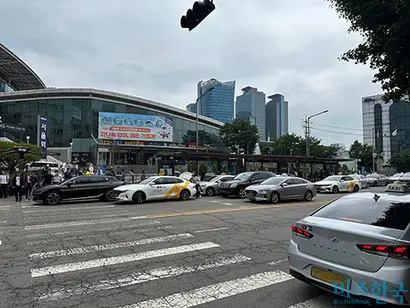
Many travelers with suitcases due to Airport Railroad… Roads blocked by loading luggage
The taxi stand in front of Exit 15 on the west side of Seoul Station is close to the Airport Railroad and the Seoul Station City Airport Terminal. Therefore, passengers looking to quickly travel between the airport and the city center come here to use taxis. However, the taxi stand is too narrow for the high volume of users, causing passenger inconvenience and road congestion.
In particular, many users arrive at the west side stand with large suitcases to catch flights or trains. Indeed, it was easy to encounter many passengers dragging their luggage. It was frequently observed that road traffic was obstructed as passengers stopped to load and unload their suitcases into taxis.
One taxi driver remarked, "(Long-distance travelers) sometimes carry two suitcases each." He added, "If we need to load luggage even into the passenger seat, the driver has to get out to help, which inevitably blocks the road." He noted, "The east side of Seoul Station is spacious, so it's better, but it's always congested here because it's narrow."
Congestion caused by cramped taxi stand and waiting taxis blocking traffic flow
The congestion stems from the structural problems of the west side taxi stand at Seoul Station. The east side of Seoul Station is adjacent to the Seoul Station Plaza, offering ample space. Furthermore, it is situated along a boulevard with more than 10 lanes, features a large transfer center for buses and taxis, and has separate areas for boarding and alighting.
In contrast, the west side of Seoul Station has limited space. Across the six-lane road are shops and residential areas. On the station side, there is no room to create additional space due to parking entrances and other facilities. Therefore, unlike the east side, the west side taxi stand merely consists of boarding platforms installed at the ends of the lanes with some signage.
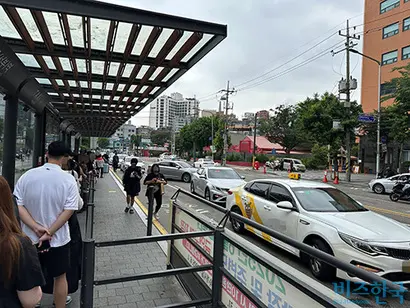
As a result, two lanes of the six-lane road (one in each direction) are effectively being used as waiting areas for taxis. This reduces the road to effectively four lanes, causing congestion. Even then, taxis stopping in the second lane constantly move in and out, creating chaos, and frequent lane-cutting or sudden stops by taxis and other vehicles were often witnessed.
Taxi stand installation regulations? "Limitations due to lack of rules considering traffic flow"
Regulations regarding the installation of taxi stands are found in the Enforcement Rule of the Passenger Transport Service Act. Article 10-2 of the rule states, "The competent authority may install a boarding platform in a place where high demand for taxi use is expected." It also specifies that the installation and facility standards are to be determined by the competent authority considering local traffic conditions and taxi demand.
However, this rule provides the basis for authorities to install a stand, but it is not a regulation specifying how the stand should be constructed. To date, there are no criteria on how to build a taxi stand while considering surrounding traffic and conditions.
An official from the Seoul Metropolitan Government stated, "Taxi stands are installed by the competent authority in consultation with related agencies such as the police," adding, "Management is complex as some stands were installed by KORAIL, not just the city." They continued, "As of now, there are no regulations on how to install a taxi stand while considering surrounding circumstances (such as traffic or pedestrian flow)."
As the Seoul official mentioned, railway stations can also install taxi stands. This is because the Korea National Railway specifies the installation of taxi stands in its standards for intermodal transport facilities. However, the standards state that while a waiting area is mandatory for first-class railway stations like Seoul Station, it may be omitted if installation is difficult due to local conditions.
Ministry of Land, Infrastructure and Transport conducting research on taxi stand improvements… Will it prevent taxis from obstructing surrounding traffic?
On January 9, the Anti-Corruption and Civil Rights Commission issued a press release identifying issues with current taxi stands, such as "inadequate installation regulations or a lack of taxi waiting spaces." It recommended that the Ministry of Land, Infrastructure and Transport (MOLIT) and local governments improve their systems, stating that "the lack of clear facility standards fails to account for the safety of users and pedestrians."
Following this recommendation, the Ministry of Land, Infrastructure and Transport contracted a research project on taxi stand installation standards through the Public Procurement Service's KONEPS on June 11, and the project is currently underway. The research period is eight months.
The ministry's request for proposals explained the background, stating, "Taxi drivers are raising complaints because stands are installed in areas where stopping is prohibited, leading to fines." It ordered the study to "investigate the problems of taxi stands based on factual surveys and examine plans to prevent taxis waiting at stands from obstructing surrounding traffic."
The aforementioned Seoul city official also remarked, "Since the Ministry of Land, Infrastructure and Transport's research is currently in progress, we will have to wait and see," adding, "Seoul City is also aware of the current congestion and is looking into the matter."