

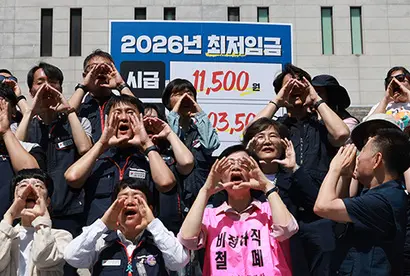
[비즈한국] Discussions on the 2026 minimum wage, to be determined in the first year of President Lee Jae-myung’s term, officially kicked off on June 11 as the labor sector proposed an hourly rate of 11,500 won, a 14.7% increase from the previous year. Although the management side has yet to submit its proposal, a fierce battle is expected, as they are likely to push for a freeze or a minor hike citing the economic downturn.
Meanwhile, the labor sector's demand to expand the scope of minimum wage application was effectively shelved for this year, though it was agreed that discussions would continue. This follows a recommendation from public interest commissioners that the government conduct fact-finding surveys and research on piece-rate workers currently excluded from the minimum wage, and submit the results for review during next year's deliberations.
Labor Sector Urges “Expansion of Coverage” in Lee Jae-myung Administration’s First Minimum Wage Talks… Democratic Party, Now the Ruling Party, Shares Consensus
Minimum wage discussions in the first year of the Lee Jae-myung administration are taking a notably different path compared to the inaugural years of past administrations. The labor sector has placed a stronger emphasis on expanding the scope of application than on the wage amount itself—a contrast to the early days of the Moon Jae-in and Yoon Suk-yeol administrations.
The Moon Jae-in administration campaigned on a pledge to "achieve a 10,000 won minimum wage." In contrast, the Yoon Suk-yeol administration criticized the rapid hikes under the Moon government and advocated for "gradual increases that consider both employers and employees."
The Lee Jae-myung administration, conversely, has not explicitly mentioned a specific amount or rate of increase. Instead, it appears to be lending weight to discussions on expanding the scope of the minimum wage.
During the election period, then-presidential candidate Lee Jae-myung and the Democratic Party submitted a written response to a parliamentary forum on improving the 2026 minimum wage, hosted by the labor sector on May 21. In response to the organizers' inquiries, the Democratic Party took the position that it would "respect the decisions of the Minimum Wage Commission" without making specific comments on the wage amount.
However, the Democratic Party stated its intent to bridge the gap by "implementing a 'presumption of employment' system to grant worker status to all individuals under the direction and supervision of an employer, ensuring they are covered by the minimum wage."
The presumption of employment system shifts the burden of proof from the worker—who currently must prove their status—to the employer, who would have to prove that a person is *not* an employee. This is intended to prevent employers from evading their responsibilities and to ensure that special employment types or platform workers under piece-rate arrangements can receive protections under the Labor Standards Act, including the minimum wage.
Labor Sector Continues to Call for “Expansion of Coverage” at June 11 Press Conference
Labor organizations, including the Federation of Korean Trade Unions (FKTU) and the Korean Confederation of Trade Unions (KCTU), held a press conference at the Sejong Center on June 11 to unveil their minimum wage proposal for 2026.
At the conference, the labor sector urged: "Protect special employment workers, platform workers, freelancers, and domestic workers who are left in the blind spots of the minimum wage." This demand was presented even before the request to raise the minimum wage to 11,500 won.
Speakers at the event also advocated for the expansion of coverage. Choi Soon-im, head of the Korean Women’s Trade Union, stated, "The minimum wage must be expanded to include the many workers in the blind spots, such as special employment and platform workers who currently do not receive it."
Nam Woo-geun, director of the Korea Irregular Workers Center, also called for guaranteed minimum wages, noting that "over 8 million special employment, platform, and freelance workers are excluded from minimum wage coverage."
Expansion of Minimum Wage Coverage Fails for 2026… “Discussions Needed at Government and Parliamentary Levels”
However, the labor sector’s demand to expand the scope of coverage appears to have been deferred for this year. During the 4th plenary session of the Minimum Wage Commission held on June 10, public interest commissioners recommended that the issue be deliberated next year following a fact-finding survey.
The public interest commissioners requested that the Ministry of Employment and Labor conduct surveys on piece-rate workers, such as those in special employment and platform sectors, to the extent possible. The Minimum Wage Commission agreed to reflect these findings in next year’s deliberations. With the consent of both management and labor representatives, the move to immediately expand the scope for 2026 was put on hold.
The public interest commissioners further suggested that the fundamental issue of expanding minimum wage coverage should be discussed by bodies with actual authority, such as the government, the National Assembly, or the Economic, Social and Labor Council, rather than the Minimum Wage Commission alone.
This is partly due to current legal challenges. Article 5, Paragraph 3 of the Minimum Wage Act and Article 4 of its Enforcement Decree allow for separate minimum wages to be set in cases where it is difficult to determine working hours, such as in piece-rate work.
Because of this, the public interest commissioners concluded that meaningful discussions on expanding coverage to piece-rate workers can only occur if the government or the National Assembly, which have the power to amend laws and decrees, take the lead.
The two major labor unions, which have been pushing for the expansion, stated, "While it is disappointing that it was not reflected this year, this was a step forward in our discussions," adding, "We urge the government to initiate the fact-finding survey as quickly as possible."