

[비즈한국] Artificial Intelligence (AI) is no longer confined to the cloud or smartphone screens. It is rapidly expanding into the physical spaces of our daily lives. Kiosks are a prime example. From cafes, restaurants, and cinemas to hospitals and airports, kiosks are already ubiquitous, yet they are often still perceived as "difficult and unfamiliar machines." How would such kiosks change when they meet AI?
At the recently held "Smart Tech Korea 2025 (STK 2025)" exhibition, a host of new AI-integrated kiosk products drew significant attention. We explored the new trend of "Physical AI," ranging from natural conversation and intuitive guidance to personalized user services.
Difficult Kiosks, Will They Be Different When Combined with AI?
Some people feel small whenever they stand in front of a machine. Although kiosks have become deeply embedded in our lives—from payments at cafes, movie theaters, and restaurants to mall navigation, airports, and hospitals—they still leave much to be desired in terms of user experience. The complexity and hassle of using kiosks are not problems faced only by the elderly. In the end, because situations where staff must step in to assist recur, the very purpose of introducing unmanned systems becomes undermined.
Recently, AI software and platform companies have been turning their attention to AI kiosks. The idea is that by integrating AI into kiosks, it is possible to provide more intuitive and optimized non-face-to-face, self-service experiences.
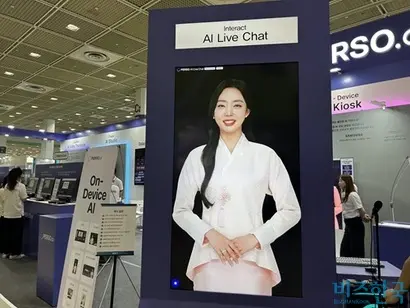
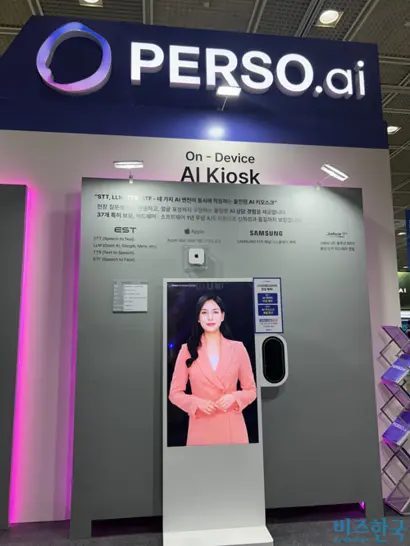
The AI kiosk from software firm ESTsoft, a participant at the STK 2025 "AI & Big Data Show," is one of the most eye-catching products. A virtual guide implemented through the company's human AI service, "PERSO.ai," greets visitors with a smile on a large kiosk screen. This kiosk is equipped with "Live Chat," which allows for responses within 1.5 seconds after text generation.
When I spoke into the microphone connected to the kiosk, asking it to "recommend a good cafe to visit in COEX," the virtual guide suggested cafes located inside the building. Its movements were natural, such as nodding slightly or smiling while listening to and answering the question.
This kiosk product can be customized for each corporate client, including its functionality, language model, and the gender, language, and cultural background of the virtual guide. Clients can choose from over 100 existing AI avatars or have a new one created, and with settings embedded, it operates even without an internet connection. The large kiosk placed at the entrance of the booth is a product currently undergoing commercialization with a global company; although the avatar appeared Korean, it provided guidance in English. For the underlying AI, if a corporate client operates their own sLLM (small language model), that model is adopted; otherwise, solutions are built using LLMs (large language models) like ChatGPT or Llama upon request.
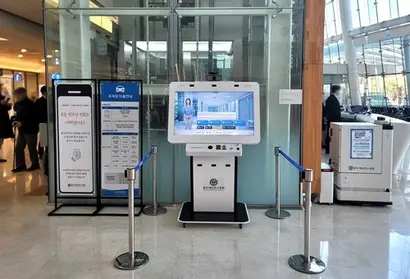
At the booth of AI firm Maum AI, located right next door, the "Maum Touch," Korea's first LLM-based barrier-free kiosk, was introduced. Maum Touch includes features such as automatic height adjustment and braille guidance to increase accessibility for the socially vulnerable, including the disabled and the elderly.
Introduced early this year at Yonsei University Yongin Severance Hospital, this product uses a conversational LLM to allow an AI virtual guide to assist visitors unfamiliar with the hospital's complex layout with location and operating hours. Future developments aim to reduce waiting times and improve visitor satisfaction by providing guidance on medical departments by disease, primary physicians, and orientation for first-time patients.
Now, AI is Integrating with Hardware
The trend of kiosks combining with AI is one of the representative examples of Physical AI. Physical AI refers to a form where AI is embedded in physical devices and operates in the real world. As the utility of AI is highlighted, this year is being called a transition period toward Physical AI. OpenAI also hinted at entering the hardware market last February by filing trademark applications for devices ranging from headphones, goggles, and glasses to laptops, smartwatches, smart jewelry, and virtual reality headsets for AI interaction and education.
As kiosks have been pointed out for their chronic accessibility limitations, there is a clear need for improving service methods, and they are attracting attention as a monetization model due to the ease of B2B contracts with kiosk manufacturers or franchise headquarters. Although they have been introduced in various fields, the industry still views the potential for expansion as high, given the growing trend toward unmanned operations.
However, there are challenges. While AI kiosks provide quick and clear answers to expected questions that can be simulated, accuracy may decrease depending on the internet connection state. This is because it is impossible to completely block "hallucinations" (the phenomenon of plausibly creating information that is not true) that general users experience when using generative AI like ChatGPT. There are limits to how much service providers can guarantee the inherent quality of the LLMs used in AI kiosks.
An on-site representative from ESTsoft stated, "In the case of LLMs, we manage them by refining and upgrading the prompts. If a client company possesses its own sLLM and can maintain a consistent database, accuracy can be guaranteed, so we recommend that route."
As the market is in its early stages, the cost of introducing AI kiosks is still high, limiting their fields of application. Currently, most customers are general corporations, and they are being used for purposes such as building information desks. The aforementioned ESTsoft representative explained, "A product bundle that includes both the kiosk hardware and the software package has a high price point, which may make it difficult for retail stores to handle. However, since it is the early stage of the service, there is room for price adjustments through consulting."