

[비즈한국] When considering movie production budgets, the first thing that comes to mind is the actors' guarantees. High-profile celebrity salaries are a frequent topic of discussion these days. One might also consider the costs of visual effects (VFX). It is widely known that most blockbuster films involve significant VFX expenses. So, what are the core costs in the performing arts industry? Since VFX is less prevalent in theater compared to movies or dramas, one might think of actor salaries or stage sets. However, stage productions rely less on star actors than movies or TV dramas, and the sets don't seem nearly as expensive—especially for small- to medium-sized creative musicals or plays.
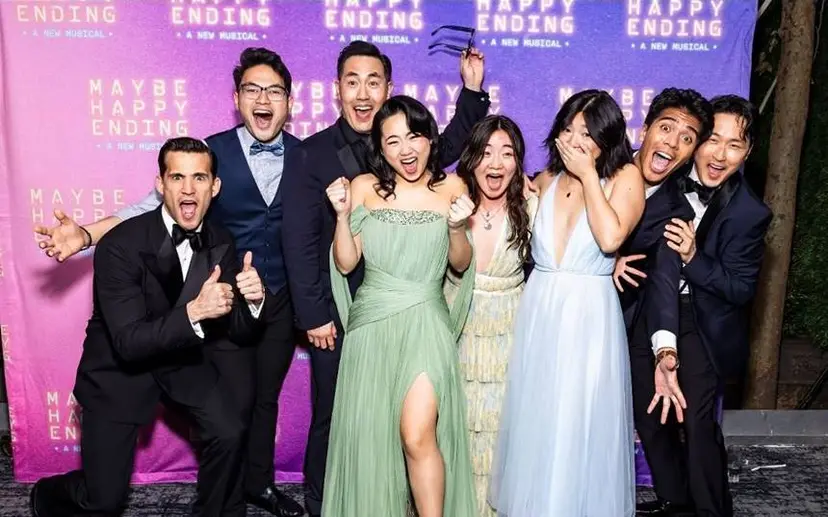
The musical 'Maybe Happy Ending' has won six Tony Awards. President Lee Jae-myung shared his congratulations on social media and announced that there would be future support for the performing arts industry. 'Maybe Happy Ending' was first planned and developed in 2014 by the Wooran Cultural Foundation, a non-profit cultural organization, and held its official premiere in a 300-seat small theater in Daehak-ro in 2015 following an internal trial run. Winning a Tony Award thanks to the dedicated support of a private non-profit foundation is a highly exemplary case. Building on this, if the public sector provides substantial support for creative works, even better results are expected.
Aiming to become one of the top five cultural powerhouses, President Lee Jae-myung, who has mentioned a 300 trillion won market and 50 trillion won in exports by 2030, has promised R&D in culture and the arts, as well as tax benefits and financial support. For this support to be effective, it must alleviate the cost burdens that the performing arts industry considers most critical.
The core costs in the performing arts industry are rent and venue leasing fees. In Daehak-ro, the hub of theater, rents have skyrocketed due to gentrification. Between 2015 and 2016, the fixed operating costs for a small theater with fewer than 100 seats in Daehak-ro were about 8 million won per month, with rent and utilities accounting for half—around 4.5 million won. By 2021, fixed costs rose to 10 million won, and rents increased accordingly. With daily rent around 250,000 to 300,000 won, a theater needed to generate 400,000 won in daily revenue just to break even.
As of 2025, the daily rent for a 100-seat theater in Daehak-ro is 500,000 won, while a 200-seat venue reaches 1 million won. To make a profit, you have to fill every seat, which sometimes leads to actors from different productions helping each other sell tickets. From a landlord’s perspective, prime locations command monthly rents exceeding 10 million won. When building owners raise rent, leasing fees follow. If the leasing cost is too high, it is impossible to run high-quality productions for long. What used to run for months is now limited to a few weeks, or sometimes just a few days.
Daehak-ro is actually a representative case of failed support; the support measures often proved counterproductive. In 2024, an area of 446,569 square meters (135,087 pyeong) covering six neighborhoods including Dongsung-dong, Hyehwa-dong, Myeongryun 2-ga and 4-ga, and Yeongeon-dong was designated as the Daehak-ro Cultural District. At the time, building owners received floor area ratio bonuses and tax benefits. Those who built new structures received a 50% reduction in acquisition and registration taxes, a 50% property tax reduction for five years, and a 100% increase in building floor area ratios. The intent was to protect and foster small theaters and promote cultural and artistic performances. However, theater troupes and small theater operators did not receive the benefits of the policy.

In fact, the situation worsened, and small theaters were pushed out of Daehak-ro. The proportion of small theaters, which was 31.6% before the cultural district designation, dropped to 20%—a decrease of about 11 percentage points. Since the designation, land prices in Daehak-ro have risen by over 10% annually, and small theater rents have jumped 126% in 10 years. Daehak-ro Theater, a long-time fixture in the area, could not withstand the soaring rent and closed in March 2019, eventually relocating to Danyang.
However, providing individual cash support to theaters or troupes also easily hits a limit. The Arts Council Korea provides support for operating expenses and venue rental fees through programs like the 'Performing Arts Specialized Theater Operation Project' and the 'Performance Venue Rental Support Project.' Yet, because this support is temporary and limited to a select few, competition is fierce, and smaller groups or those without production budgets cannot even attempt to apply. It is crucial to select a diverse range of works. Practical support tailored to reality, such as funding even small-scale but highly experimental and innovative performances, is necessary.
The performing arts industry proposes a 'Resident Theater Troupe Support System.' In this model, if the government or local municipalities subsidize a theater, the troupes residing in that theater perform free of charge for a certain period. For example, if the government provides 70 million won to a small theater, three troupes could perform for free for six months. Naturally, this should include troupes lacking production funds and personnel. Resident troupes can be selected through an evaluation process. Instead of supporting building owners, this method ensures support goes to the troupes that use the space and the companies that need venues to perform.
Furthermore, promotional marketing is vital for small creative groups. It is an unwritten rule that no matter how good a piece is, marketing is essential. Recently, performances have moved beyond Daehak-ro to areas like Seongbuk-gu, Eunpyeong-gu, Gwanak-gu, Mullae-dong, Hongdae, and Seodaemun-gu, but audiences are often unaware of where performances are held or how to get to the venues. It is not easy for small theaters or troupes to carry out such marketing efficiently, especially for creative musicals or plays. This is why the industry is calling for an integrated promotional marketing center.
The reason the government and local municipalities should support rental fees or marketing for troupes is to allow them to focus on production and foster a diverse range of high-quality work. Tailored support policies must be implemented to ensure that young talent can continue their creative efforts.
The author, Kim Heon-sik, has been walking through and navigating the forest of popular culture phenomena since his 20s, driven by the hope that there is a way to make the world a better place through culture. In the 21st century, where artificial intelligence and quantum computers are active, he continues on the same path with the same belief.