

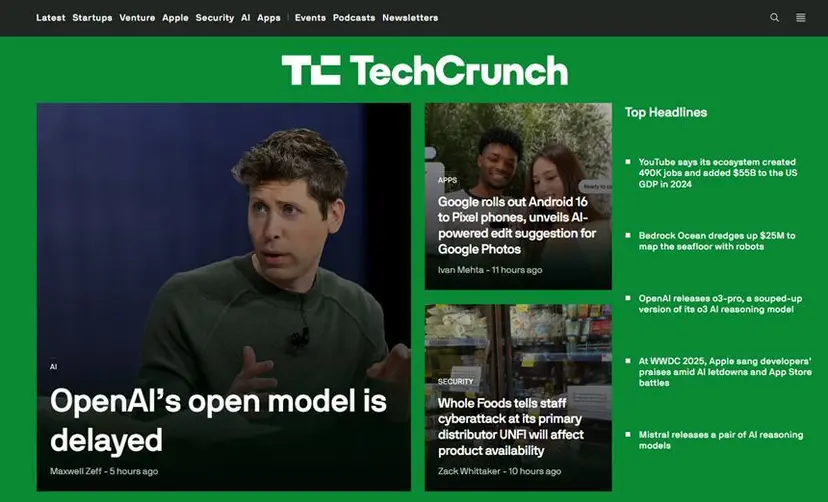
[비즈한국] In June 2025, TechCrunch, the symbolic media outlet for global startups in Silicon Valley, quietly withdrew from the European market. Without any official announcement regarding the discontinuation of its European regional coverage, which had been active for 15 years, the entire European team was laid off. This marks the first large-scale restructuring implemented by TechCrunch since its acquisition by the private equity firm Regent last March. This news came to light as reporters who had covered the European ecosystem for years began sharing their departures on social media one by one.
Regent is a global private equity (PE) fund based in Beverly Hills, California, that has focused on acquiring companies across various sectors, including retail, luxury brands, media, technology, automotive, and industry. Its investment portfolio is diverse, ranging from consumer goods brands like Bally, DIM, Club Monaco, and Escada to media companies such as Sunset, Defense News, and CheddarTV.
Before acquiring TechCrunch from Yahoo, Regent also acquired Foundry from International Data Group (IDG). Foundry is a leading IT journalism group that owns PCWorld, Macworld, InfoWorld, CIO, and TechAdvisor, while TechCrunch has built its reputation on in-depth reporting across startups, venture capital, deep tech, and the Silicon Valley and European ecosystems.
The European Startup Ecosystem and TechCrunch’s Role
The TechCrunch Europe team was the first gateway that introduced numerous European unicorns, such as Revolut, Wise, and Vinted, to the world. Although they are now famous big tech companies, it was TechCrunch that took notice of them during their early days—a time when they had not yet raised formal investment and major media outlets showed no interest.
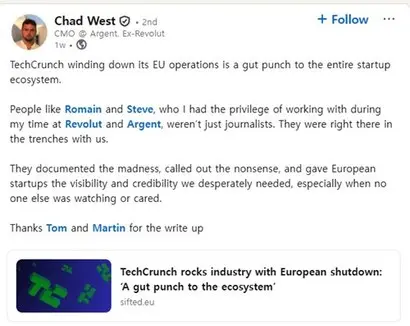
Chad West, former global head of communications at the UK fintech unicorn Revolut, expressed his shock on LinkedIn: "This isn't just a media company withdrawal. It's a powerful uppercut to the entire European ecosystem."
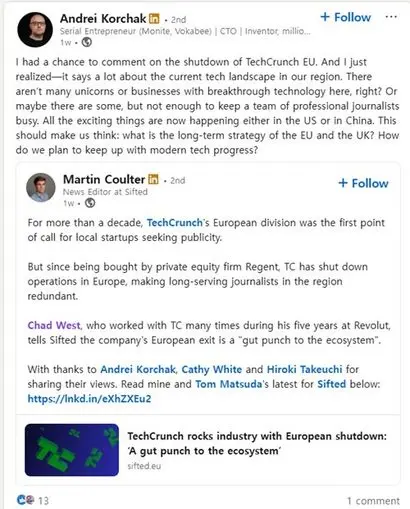
Andrei Korchak, co-founder of the fintech startup Monite, expressed his regret in an interview with Sifted, stating that TechCrunch was "the most powerful sales tool to introduce a company to US investors" during a startup's early growth stage. Korchak also proposed a discussion on LinkedIn, asking: "Is this an assessment that there isn't much to cover in Europe compared to the growth of the US and Chinese tech scenes, or is Europe not a technologically groundbreaking market? Let's discuss what kind of plan the European startup ecosystem needs regarding this."
Is European News Not Important?
TechCrunch served as a bridge connecting US venture capitalists (VCs) to Europe. It is said that renowned US VCs like Sequoia Capital and Accel used to monitor TechCrunch to discover new technology companies.
This withdrawal is a decision by Regent, the private equity firm that acquired TechCrunch. By judging "international news coverage" as a "non-core area," Regent resulted in the dissolution of the entire European reporting team. It was a decision where the US private equity firm prioritized short-term profitability and restructuring logic over the journalistic value of the European ecosystem.
Mike Butcher, who contributed news about Europe to TechCrunch, expressed his sadness while revealing the abrupt end of his 18-year journey in a LinkedIn post. "Over the past 18 years, while contributing over 6,500 articles about startups and investors to TechCrunch (almost one article every day for the entire duration), I have seen and experienced so much. In that process, I started the UK’s first coworking space for startups, created three non-profits and The Europas, made it onto several Top 100 lists, spoke at the WEF, served as a talk show host on many TV channels, was awarded an MBE for my contributions to journalism and technology... (omitted) TechCrunch was my career and a companion to the European ecosystem. This farewell is not what I wanted."
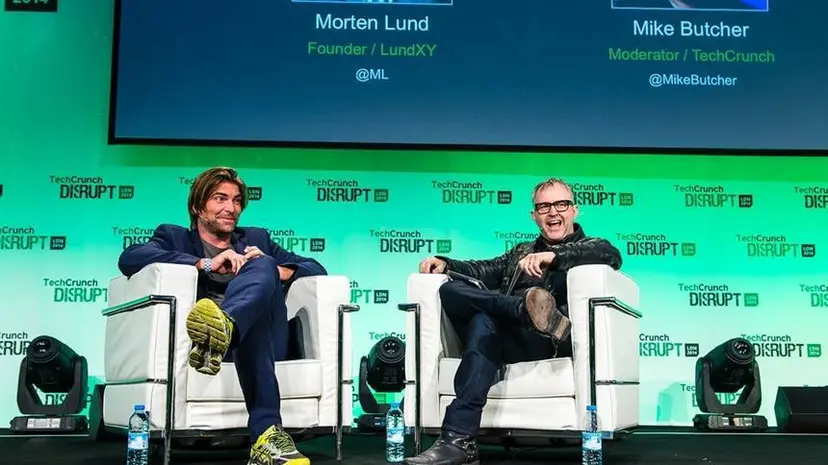
As evident through Butcher's activities, TechCrunch played a role far beyond just media; it was a catalyst driving the European tech ecosystem. This is why many are worried about how the European tech ecosystem will be affected in the future.
Not only Mike Butcher, but senior reporter Romain Dillet also emphasized on LinkedIn that "I strongly oppose Regent's decision," highlighting that global tech ecosystems were able to grow because of TechCrunch's international reporting.
Cathy White, a 15-year startup communications expert and angel investor, remarked, "One way for American eyes to see Europe has now disappeared," implying that this will not only affect the European ecosystem.
As many are saying, the European startup ecosystem has just lost a vital asset. But is this just a European story? TechCrunch served as a window through which US VCs looked at the European market, meaning its role as an international link was immense. If we consider an important element of the startup ecosystem to be "diversity," this is a significant loss for the global tech ecosystem as well.
It seems expected in the current trend that private equity firms, which prioritize profit, would view media assets as targets for monetization and restructuring. TechCrunch’s withdrawal from Europe is drawing attention as a symbolic case revealing a changed investment landscape in global tech and startup reporting, where "profitability takes precedence over editorial independence."
However, how do we remember, record, and prove the startup ecosystem? If we simplify it only by numbers and profits, the multi-dimensional facets of this ecosystem will be difficult to see. Should the TechCrunch case be viewed as a restructuring of a media company or a strategy change by a private corporation, or as a "threat to the countless dreams created by a single line of an article" recording the startup ecosystem? The answer rests with the members of this ecosystem who will continue to write the next chapter of startup stories.
The author, Lee Eun-seo, majored in law in Korea and studied theater in Berlin. Based in Berlin, a city of arts and a hub for European startups, she leads 123factory, which connects the Korean and German startup ecosystems while growing alongside the city.