

[비즈한국] The core equipment for Hanwha Aerospace’s ‘Chunmoo 3.0,’ which had previously only been the subject of rumors, has been unveiled for the first time. The newly revealed equipment is a loitering munition (suicide drone) named ‘L-PGW.’ It applies an innovative concept that combines with Chunmoo rockets and missiles to reshape the paradigm of long-range strike weaponry. L-PGW and Chunmoo 3.0 are expected to become Hanwha Aerospace’s next-generation flagship export products upon the completion of their development by 2028.
At the ‘Korea Military Science and Technology Symposium’ held at the Jeju Convention Center on the 11th, Hanwha Aerospace showcased the ‘L-PGW,’ a new concept future weapon that had not been revealed previously. Originally, the Chunmoo Multiple Launch Rocket System (MLRS) was developed as a weapon to strike fixed enemy positions and targets using the 80km-range GPS-guided CGR-80 rocket. However, Hanwha Aerospace has continuously expanded and evolved the capabilities of Chunmoo for over a decade.
The first improvement to Chunmoo was the integration of the export-type surface-to-surface missile, CTM-290. This missile, which shares a similar structure with the KTSSM-1 used in stationary launchers, is an export-compliant version adhering to the Missile Technology Control Regime (MTCR) and has been lauded for its superior cost-performance ratio. It is currently being exported in large quantities to Poland and Saudi Arabia, and the South Korean Army plans to operate the upgraded KTSSM-2 on Chunmoo launchers.
In the Chunmoo 2.0 phase, the 280mm-class new missiles CTM-MR and CTM-ASBM are under development. The CTM-MR is a medium-range missile with a 160km range developed at the request of export customers, while the CTM-ASBM is an infrared-guided anti-ship ballistic missile requested by countries like Norway to target naval vessels. While the existing CTM-290 allowed only two missiles per Chunmoo unit, the CTM-MR and CTM-ASBM can be loaded with up to eight, significantly improving range and simultaneous strike capabilities.
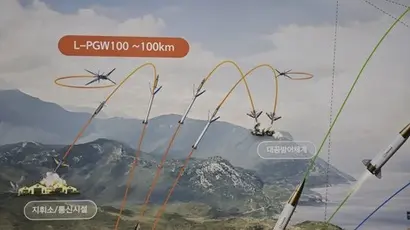
However, the true innovation of Chunmoo 3.0 lies not in the rockets, but in the drones. The L-PGW (Loitering Precision Guided Weapon) unveiled this time is a suicide drone or loitering munition, signaling a shift toward long-range drone weapon systems by loading drones onto Chunmoo rockets. While foreign competing systems such as Germany’s Rheinmetall GMARS and Israel’s KMW PULS are being developed in a similar direction, the differentiator for Chunmoo 3.0 is that it is the first to actually systemize the rocket-drone hybrid concept.
The L-PGW is a composite weapon that replaces the warhead of a Chunmoo rocket; it infiltrates enemy territory at high speed before detaching from the rocket and transitioning to drone flight mode. One unit (L-PGW 100) is loaded onto a CGR-80 rocket, while three units (L-PGW 300) are loaded onto a CTM-290 missile. After entering enemy airspace at high speed during the rocket propulsion phase, the drone detaches and enters loitering mode. The L-PGW is equipped with an AI function for automatic target recognition and a micro-satellite communication device, enabling real-time control and strikes from long distances. Through its AI-based Automatic Target Recognition (ATR) function, it prioritizes and strikes high-value mobile targets such as Transporter Erector Launchers (TELs), automatically selecting the most critical objective among multiple targets.
Because the drone requires both high maneuverability and long endurance, it features a unique foldable wing design. Unlike conventional loitering munitions that use two straight wings, the L-PGW utilizes two pairs of wings that fold for storage, achieving high lift and fast entry speeds. It is powered by an electric motor and lithium-ion batteries.
Another strength of the L-PGW is its ‘Battle Damage Assessment (BDA)’ capability. Some L-PGW units are equipped with satellite communication relay equipment instead of warheads to transmit the results of strikes from other L-PGW units to command posts in real time. This allows for adjustments in follow-up missile launches based on whether targets have been destroyed, or it can maximize anti-naval strike capabilities through coordination with the CTR-ASBM anti-ship ballistic missiles.
Hanwha Aerospace is already in the process of developing the L-PGW, and a physical unveiling is expected around 2028. Although currently being developed for overseas export, if the South Korean military adopts it for the Chunmoo MLRS, it is expected to significantly enhance the ability to strike high-value, time-sensitive targets such as North Korean armored units and mobile ballistic missile launchers.