

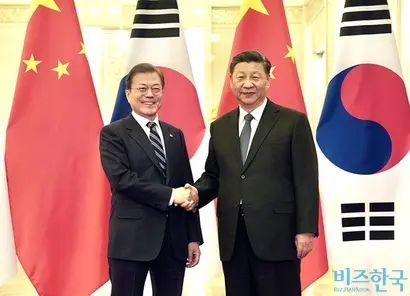
BizHankook visited Xiamen, China, immediately after the 21st presidential election on the 3rd. Xiamen is one of China’s seven special economic zones and a maritime city adjacent to Taiwan. As a sensitive region that has historically seen frequent disputes, it has always responded keenly to shifts in the diplomatic climate. BizHankook asked local experts in international relations about the current state of Korea-China relations and future prospects.
On June 4, the day after the election, the state-run Xinhua News Agency reported that President Xi Jinping had sent a congratulatory message to President Lee Jae-myung on his election victory. According to the report, President Xi noted, “China and South Korea are close neighbors and cooperative partners important to each other,” and pointed out that “the world is currently undergoing changes unseen in a century, and uncertainty in the international and regional situation is increasing.”
In the same message, President Xi emphasized cooperation between China and South Korea. President Xi stated, “As important countries on the world and regional stage, China hopes to work with South Korea to uphold the original intention of establishing diplomatic ties, firmly maintain the direction of good-neighborly friendship, aim for mutual benefit and common prosperity, and continuously develop the China-Korea strategic cooperative partnership to provide greater benefits to the people of both countries.”
Local Chinese experts collectively interpreted President Xi’s message as going beyond mere protocol and hinting at a potential shift in diplomatic stance.
An international relations expert at a university in the Xiamen region emphasized that President Xi sending a message immediately after President Lee’s election was a “clear signal.” According to the expert, while there was an initial expectation within China that former President Yoon Suk-yeol would not be removed from office, the atmosphere shifted starting in April. They noted that public opinion friendly toward Korea has been forming following the removal of former President Yoon and the election results in June.
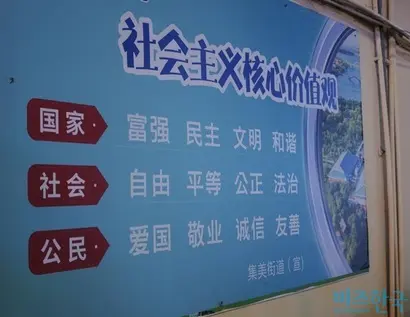
Prospects for the lifting of the "Hallyu ban" (restrictions on Korean cultural content) were also raised. A local expert noted that President Xi’s message indicates a desire for comprehensive development between Korea and China, and given the emphasis on the Korea-China FTA and economic cooperation, they expect the Chinese government's policies to align with the expectations of Korean companies.
Experts are paying close attention to the possibility that China might comprehensively readjust its existing diplomatic strategy in response to the second Trump administration. A local expert noted that China’s intention to improve relations with countries near the U.S., such as Korea, Japan, and Europe, is clear, and they view this as an opportunity to "pull in" nations close to the United States. They explained that while China could not predict the Trump administration's moves during his first term, President Xi now displays significant confidence toward the U.S., and China’s diplomatic stance has changed.
This atmosphere is highly likely to become more visible starting with the Asia-Pacific Economic Cooperation (APEC) summit to be held in Gyeongju this October.
The expert mentioned that China is exercising immense patience, understanding the positions of Korea and Japan as they face pressure from the U.S. China, they said, is responding based on principles rather than weighing every aggressive remark from neighboring countries. They also added that having experienced what kind of person Trump is, they have no intention of relying on the United States.
Another local expert also identified the APEC summit in October as a key point to watch for in Korea-China relations. With the Fourth Plenary Session of the Central Committee of the Communist Party of China approaching, they noted that important decisions, such as China’s foreign policy line and its role regarding inter-Korean relations, are expected to be made there.
Amid this atmosphere, there is an expectation in China that the "lost decade" will be recovered. Since the deployment of THAAD in 2016, a ban on Korean content was imposed in China. As a result, the K-pop market, which had been growing explosively, remained suppressed for 10 years. A local expert suggested that opinions on easing these restrictions have been exchanged between high-level officials in China and Korea since last year, and they predicted that changes would occur soon.
However, even if China opens its market, political instability remains a factor. According to the expert, whether South Korea respects the "One China" principle and the potential for U.S. Forces in Korea to move due to the Taiwan issue could still act as risk factors. Furthermore, since China has significantly filled the voids in its own popular culture and entertainment sector during the lost decade, it is expected that even if the Korean Wave returns, it may be difficult for it to command the same level of influence as before.
The expert predicted that if the Lee Jae-myung administration pursues "pragmatic diplomacy," the potential for Korea-China cooperation will be very optimistic.
Jang Young-hee, a research fellow at the Chungnam National University Institute for Peace and Security, predicted, "The '2025 APEC Summit' held in Gyeongju from October 31 to November 1 is highly likely to serve as a stage for restoring summit diplomacy between Korea and China." She anticipated that this could lead to the regularizing of diplomatic channels between the leaders of the two countries. Jang stated, "They will likely attempt to speed up the follow-up negotiations on the resumed Korea-China FTA and investment, and deepen cooperation in the carbon market, including the linkage of the two countries' Emissions Trading Systems (ETS), to achieve practical results on multilateral stages such as APEC and the WTO."