

[비즈한국] The Helix Nebula is a celestial object particularly beloved by space enthusiasts. It features a small, round gas remnant surrounding a hollow center, while beyond that, gas debris spreads out into a slightly distorted elliptical shape on either side. It looks exactly like a giant eye in space. Thanks to its captivating appearance, it was used as the main image for Neil deGrasse Tyson's 2014 Cosmos documentary series. I also used this nebula as the cover photo for my book, "A Piece of the Universe Every Day," published last year.
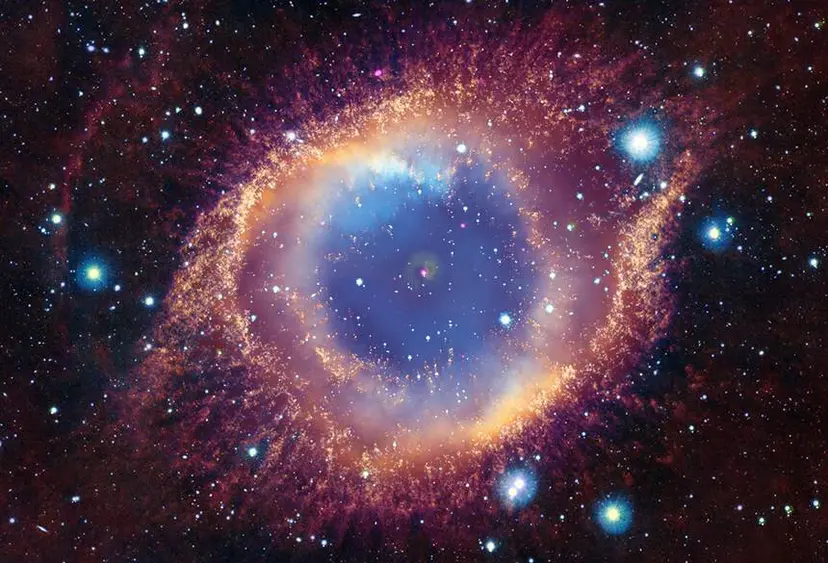
The center of the gas cloud scattered in all directions from the Helix Nebula is completely empty. In that void lies the corpse of a dead star that lost its outer atmosphere long ago: a white dwarf. For a long time, astronomers believed that the white dwarf remained alone, gradually losing its light in solitude. However, they recently discovered that a surprising, unexpected entity was hiding there. A tragic yet majestic end was unfolding: a planet trapped by the white dwarf's gravity was being slowly destroyed. In the middle of a beautiful scene left behind by a star's death long ago, another planet was meeting its end.
The Helix Nebula is a gas cloud located about 650 light-years away in the direction of the constellation Aquarius. It is the trace left behind after a star like the Sun disappeared long ago. This giant cosmic eye currently spans about 5 to 6 light-years in diameter. This debris continues to expand at a speed of 30 km per second. As the long-dead star blew off its outer atmosphere, its interior was exposed, and that remains today as the white dwarf WD 2226-210 at the center of the Helix Nebula.
Although it is the corpse of a dead star no longer capable of nuclear fusion, the temperature is incredibly hot because the star's interior was exposed when it shed its outer atmosphere. Its surface temperature approaches 120,000 degrees. However, it only appears dark overall because the star is so small; the white dwarf's diameter is only about 2% of the Sun's. Because it is so hot, it glows white, which is why it is called a white dwarf.
Since white dwarfs are extremely hot, they usually emit most of their energy in very short wavelengths, such as ultraviolet light. However, the white dwarf at the center of the Helix Nebula was a bit strange. Quite a bit of energy was observed not only in the ultraviolet but also in the infrared range. In the mid-2000s, astronomers analyzing the spectrum of this central white dwarf across various wavelengths estimated that this "infrared excess" was likely caused by a thick dust disk surrounding the white dwarf. Subsequent observations detected clear metal components in the white dwarf's spectrum. Some astronomers speculated that these could be traces of the white dwarf being "contaminated" by metals as it consumed asteroids or planets long ago.
Based on these observations, astronomers estimated that there might be a dust disk around the central white dwarf, filled with large and small debris and remnants of minor bodies, much like the Kuiper Belt around our Sun. Alternatively, they suggested it could be because comets the star had possessed during its lifetime were still surrounding it like an Oort cloud.
In 2024, it was revealed that the brightness of the central white dwarf fluctuates at regular intervals. Astronomers speculated that this might be because a planet still survives and maintains its orbit nearby. If a gas planet roughly the size of Neptune is orbiting the white dwarf at an inclination of about 25 degrees (relative to the nebula itself), it could explain the observed brightness fluctuations. Based on this, astronomers inferred that a planet, not completely destroyed, remains in orbit. However, it cannot be entirely ruled out that the brightness fluctuations are due to the instability of the white dwarf itself, rather than a planet.
The white dwarf at the center of the Helix Nebula holds one more mystery that has remained unsolved for nearly 40 years. Since the 1980s, astronomers have captured unexplained, clear X-ray light from this central white dwarf. But this was strange. Usually, X-rays are produced when there is a celestial object emitting energy far more extreme than ultraviolet light. However, a planetary nebula is merely a trace left by a star that died long ago. Although a hot white dwarf exists, the intense X-rays observed in the Helix Nebula cannot be explained by the white dwarf alone. In other words, something more is needed.
In this study using observational data from the Chandra X-ray Observatory, astronomers suggest that this could be evidence of a second planet. Perhaps there were not one, but two planets near the white dwarf. One of them might have been drawn in by the white dwarf's strong gravity and destroyed near the star long ago, with the fragments of the shattered planet being rapidly pulled into the white dwarf. The remaining planet, which has not yet been destroyed, might still be orbiting nearby.
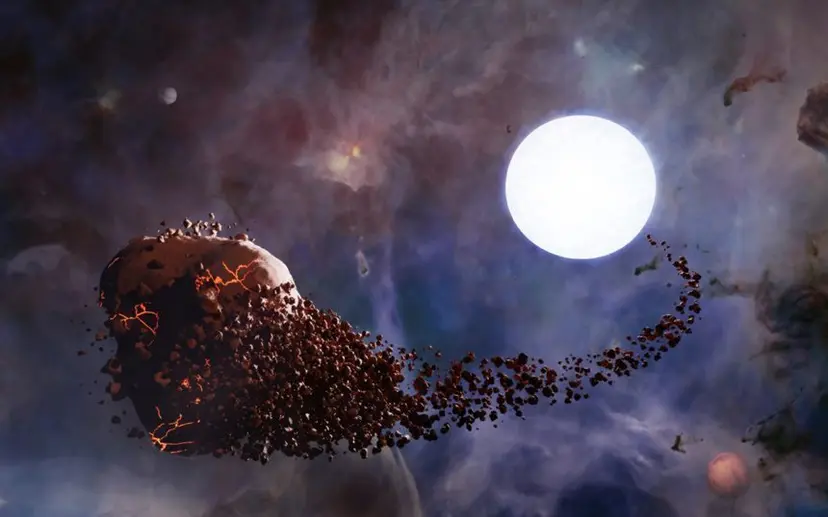
Astronomers estimate that there was likely another planet as massive as Jupiter, and that this planet was drawn in by the white dwarf's strong gravity, causing its orbit to shrink as it was crushed and destroyed. In this process, the planet's material plunges toward the white dwarf's surface at very high speeds, and during this time, the material can be heated to extremely high temperatures. As a result, a thin disk of heated planetary debris forms around the central white dwarf. It is the same principle as an accretion disk, which forms around a black hole when it consumes a star.
Because the accretion disk formed around the white dwarf is very hot, it can sufficiently emit light in X-rays. If this analysis is true, the white dwarf at the center of the Helix Nebula is a very unique site. It could be surrounded by dust disks of different types, both inside and outside—not just by a somewhat ordinary asteroid belt, but also by a very hot accretion disk closer in.
From the ROSAT in 1992 to the Chandra in 1999 and the XMM-Newton telescope in 2002, thanks to ten years of long-term space telescope observations, we can now track what is happening at the heart of the Helix Nebula, including the changes in its X-rays. Interestingly, the X-rays here are not constant. They show a rhythmic pattern, strengthening and weakening with a short period of about 2.9 hours. Astronomers believe this regularity is strong evidence that something is still orbiting this white dwarf at a constant period. While the giant, Jupiter-sized planet that was originally there is gone, the debris left behind in the process of its destruction may still be circling the white dwarf.
It is possible that the object captured nearby is not the debris of a destroyed Jovian planet, but a relatively low-mass star. However, stars have much stronger self-gravity than planets, so they are not easily destroyed just by approaching a white dwarf. Therefore, if it were a light, ordinary star rather than a planet, it would not have produced the clear and regular X-rays currently observed. For this reason, astronomers estimate that a scene of a white dwarf devouring a gas-type planet is unfolding at the center of the Helix Nebula.
This discovery suggests the possibility of a new type of variable star. A variable star familiar to us is one where an unstable star that has undergone some evolution fluctuates in brightness as it repeatedly contracts and expands. This discovery, however, shows that even a star that is already dead can experience similar rhythmic brightness fluctuations as it devours the remnants of a planet still remaining nearby. This provides an interesting clue to look deeper into the stories of stars that are pulsating with different rhythms across the universe, not just the process of a star's death.
The Helix Nebula is very similar to what our Sun will look like after it finishes its remaining 5 billion-year lifespan. Since our Sun is not a very massive star, it will not go supernova, but will instead leave behind something just like a planetary nebula. In the process, the Sun will inflate massively, and in its final moments, it will blow its outer atmosphere away in all directions, disappearing while leaving only a small white dwarf in the center.
By that time, our Earth will have long since become part of the Sun and been captured. However, gas planets relatively far from the Sun, like Jupiter and Saturn, may luckily survive without being destroyed all at once, and will quietly guard the Sun, which has become a white dwarf. And when that time comes, our solar system, too, will become a giant cosmic eye to someone else, staring at them endlessly. The Helix Nebula is both the most beautiful "dying message" and a mirror showing our fate 5 billion years from now.
References
https://chandra.cfa.harvard.edu/press/25_releases/press_030425.html
https://academic.oup.com/mnras/article/536/3/2477/7922854?login=false
Who is the author, Ji Ung-bae? He loves cats and the universe. After watching "Galaxy Express 999" as a child, he dreamed of sharing the beauty of the universe. He is currently researching the evolution of galaxies through their interactions at the Center for Galaxy Evolution and the Near-Universe Research Laboratory at Yonsei University, and is engaged in various science communication activities, including lectures and writing. He has written books such as "The 'Some' Observatory," "Thinking About the Universe All Day," and "Stars, the Science of Light."