

[비즈한국] President Lee Jae-myung is set to attend the Group of Seven (G7) summit, which begins on June 15. This marks his debut on the international stage just over ten days after his inauguration, an achievement being hailed as an exceptional diplomatic feat. As a non-G7 member, South Korea has historically only participated in the summit when formally invited.
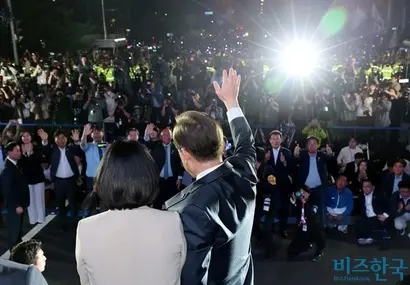
The Presidential Office announced on the 7th, “President Lee Jae-myung has decided to attend the G7 summit, which will be held from June 15 to 17, following an invitation.” Presidential Spokesperson Kang Yu-jung added, “Accordingly, the Lee Jae-myung administration plans to restore the number of journalists accompanying the President on Air Force One—which had been significantly reduced by the Yoon Suk-yeol administration—to the levels maintained during the Moon Jae-in administration.”
The G7 summit is a meeting of major nations launched in the 1970s to respond to the global economic crisis. The current G7 member states are the United States, Japan, Germany, the United Kingdom, France, Italy, and Canada. The most recent instance of a South Korean president attending the G7 was in 2023, when Japan served as the chair. South Korea was not invited to the 48th summit held in Germany in 2022 or the most recent 50th summit held in Italy in 2024.
Attention is also focused on the potential meeting between President Lee Jae-myung and U.S. President Donald Trump. There is a possibility that President Lee will meet President Trump in person for the first time during this G7 summit. Previously, President Lee spoke with President Trump over the phone on the 6th, just two days after his election. The Presidential Office stated, “The two leaders discussed economic issues, including tariff negotiations, for approximately 20 minutes.”
Political circles have expressed high expectations. Cho Seung-rae, chief spokesperson for the Democratic Party of Korea, commented, “We hope this will serve as a turning point to restore our nation’s standing on the diplomatic stage, which had been diminished by the Yoon Suk-yeol insurrectionist regime.” Lee Jun-woo, spokesperson for the People Power Party, also stated, “As this is his first diplomatic stage to stand shoulder-to-shoulder with the leaders of the world’s major nations, we hope it leads to genuine outcomes that serve the national interest.”
The Lee Jae-myung administration is expected to pursue a “pragmatic” foreign policy line. Wi Sung-lac, a Democratic Party lawmaker appointed as Director of National Security, is a figure who has emphasized improving relations and cooperation with China while maintaining the core of strengthening Korea-U.S.-Japan cooperation. Cho Hyun, former First Vice Minister of Foreign Affairs, who is mentioned as a candidate for Minister of Foreign Affairs, is also classified as having a centrist-pragmatic orientation, prioritizing coordination with the U.S. and Japan while minimizing friction with China. Kim Hyun-jong, former Second Deputy Director of the National Security Office, who is discussed as a special advisor for foreign affairs and security, is a prominent working-level expert who led the Korea-U.S. FTA negotiations.