

[비즈한국] Last year, South Korea's Gross National Income (GNI) per capita increased by nearly 6% year-on-year, approaching 50 million won, sparking projections that the nation could enter a "$40,000 era" within a few years. While per capita GNI has risen significantly, observers point out that the income felt by the public does not match this growth. This is because the "compensation of employees"—the share of national income provided to economic subjects, namely workers—saw a growth rate of only 4.1% last year, falling short of the per capita GNI growth rate.
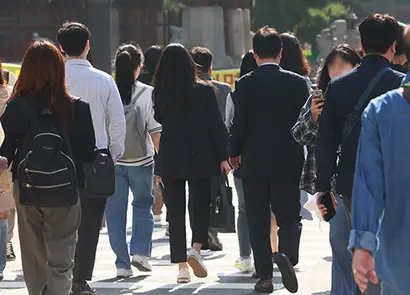
In particular, the growth rate of this compensation is expected to fall even further this year, suggesting that the public's perceived income will worsen. Although President Lee Jae-myung stated in his inauguration speech on the 4th that he would share the opportunities and fruits of growth equitably, it appears highly likely that the lives of workers will worsen starting from the first year of his presidency.
After taking his oath of office on the 4th, President Lee Jae-myung presented five key governance keywords in his "Address to the Nation," with the third being "a country where everyone prospers together." President Lee stated, "Unbalanced growth strategies have revealed their limitations, and polarization resulting from inequality is hindering growth," adding that "sharing the opportunities and fruits of growth equitably is the path to sustainable growth." He also emphasized that "growth and distribution are not contradictory but complementary." However, with workers' perceived income expected to deteriorate further this year, there are concerns that the policy burden on President Lee will increase.
According to the Bank of Korea’s "2024 Annual National Income (Provisional)" data, South Korea's per capita GNI was 49.955 million won, a 5.7% increase from the previous year (47.248 million won). In dollar terms, it stands at $36,624, ranking 6th globally among countries with populations of 50 million or more, following the U.S., Germany, U.K., France, and Italy. While South Korea’s per capita GNI may be 6th in the world, the reality is that the income actually felt by the public is not as favorable. This is because the growth rate of compensation of employees—which is distributed to the public out of the income the nation has earned overall—has been falling steadily.
Compensation of employees refers to all forms of remuneration paid to workers in exchange for the labor provided to private companies, the government, or public corporations. The higher the growth rate or share of this compensation, the greater the portion of income generated by economic agents that goes to laborers, or workers. However, looking at the growth rate, it showed an upward trend until 2022 but has since been on a downward slope. According to the Bank of Korea and the National Assembly Budget Office, South Korea's growth rate of compensation of employees hit a low of 4.1% in 2019, then expanded to 5.1% in 2020 and 6.1% in 2021. Notably, in 2022, the growth rate climbed to 6.3%.
However, it plummeted to 4.2% in 2023 and fell further to 4.1% last year, regressing to levels seen five years ago. This is because the ongoing decline in high-quality jobs, particularly in manufacturing due to weak domestic demand and poor performance by technology companies, is adversely affecting compensation of employees. The growth rate is expected to drop even further this year, reaching only 3.6%. With former President Yoon Suk-yeol's declaration of martial law and subsequent impeachment dealing an additional blow to sluggish domestic demand, coupled with the export slowdown caused by the tariff war initiated by U.S. President Donald Trump, a slump in employment and income seems inevitable. Due to these internal and external negative factors, the income level perceived by the public is likely to worsen in the first year of President Lee's term, despite his emphasis on growth and distribution.
As the growth rate of compensation of employees declines, the share of GNI accounted for by this compensation is also on a downward trend. Compensation of employees, which accounted for 47.2% of GNI in 2019, gradually increased to 47.5% in 2022 and 47.9% in 2023, showing signs of exceeding the 48% mark. However, the share dropped sharply to 47.0% last year and is expected to remain at 47.0% next year. The economic downturn is hitting not only workers but also the self-employed, causing the share of operating surplus, which reflects the income of the self-employed, to fall as well. The share of operating surplus in GNI was 24.1% in 2019, but it has since slowly declined, dropping to 21.8% last year. This year, the share of operating surplus in GNI is projected to fall to 21.5%.