

[비즈한국] Competition in the simple payment market is intensifying. Transaction amounts have surpassed 100 trillion won, and the number of uses is trending upward by more than 10% annually. Simple payment providers are actively engaging in mergers and acquisitions (M&A) and expanding their business domains to scale up. Kakao Pay377300, the first simple payment provider and the second-largest platform, has begun strengthening its position by adding new businesses following its achievement of a surplus. However, with pending lawsuits and sanctions regarding personal information leaks, all eyes are on the outcome.

Kakao Pay has successfully transitioned to a profit. It recorded revenue of 211.9 billion won and an operating profit of 4.4 billion won in the first quarter of this year. Since listing at the end of 2021, Kakao Pay had not posted a consolidated operating profit. In particular, the previous quarter (Q4 2024) saw losses swell to 33 billion won as losses from the "TMON-WeMakePrice crisis" were reflected.
Kakao Pay attributed the improved performance to the fact that "all business areas, including payments, finance, and other services, grew evenly. Financial services and other service revenues drove growth," adding, "Our subsidiary, Kakao Pay Securities, increased revenue by 58% compared to the same period last year, achieving a surplus for two consecutive quarters."
The company has also set out to expand its business and secure customers. At its regular shareholders' meeting in March, Kakao Pay added "telecommunications billing service provider" to its new business objectives. Telecommunications billing refers to mobile micropayment services. Since November 2023, the age for using such payment methods has been lowered from 19 to 12. The plan is to secure new commission revenue sources while simultaneously attracting teenagers as users.
Kakao Pay stated through a disclosure, "This is to examine the addition of electronic payment methods so that mobile micropayments can be provided in combination with simple payment services," adding, "We will look for new business opportunities, such as increasing the number of merchants that provide mobile micropayments." According to the company, specific plans have not yet been finalized.
Kakao Pay has added new businesses every year. In 2023, it added "online product and service brokerage" for service recommendation services like banking and insurance, and last year, it added location information and location-based services to enhance its "Around Me" service, which displays information on Kakao Pay merchants on a map based on the user's location. Kakao Pay revealed it is also considering a used car purchase loan business in its future roadmap and is expanding partnerships with insurance companies.
It also appears to be considering M&A to scale up. It is known that Kakao Pay is considering the acquisition of "SSG Pay" and "Smile Pay (Gmarket)," which are simple payment services of the Shinsegae Group. The fact that SSG.com split its SSG Pay business division into an independent entity on May 23 also supports the rumors of an acquisition.
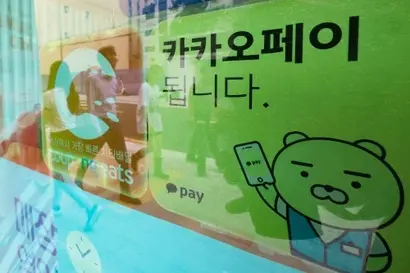
The backdrop to these efforts to expand the business is the fierce competition in the simple payment market. The three major platform-based players are Naver Pay, Kakao Pay, and Toss Pay, which have recently been securing positions not only online but also in the offline market. The No. 1 platform, Naver Pay, is also jumping into M&A, currently pursuing the acquisition of the real estate big data platform "Asil (operated by Ddukkobi World)."
It is also noteworthy that Apple added Naver Pay and Toss Pay to its domestic simple payment methods starting May 16. With this, all three companies have become Apple's simple payment providers, meaning Kakao Pay, which was the first platform to provide simple payment services to the Apple App Store in July 2019, will have to share the pie.
The timing is also striking, as it coincides with Apple fulfilling sanctions it received for personal information leaks. On May 24, Apple posted a notice on the App Store stating that it had "received disciplinary action for violating the Personal Information Protection Act regarding Kakao Pay users." Previously, Apple was sanctioned along with Alipay, as a commissioned party, in an incident where Kakao Pay leaked personal information to Alipay without customer consent.
The incident was uncovered in August 2024. Alipay provided integrated payment system services within Apple and handled credit score (NSF) calculations and settlements for each customer. It was revealed that Kakao Pay had been providing customer credit information for six years to allow Alipay, Apple's commissioned party, to calculate individual NSF scores. Kakao Pay routes payment information through Alipay when transmitting it to Apple.
The Personal Information Protection Commission also sanctioned Apple. It imposed a fine of 2.405 billion won for the act of entrusting personal information abroad without disclosing or informing customers about the trustee (Alipay), and a penalty of 2.2 million won for failing to disclose the entrustment itself. It also issued a corrective order and an order to publicize the sanctions.
On the other hand, Kakao Pay, which received a fine of approximately 6 billion won along with corrective and publication orders, has rebelled by filing an administrative lawsuit. The intent is to challenge whether the action constituted providing personal information to a third party or a standard business entrustment. As the Seoul Administrative Court granted an injunction on April 30, the effect of the sanctions is suspended until a verdict is reached in the main trial. All eyes are on whether Kakao Pay will be able to shed the stigma of being a company that leaked personal information depending on the ruling.
Financial authorities are also discussing sanctions for violations of the Credit Information Act and other matters. It is known that the Financial Supervisory Service previously set the scale of the fine at around 15 billion won, but a final decision has not been reached since it was transferred to the Financial Services Commission's subcommittee. An official from the financial authorities stated, "As the sanction procedures are ongoing, the imposition of the fine has not been finalized."