

[비즈한국] Artificial Intelligence (AI) films—which feature directors but lack actors, physical sets, or cameras—are making their way into theaters. AI is now moving beyond a simple directorial assistant tool to participate in the entire production process. Among domestic multiplex chains, CGV is the most proactive in adopting AI films. Following the exclusive release of the AI film 'It's Me, Moon-hee,' which legally utilized an actor's portrait rights late last year, the company recently held its own competition to explore the potential of AI cinema. Although still in an experimental stage, the industry sees glimpses of commercial potential in AI films.
AI films are gaining attention for their extreme efficiency, transcending the constraints of production costs, time, and space. However, at this stage, there are clear limitations ranging from technical prowess to audience immersion. How will AI, now embedded in every step of production, change the film industry?
From script to filming, creating movies with just text input
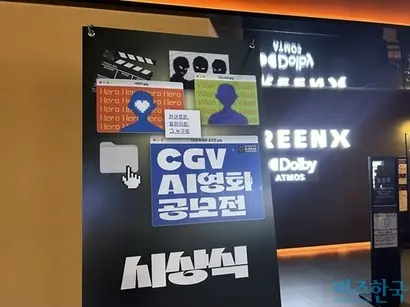
CGV held the first-ever AI film competition in the theater industry, culminating in an awards ceremony on the 30th of last month at CGV I-Park Mall in Yongsan-gu, Seoul. Jung Jong-min, CEO of CGV, explained, "We wanted to see how complete a film could be with current technology. It is a venue to examine the evolution and potential changes of AI technology," adding, "The number of entries, their quality, and storytelling all far exceeded our expectations."
The competitiveness of AI technology is well-illustrated by the behind-the-scenes stories of the creators. Director Kim Yun-gak of 'Paper World,' which won the CJ ENM 035760 Special Award, said, "Actually, this project was planned when I was in college. Back then, I tried to implement paper images in 3D, but it was incredibly difficult. It wasn't easy to capture an animation feel, but I was able to complete it through AI."
Generative AI is lowering the barrier to entry for video production, turning concepts that previously remained only in imagination due to limitations in cost, manpower, technology, time, and space into tangible results. Director Hyun Hae-ri, who won the Grand Prize with 'The Wrong Visitor,' emphasized, "Through the tool of AI, concepts became reality, became content, and became works that can be screened in movie theaters. I think the essence of AI film is 'Film with AI.' It will serve as an opportunity for emerging creators to knock on the doors of the screen using AI as a tool."
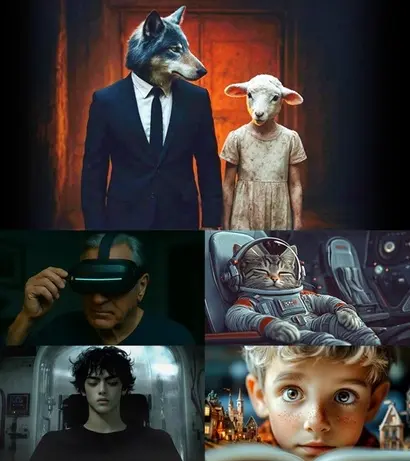
'De-aging' technology, which recreates an actor's younger years, is being actively used in Hollywood, and the younger version of the actor in the film 'A Fairytale, But It's 19+' (released in January) was also realized through AI.
While AI previously played a supportive role mainly in post-production, such as visual effect corrections or color grading, it is now being utilized across the entire process, including scriptwriting, directing, and filming. Unlike traditional film production, which required expensive equipment or specialized personnel, experts suggest an era has opened where a finished film can be produced on a budget as low as a few hundred thousand won.
A film industry official explained, "Traditional special effects were essentially 'manual labor.' AI is much faster and cheaper to produce," adding, "Because it has already penetrated many areas of film production and has an innovative nature, interest in AI on set is significantly high."

Generative AI video technology is rapidly advancing, with the video generation model 'Veo 3' recently unveiled by Google at its annual developer conference. Veo 3 is a model capable of generating video from text. Compared to its predecessor, it not only reflects actual physical laws and prompts more precisely but is also the first video AI capable of implementing video that includes audio, such as dialogue. 'Flow,' a tool for AI film production revealed alongside it, integrates Veo with image generation models like 'Imagen.' As the technology evolves so that text input alone generates video clips suitable for a scenario, the outlook is that AI films will quickly move beyond the technical testing phase and into the realm of commercial content.
Most of all, the strength lies in significantly reducing production costs. According to the Korea Copyright Commission, the horror film 'Expedition Villa,' released at the end of last year, automated 20–30% of its post-production through AI, reducing total production costs by about 30%. Editor Kang Da-bin, who participated as a scriptwriter for the excellence award-winning film 'Pinocchio: Begins,' said, "Neither the film experts nor the video experts had deep knowledge of AI. As a college student, I had no money, so I made this film with 200,000 won, but I consider that process valuable."
'Rapidly growing' AI films face challenges of quality limits and harmony on set
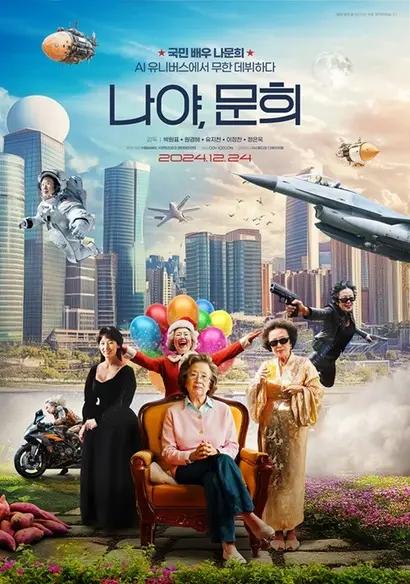
The 5 award-winning films and 4 finalist entries from the competition will be screened specially for the general public this summer. Starting from last year, AI films are entering theaters. The film 'It's Me, Moon-hee,' created by utilizing the digital intellectual property (IP) of actor Na Moon-hee, was officially screened at CGV late last year. This film, which expanded the actor's range of activities by depicting her in forms ranging from her 20s to a Santa Claus and an astronaut, drew attention as an attempt to legally utilize an actor's portrait rights.
However, the lack of technical maturity, unnatural images, and connectivity issues remain critical weaknesses that hinder immersion. The 10–20 minute award-winning films from the competition also showed inconsistencies in character details per cut, distortions, awkward movements, and jerky screens, leaving something to be desired in terms of overall quality compared to regular films.
Regarding the background of expanding touchpoints with AI films, a CGV official stated, "We held the AI film competition in the context of diversifying theater content. Moving beyond being a simple screening platform, it is intended to think about the future of creators and the industry together from the early stages of change, as AI technology becomes a trend in film creation."
The film industry has reached a new turning point with the introduction of AI technology. Changes are underway across the entire spectrum, from production sets to distribution and circulation. AI is also used to predict under what conditions a specific film might have a higher probability of box office success based on social media and streaming data analysis. Lee Ha-young, an operation committee member of the Directors Guild of Korea, predicted, "A new paradigm, such as cost reduction and redefining the limits of ideas, is expected to come, and as a result, there will be major changes on filming sets."
AI film is expanding its reach rapidly across the globe. According to global market research firm Market.us, the global AI film market is expected to grow from $1.8 billion in 2024 to approximately $14.1 billion by 2033. The forecast is that the compound annual growth rate over 10 years will reach 25.7%.
Committee member Lee pointed out, "While it is positive as a technology that reduces various constraints, it is also important to strike a balance with existing personnel during the introduction process. In particular, since it can replace even human creativity, such as in the realm of screenwriting, minimal points of consensus—such as distinguishing whether a film was produced by AI—must be established."