

[비즈한국] Following a prolonged impeachment political situation, Lee Jae-myung of the Democratic Party of Korea has finally been elected as the 21st President of the Republic of Korea. After the martial law crisis on December 3 of last year, our military and the Ministry of National Defense, as direct parties involved, remained silent while becoming subjects of investigations; however, the defense industry continued its "defense boom" atmosphere, with stock prices hitting all-time highs driven by consistent overseas order successes.
The phenomenon of defense company stock prices rising while the military, the Ministry of National Defense, and the government were effectively unable to take much action created a sort of optical illusion for the public. It fostered an expectation that the capabilities and growth of our defense industry were possible even without government support. However, this is far from the truth and borders on a misunderstanding.
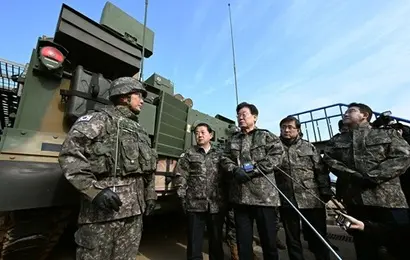
The core export products of our defense industry—the K9 self-propelled howitzer, K2 tank, and Dosan Ahn Chang-ho-class submarine—are all government-led weapon systems for which the Agency for Defense Development (ADD) holds the intellectual property (IP) rights. While the KF-21 Korean fighter jet can be considered a case of industry-led development, it was still developed using budgets received from the Defense Acquisition Program Administration (DAPA), and the AS-21 Redback by Hanwha Aerospace012450 is arguably the only purely private-led export weapon designed by a company itself.
From this perspective, it is no exaggeration to say that the defense acquisition and national defense R&D sectors have practically come to a standstill since the martial law crisis. During the prolonged government vacuum, various R&D projects that were set to become South Korea's next-generation defense bestsellers were either halted or pushed back.
Therefore, whether the South Korean defense industry, which is currently breaking all-time sales records, will soar to new heights or see its growth trend broken and fall will depend entirely on the goals and direction of the defense industrial policy pursued by the Lee Jae-myung administration.
Then, what tasks must be solved for the next administration's defense policy to succeed? Synthesizing my personal judgment and the opinions of defense industry experts, there are three major tasks that must be addressed.
The first task is entering the U.S. market, a long-cherished ambition of the Korean defense industry. Our defense exports were a mere $250 million in 2006, but increased to $17.3 billion in 2022. However, the growth trend of defense exports slowed down during the Yoon Suk-yeol administration, and to reverse this, we must explore new markets beyond the Middle East and Eastern Europe. The key among these is the U.S. market.
Weapon systems with export potential to the U.S. include LIG Nex1's079550 Poniard guided rocket, Hanwha Aerospace's wheeled self-propelled howitzer, and KAI's TA-50N naval trainer aircraft. Since the U.S. military demands the world's best weapons, selling our weapons in this market signifies a transition from "a country that receives military aid" to "a country that exports weapons." As large orders are possible upon successful export, the diplomatic, security, and defense ministries must act as "One Team" and stake their all on entering the U.S. market.
The second task is the advancement of the national defense MRO (Maintenance, Repair, and Overhaul) industry, which encompasses both military vessels and aircraft. The naval MRO market is gaining attention as a new growth engine for the defense and shipbuilding industries; major shipbuilding companies have already completed or are about to begin MRO work on non-combatant U.S. Navy vessels.
However, MRO for non-combatant vessels is low-profit and currently limited to ships from the Asia-Pacific fleet rather than the entire U.S. Navy. To overcome this, we must negotiate with the U.S. Navy to expand the scope of MRO work available to our shipyards, secure authorization for combatant ship MRO projects, and challenge ourselves to perform MRO on high-value vessels such as U.S. Aegis destroyers.
Furthermore, it is important to identify new MRO growth engines beyond naval vessels. In particular, we must secure demand for military aircraft MRO and advance the industry by entering the U.S. Air Force and Navy aircraft MRO markets, starting with aircraft belonging to U.S. Forces Korea and U.S. Forces Japan. KAEMS, an MRO specialist located in Sacheon, possesses the facilities and personnel to perform performance upgrades on the South Korean Air Force's E-737 Peace Eye; therefore, the government needs to attract U.S. military aircraft MRO projects and encourage the participation of not only KAEMS but also companies like Korean Air003490.
The third task is promoting follow-up projects for the defense innovation clusters that have fallen into a stalemate. Defense innovation clusters are support projects designed to back the sustainable growth of the defense ecosystem and support the development of defense-specialized technologies and products by region, which have been underway in various areas including Changwon over the past five years.
However, cluster projects operate on a temporary basis and are set to end this year; the system requires advancement as it has failed to actively respond to the needs of new regions wishing to host them. For example, North Jeolla Province is proposing a material-centric defense cluster utilizing the carbon fiber industry, aiming to become the fourth cluster following Changwon, Daejeon, and Gumi. In this way, we must expand follow-up projects for defense innovation clusters in response to local government proposals and actively foster clusters for R&D in defense fields tailored to regional characteristics, such as drones.
During the election, President-elect Lee Jae-myung put forward "leaping into one of the world's top 4 defense powerhouses" as a pledge for the defense sector. For South Korea, currently at 8th place in the world, to surpass the UK, Italy, Germany, and France and enter the top 4, success in a massive innovation of the defense industry with a sense of urgency is the only way forward.