

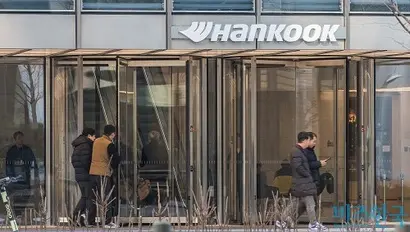
[비즈한국] It has been confirmed that Hankook Tire & Technology161390 invested 143.96 billion won into its U.S. subsidiary, 'Hankook Tire America', earlier this year. The investment is intended for the expansion of its Tennessee plant. With U.S. President Donald Trump implementing high-tariff policies, the outlook for the domestic tire industry is not bright. In this climate, the expansion of Hankook Tire & Technology's Tennessee plant could prove helpful in capturing the U.S. market.
However, the recent arrest of Cho Hyun-bum, Chairman of Hankook & Company000240 Group (53), which has created a leadership vacuum, is considered a variable. This is because decision-making processes, such as adjusting future investment plans for the U.S. market, could be delayed.

Hankook Tire & Technology completed the construction of its Tennessee plant in the U.S. in 2017. The annual production capacity of the Tennessee plant is 5.5 million units. In 2022, the company began expanding the plant. At the time, Hankook Tire & Technology explained, "The decision to increase production at the Tennessee plant was made to respond to continuously growing demand in the North American market and to establish a balanced global production base portfolio."
To this end, it announced an investment of $1.575 billion (approximately 2.1 trillion won) in stages from the second half of 2022 to the first half of 2026. Once the expansion is complete, the annual production capacity of the Tennessee plant will double to 11 million units.
Once the Tennessee plant expansion is complete, Hankook Tire & Technology will be better positioned to counter President Trump's high-tariff policies. The U.S. government has been imposing a 25% tariff on imported cars since April. This has raised concerns about a decline in imported car sales within the U.S. If sales of imported cars fall, the sales of tires installed on these vehicles are inevitably bound to decrease as well.
Since May, President Trump has also been imposing a 25% tariff on automotive parts. Because tires fall under the category of automotive parts, Hankook Tire & Technology is expected to take a direct hit. Currently, the volume produced at the Tennessee plant alone is insufficient to meet the demand in the North American region.
However, President Trump stated that he would temporarily waive tariffs on certain automotive parts installed in finished vehicles manufactured within the U.S. Specifically, from April 3 of this year to April 30, 2026, parts accounting for 15% of the price of finished vehicles assembled in the U.S. will be exempt from tariffs. From May 1, 2026, to April 30, 2027, this ratio will be reduced to 10%. For Hankook Tire & Technology, completing the plant expansion during this grace period would allow for some response to the tariff policy.
Of course, the decision to expand the Tennessee plant was made before President Trump took office. At the time, increasing local U.S. production was not an urgent issue. Now, the situation has changed. If the Tennessee plant expansion is delayed due to President Trump's policies, it could lead to a worsening of performance in the North American region, so the expansion must be completed as quickly as possible. Hankook Tire & Technology's 143.9 billion won investment in its U.S. subsidiary is interpreted as a commitment to speed up the expansion. A representative for Hankook Tire & Technology also explained regarding this investment, "The capital was injected to secure the funds necessary for the expansion of the U.S. Tennessee plant."
Song Sun-jae, a researcher at Hana Securities, commented on Hankook Tire & Technology, stating, "The imposition of U.S. import tariffs has created a cost burden on products exported from Korea and Indonesia to the U.S.," and added, "The goal is to execute 90% of the expected investment amount for the Tennessee plant by the end of 2025, produce initial PCLT (passenger car and light truck) products in the third quarter of this year and TBR (truck and bus) products in the fourth quarter, and complete full-scale mass production by the fourth quarter of next year."
However, an unexpected variable has recently emerged for Hankook & Company Group. On May 29, the Seoul Central District Court sentenced Chairman Cho Hyun-bum to three years in prison for embezzlement and breach of trust under the Act on the Aggravated Punishment, etc. of Specific Economic Crimes, and he was taken into court custody. As a management vacuum has been created at the top, decision-making regarding future investments, such as additional investments in the U.S. market, could be delayed.
Hankook & Company Group plans to have professional managers handle major corporate decisions for the time being. A business industry insider remarked, "It is realistically difficult for professional managers to proceed with large-scale corporate investments or M&As alone without exchanging opinions with the head of the company," adding, "I have seen countless companies miss various investment opportunities due to the absence of the head."