

[비즈한국] With the dawn of the James Webb era, a new mystery has emerged: the 'Little Red Dots' (LRDs). Since James Webb began full-scale deep space observations in 2024, numerous red dots have been captured at the very edge of the universe. This has baffled astronomers. Never before, whether through the Hubble Space Telescope or any other ground-based or space telescope, have such celestial objects been observed. They are strange entities found only through James Webb’s infrared observations.
LRDs are found especially in the very distant past of the universe, between 600 million and 1.6 billion years after the Big Bang. The oldest LRD discovered to date retains the appearance of 13.2 billion years ago. Although over 300 LRDs have been identified so far, astronomers still do not know exactly what they are. Only various speculations abound. It remains unclear whether each of these tiny dots is a primitive galaxy from the early universe, or a massive primordial star; in fact, it is not even certain if they are stars or galaxies. Because they are not easily understood, news headlines occasionally appear claiming that LRDs "threaten the existing Big Bang theory."
However, a very unique hypothesis regarding their identity has recently emerged. Astronomers analyzed a well-known LRD named MoM-BH*-1 and discovered a surprising possibility never before considered. Perhaps the hundreds of LRDs discovered at the edge of the universe by James Webb until now are neither small primitive galaxies nor heavy primordial stars. They may be a completely different kind of celestial object—neither star nor galaxy.
LRDs have a distinctly red color. Most LRDs discovered so far show a very uniform spectral shape across the infrared range. In the universe, red color is created when something is surrounded by a massive dust cloud. This is because dust particles warmed by light from other sources emit red light across the infrared range. A representative example is a type of galaxy found in the distant universe known as Hot DOGs (hot dust-obscured galaxies). However, Hot DOGs cannot explain LRDs. LRDs emit an excessively intense red, infrared light and appear too small to be simply galaxies with high dust density.
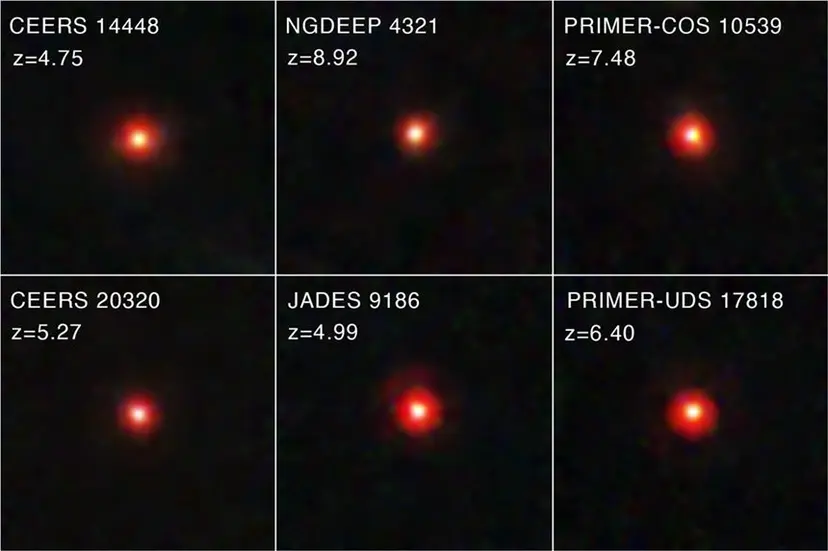
Most LRDs contain a high hydrogen content. Therefore, Balmer lines—the trace of light emitted by hydrogen—are visible in their spectra. However, many LRDs often show Balmer lines that are not sharp but broadly spread out on both sides. This means that the hydrogen clouds contained in the LRDs are swirling at very high speeds. In extreme cases, they appear to be orbiting something at the center of the LRD at speeds approaching 1,000 km per second. This is a characteristic often found in galaxies housing very heavy supermassive black holes at their centers. Based on this, astronomers have raised the possibility that LRDs are primitive galaxies harboring supermassive black holes formed early in the initial universe.
However, this does not provide a perfect explanation either. If they were in the early universe, newly formed supermassive black holes would be going through a very violent phase. We should also observe them devouring high-density gas clouds nearby and ejecting massive amounts of energy along the black hole's axis of rotation. Such extreme conditions of a galactic central black hole create a diverse and rich spectrum including not just infrared, but also X-rays and ultraviolet rays. Yet, most LRDs captured by James Webb so far do not show these features. It is difficult to simply view them as violent black holes or active galactic nuclei formed in the early universe.
Moreover, many LRDs show a distinct feature known as the "Balmer break." A Balmer break is a phenomenon in the spectra of stars or galaxies where the spectrum drops like a cliff and light decreases at wavelengths shorter than 364.5 nm. In neutral hydrogen, consisting of one proton and one electron, an electron at energy level n=2 absorbs light with a wavelength shorter than 364.5 nm and moves to a higher level or becomes ionized. Generally, an older star with a lukewarm surface temperature has many electrons remaining at energy level n=2 in its surface atmosphere. Therefore, in galaxies where old stars are concentrated, one can easily see the Balmer break, where the spectrum drops sharply at wavelengths shorter than 364.5 nm as a large number of electrons at n=2 absorb light.
But this fact makes LRDs even more incomprehensible. All the LRDs discovered by James Webb live in the very early universe, where the age of the universe is less than 1 billion years. Naturally, galaxies at this time should be considered very young, primitive galaxies that have just begun forming stars. Yet, the Balmer break is a feature seen mainly in galaxies filled with old stars rather than young ones. This contradiction makes LRDs appear like precocious galaxies that have aged too quickly. Because of these perplexing problems, some media once reported that the existence of LRDs was shaking the foundations of the Big Bang theory.
However, this recent analysis offers a new possibility that can explain the Balmer break feature of LRDs. In fact, in neutral hydrogen, electrons do not stay in the n=2 level for long. Electrons in this state are very unstable. In just 1-2 nanoseconds, they fall to the more stable n=1 level with lower energy, emitting light corresponding to the Lyman series. The fact that most LRDs show a clear Balmer break in their spectra means that a mechanism is at work that forces most of the electrons within the hydrogen atoms in the LRDs to remain in the n=2 level.
Let’s consider an extreme situation where this might happen. For example, if hydrogen atoms are gathered at an excessively high density. In such high-density gas, collisions between hydrogen atoms become frequent, and electrons in each atom, attempting to fall to the n=1 level, regain energy and bounce back up to the n=2 level. If the density of hydrogen atoms is so high and crowded that the frequency of falling from the n=2 level is balanced by the frequency of bouncing back up to n=2, a type of equilibrium is reached. Thus, the number of electrons staying at the n=2 state within the gas cloud can be kept at a consistently high level. If that happens, even without a single star, electrons at n=2 within the gas cloud itself will continuously absorb light at wavelengths shorter than a specific threshold, creating the distinct feature of a Balmer break on the spectrum.
Applying this hypothesis allows us to envision a very interesting scenario. The central supermassive black hole is wrapped in an extremely high-density clump of hydrogen gas. There are no stars here. Only a supermassive black hole is hidden in the center of a dense, thick gas cloud. It is as if the black hole is living inside a giant "cocoon" of hydrogen gas. According to the model, the density of this hydrogen gas cocoon housing the supermassive black hole is comparable to the density of the upper atmosphere of an ordinary star! It means that the cocoon is tightly packed around the central black hole with atoms—not at the density level of sparse interstellar material in a typical galaxy, but at the density of a stellar atmosphere.
In this analysis, astronomers analyzed the spectrum of MoM-BH*-1, one of the LRDs, using James Webb's infrared spectroscopy. They confirmed that when the model of a gas cloud cocoon surrounding a central supermassive black hole is applied, the actually observed spectrum is explained perfectly. A celestial object with a supermassive black hole at the center, surrounded by a high-density gas cloud equivalent to an ordinary stellar atmosphere. The radius of the gas cloud is only about 40 AU. It is smaller than our solar system, let alone a galaxy! This looks more like a "giant red star" harboring a supermassive black hole at its center rather than a primitive galaxy. It is a new kind of celestial object, different from any star or galaxy we have known until now. Astronomers have named this new object a "Black Hole Star."
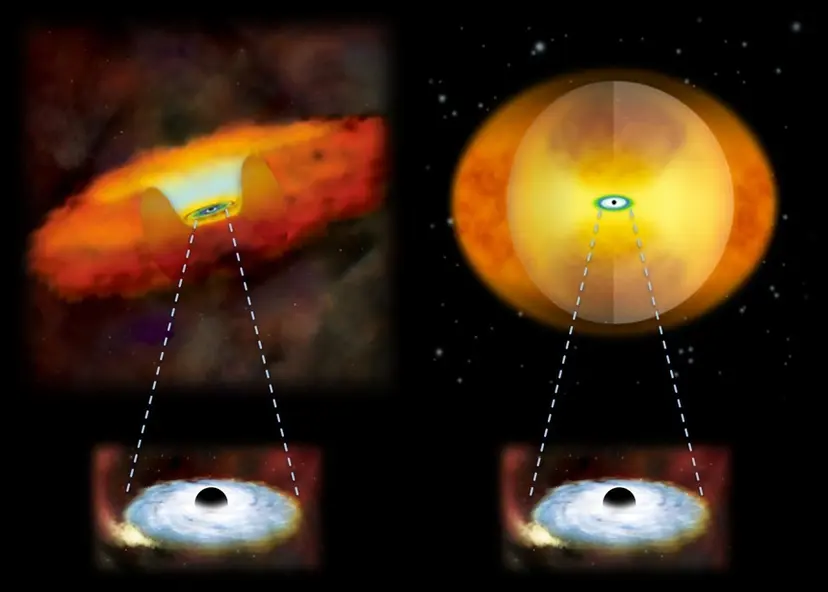
If we explain LRDs as a new type of celestial object called "Black Hole Stars," the mass problem—one of the biggest issues with LRDs until recently, as they appeared excessively heavy—is also naturally resolved. Astronomers confirmed that by applying the new model, the mass of the supermassive black holes they contain is calculated to be much lighter. It is reduced to a level of 100,000 to 10 million times the mass of the Sun, more than 100 times lighter than previously estimated. This is more of an intermediate-mass black hole level than a supermassive black hole. It is a reasonable level of mass that a primordial black hole in the very early universe, just starting to take shape, could sufficiently possess. The confusion caused by the excessively heavy mass immediately after the Big Bang is naturally resolved.
The surprising possibility for LRDs presented by this paper provides a new clue to one of modern astronomy's age-old riddles: the link between galaxies and their central supermassive black holes. Astronomers are still contemplating both possibilities: whether the galaxy is born first and the black hole grows at the center, or whether the black hole is created first and the galaxy forms around it. This is the age-old chicken-and-egg problem of astronomy.
However, this scenario provides a clue that in the early universe, extremely high-density gas clouds were kneading, and at their center, an intermediate-mass black hole—not a star—was the first thing to form. If "Black Hole Stars" formed in this way later collide and merge to grow larger, they would eventually become the heavier supermassive black holes we see at today's levels. In the process, ordinary stars were likely created around them, forming the shape of today's galaxies. We are finally able to foresee whether the chicken or the egg came first, and which one—the galaxy or the black hole—was the first button in the history of the universe.
Reference
https://ui.adsabs.harvard.edu/abs/2025arXiv250316596N/abstract
Who is author Woong-bae Ji? He loves cats and the universe. After watching 'Galaxy Express 999' as a child, he dreamed of making the beauty of the universe known to the world. He is currently researching the evolution of galaxies through their interactions at the Center for Galaxy Evolution and the Near-Universe Cosmology Laboratory at Yonsei University, and is engaged in various science communication activities such as lectures and writing. He has authored books including 'The Sseom (Chemistry) Observatory', 'Thinking About the Universe All Day', and 'Stars, the Science of Light'.