

[비즈한국] Ahead of the June 3 presidential election, major candidates have put forward the expansion of the Great Train Express (GTX) as a key campaign pledge. While the plan aims to extend the GTX not only to the outskirts of the capital region but also to major provincial cities, concerns are being raised about the policy's effectiveness due to massive project costs and a lack of business viability.

According to political circles on the 30th, Democratic Party presidential candidate Lee Jae-myung announced that he would connect major hubs in the capital region into a single economic zone through the GTX. His plan is to expand the radius of daily life to the outskirts of the capital region and even Gangwon Province by sequentially adding new routes, such as GTX-D, E, and F, based on regional demand and efficiency. He also plans to actively review a "GTX Plus" project that includes extending the GTX-C line to Oido and adding G and H lines.
People Power Party presidential candidate Kim Moon-soo proposed a plan to build a nationwide high-speed rail network by expanding the GTX into five major metropolitan regions across the country. He intends to expand GTX routes to include the capital region, the Bu-Ul-Gyeong (Busan, Ulsan, Gyeongnam) region, Daegu-Gyeongbuk, Chungcheong, and Gwangju-Jeonnam, and to push for the opening and extension of new routes. He aims to expedite the opening of the Dongtan-Anseong-Cheongju Airport GTX connecting the capital region and Chungcheong, as well as the Wirye-Gwacheon Line and the Sinansan Line's Songsan-Yeouido route.
The backdrop to both candidates making the nationwide expansion of the GTX a core campaign pledge seems to be a shared understanding that, in a situation where population decline due to low birth rates and an aging society is deepening, it is necessary to promote balanced regional development by resolving the phenomenon of concentration in the capital region.
Trillion-won GTX projects: Plans to expand, but funding remains a question mark
However, analysts suggest that it is realistically difficult to achieve the GTX pledges promised by the candidates. This is because the Great Train Express requires more financing than many other types of social overhead capital (SOC). According to the Korea National Railway, the total project costs for the GTX lines already confirmed for opening amount to 3.708 trillion won for Line A (Paju Unjeong–Samsung), 4.2894 trillion won for Line B, and 4.6084 trillion won for Line C.
Despite the enormous cost burden, concrete plans for securing funding have not been presented. Candidate Lee's position is to secure funding for large-scale fiscal projects through restructuring government spending and utilizing the projected total annual revenue increase from 2025 to 2030. Candidate Kim plans to raise funds through attracting private investment, national and local government budgets, and re-adjusting SOC budgets. However, critics point out that neither candidate has offered a practical funding strategy.
Seo Jin-hyung, a professor of Real Estate Law at Kwangwoon University, said, "Even pushing for the GTX project as a fiscal project has limits due to budget constraints. To attract private investment, profitability must be guaranteed, but given the current downturn in the construction industry and future population trends, it will be difficult to ensure sufficient business viability."
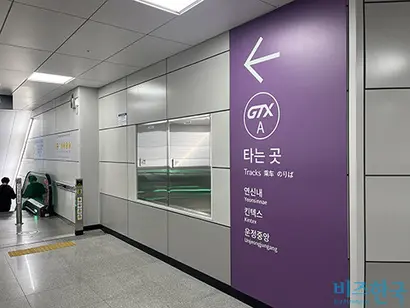
Existing GTX-A, B, C projects face delays, with some yet to even break ground
The operational status and construction periods of existing GTX projects are also factors that diminish the realism of these campaign pledges.
The Unjeong–Seoul Station section of GTX-A, proposed by Gyeonggi Province in 2009, broke ground in December 2018 and took six years to open, with the remaining sections scheduled for completion in 2028.
The GTX-B line, which held its groundbreaking ceremony in March last year and was expected to open in 2030, has yet to even break ground due to issues such as funding disruptions from the project financing (PF) crisis and rising construction costs.
Within the Daewoo E&C047040 consortium in charge of the project, construction companies such as DL E&C375500, Lotte E&C, Namkwang Engineering & Construction001260, and Hoban Industrial have withdrawn, and Hyundai E&C000720 has decided to return 13% of its 20% stake. While the lead contractor, Daewoo E&C, is in discussions with mid-sized construction firms to replace them, there are concerns that delays in acquiring those stakes could impact the construction schedule.
GTX-C, which is entirely a private investment project, is also facing difficulties as some construction firms have expressed their intention to withdraw, citing demands for increased construction costs.
Under these circumstances, concerns are being raised that business conditions could deteriorate further if GTX routes are expanded into local provinces, where demand is relatively lower than in the capital region.
An industry official stated, "Because public-led projects have lower profitability than private ones, construction firms are reluctant to participate actively. In particular, it will not be easy to find contractors for local provinces because it is even harder to secure business viability compared to the projects previously carried out in the capital region."
Experts point out that thorough feasibility studies and region-specific approaches must come before any nationwide expansion of the GTX.
Professor Seo Jin-hyung remarked, "If large-scale transportation projects like the GTX hit snags, it increases market uncertainty and local residents inevitably suffer direct damage due to the lack of transportation networks. We must minimize the burden on project operators and reduce local confusion by prioritizing routes that have secured economic feasibility through rigorous preliminary feasibility studies."
Lee Eun-hyung, a research fellow at the Research Institute of Construction Policy, said, "It is clear that building a nationwide metropolitan transportation network is necessary from the perspective of social benefits, such as balanced development, regardless of profitability. We need to consider plans that are helpful to local residents and can secure at least minimal profitability, taking into account both existing GTX routes and the various local conditions."