

[비즈한국] With less than a week remaining until the presidential election on June 3, the country has entered the so-called "blackout" period, during which the publication of presidential election poll results is prohibited. As attention turns to where voters' sentiments lie, they are expected to cast their ballots after carefully scrutinizing the candidates' pledges. In particular, interest is focused on AI-related pledges, a core promise from both Democratic Party candidate Lee Jae-myung and People Power Party candidate Kim Moon-soo, both of whom have pledged 100 trillion won in investment.
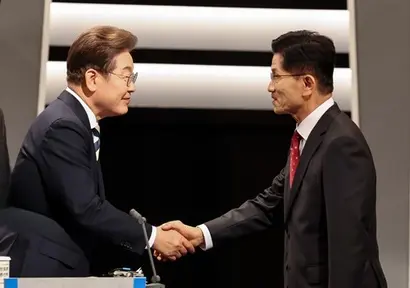
Lee Jae-myung and Kim Moon-soo Promise AI Infrastructure and Talent Development
Democratic Party presidential candidate Lee Jae-myung and People Power Party candidate Kim Moon-soo have both presented becoming an "AI Powerhouse" as one of their core pledges. The intent is to transform South Korea into an AI powerhouse by investing massive budgets into the AI industry as the world enters a major transition era of establishing AI infrastructure. Their strategies involve expanding jobs and revitalizing the economy by fostering the AI industry. Both candidates have promised 100 trillion won in investment for AI industry development.
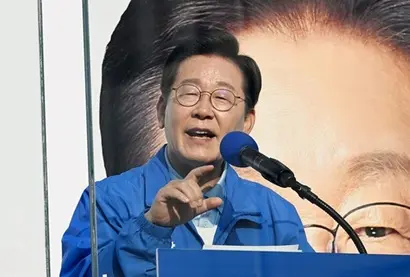
Candidate Lee Jae-myung stated that he would invest 100 trillion won in the AI industry to open an "AI Basic Society," connecting it to his signature policy of a "Basic Society." An AI Basic Society refers to a digital welfare state where everyone, rather than just a small group of capital holders, can enjoy the benefits of artificial intelligence technology. His plan is to provide generative AI services to the entire public through the opening of public data to the private sector and the "AI for All" project.
Candidate Lee also made government-led AI infrastructure construction a key pledge. He proposed a plan to secure 50,000 high-performance GPUs (Graphics Processing Units) and create a national AI data cluster.
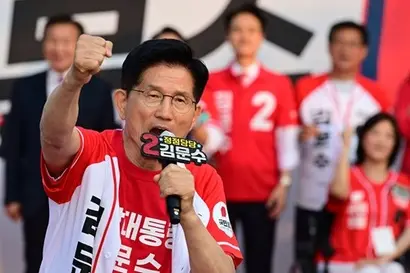
Candidate Kim Moon-soo also chose AI as a core national technology, announcing plans to establish a presidential committee and create a 100 trillion won fund to foster AI companies. His intent is to discover relevant companies by creating an "AI Startup and Venture Growth Fund" led by domestic and foreign companies.
Candidate Kim Moon-soo also pledged to cultivate 200,000 young AI talents. He plans to expand enrollment in AI graduate schools and software (SW)-focused universities, and support cooperation with global universities. He intends to support necessary labor and research costs for attracting outstanding overseas personnel through government and private matching funds.
Both candidates mentioned deregulation. Candidate Kim Moon-soo planned to significantly reduce AI-related regulations that have been requested by startups and small and medium-sized enterprises (SMEs). His position is to strengthen the functions of the National AI Committee to coordinate differences between regulatory ministries. It has been pointed out that the current National AI Committee lacks substantial authority to cover all government departments. Candidate Lee Jae-myung also pledged to revitalize AI-converged industries by easing regulations and establishing special exemptions.
Both candidates have shown active moves to build AI infrastructure, such as recently meeting with OpenAI, which leads the global artificial intelligence market. According to industry sources, OpenAI met with candidate Lee Jae-myung's side at the Four Seasons Hotel in Jongno, Seoul, on the morning of the 26th. On the afternoon of the same day, they met with People Power Party lawmaker Choi Hyung-du at the National Assembly in Yeouido, Seoul. At the end of the conversation, a video call was also held between candidate Kim Moon-soo and CSO Jason Kwon. On this day, OpenAI announced that it would officially establish a Korean branch.
AI-related pledges were absent from the 10-point manifesto of Reform Party candidate Lee Jun-seok. However, in media interviews, candidate Lee Jun-seok emphasized data freedom in the AI industry. He proposed opening data for AI training and establishing a foundation for securing competitiveness in LLMs (Large Language Models). He also stated that he would create a new "Deputy Prime Minister for AI Strategy" to increase the consistency and implementation power of AI policies.
Unlike the other two candidates, candidate Lee Jun-seok did not mention the scale of investment for the AI industry. Regarding the "100 trillion won investment" of candidates Lee Jae-myung and Kim Moon-soo, he pointed out, "The basis of the AI industry is the promotion of private investment," adding, "It is important to talk about regulatory reform, and talking about superficial figures like 100 trillion or 200 trillion won actually shows a lack of understanding of the industry."
Financing Methods Lack Basis or Realism
There are also criticisms and concerns regarding the AI pledges of candidates Lee Jae-myung and Kim Moon-soo, who promised large-scale investments. The biggest problem cited is the lack of transparency in financing plans. Although both candidates promised a 100 trillion won investment in fostering the AI industry, they have been criticized for lacking concrete funding plans.
Regarding the method of raising 100 trillion won, candidate Lee Jae-myung's side mentioned the previous administration's private investment attraction plan (65 trillion won) and the expansion of government fiscal investment, but critics argue that this is insufficient grounds for such large-scale budget input. Candidate Kim Moon-soo's plan to raise funds through the creation of a 100 trillion won public-private joint fund is also facing concerns about its lack of realism.
Experts evaluate that while both candidates have put forward pledges emphasizing the fostering of the AI industry, they have failed to present specific plans. An industry official pointed out, "As of now, it cannot be said that proper AI-related policies have been put forward. They are only showing, in a broad framework, whether they are focused on government supply or the private sector."
There are also voices of regret regarding the talent development plans for the long-term growth of the AI industry. Shin Min-soo, a professor of business administration at Hanyang University, pointed out, "The current pledges emphasize training new personnel. However, there is an opinion as to whether it is really possible to train that many new people," adding, "Consideration for converting existing personnel into AI workers is also needed."