

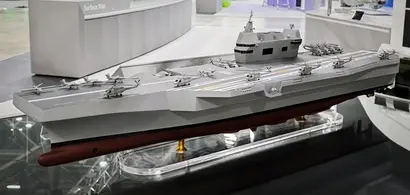
[비즈한국] At the maritime defense exhibition ‘MADEX’ held in Busan starting May 28, Hanwha Ocean042660 unveiled for the first time its manned-unmanned teaming command and control ship, dubbed ‘Ghost Commander II.’ This model is set to compete with the HCX-23 Plus recently introduced by HD Hyundai Heavy Industries329180. It is considered to have high technical maturity as it improves upon a traditional aircraft carrier design to enable the operation of both manned and unmanned aircraft.
The manned-unmanned teaming command and control ship, which has reportedly had its requirements recently finalized, can be considered the ROK Navy’s next-generation flagship—a project that replaces the aircraft carrier plan pursued over the past few years. Originally, during the previous Moon Jae-in administration, the Navy pushed for a Korean-style aircraft carrier plan, with HD Hyundai Heavy Industries and Hanwha Ocean competitively designing it up to the conceptual stage; however, the project was effectively abandoned due to various controversies.
The biggest reason the Navy, which had strongly pushed for the aircraft carrier plan, ultimately folded was the cost—specifically, the cost associated with operating fixed-wing aircraft. Initially, the aircraft carrier plan was designed by adding aircraft operation capabilities to the LPX-2, a next-generation large amphibious assault ship then under design. This LPX-2 was developed under the premise of having aircraft operation capabilities similar to the U.S. Navy’s ‘America’-class large amphibious ships, meaning the operation of the U.S. F-35B Lightning II.
However, while the F-35B has the advantage of short take-off and vertical landing (STOVL) capabilities without the need for special equipment on short runways, its high price tag was a significant issue. To resolve this, the military and defense industry once considered mounting a modified version of KAI’s Boramae fighter, dubbed the ‘KF-21N,’ onto the carrier.
But while the procurement cost of the KF-21N itself was lower, operating it on a carrier would have required complex and expensive equipment such as an angled flight deck, arresting wires, and above all, an aircraft catapult. This would have increased both the size of the carrier and the overall costs.
Because of this, the Ministry of National Defense and the Navy are currently preparing a new plan for an unmanned aerial vehicle (UAV) carrier, referred to as an ‘unmanned power command and control ship.’ They have pivoted to a concept that centers on operating unmanned aerial vehicles and manned rotorcraft instead of manned fighters like the F-35B or KF-21N.
The ‘Ghost Commander II,’ unveiled by Hanwha Ocean this time, is a conceptual model designed to participate in this unmanned power command and control ship project and is expected to compete with HD Hyundai Heavy Industries’ HCX-23 Plus. While the HCX-23 Plus features an innovative ship form for unmanned-centric operations—showcasing a distinct style such as a dual-deck structure and a focus on stealth design—Hanwha Ocean’s Ghost Commander II modifies and supplements a traditional aircraft carrier design, specifically the one Hanwha Ocean presented at MADEX in 2021.
First, an angled flight deck for landing has been added to the side, and the dual islands have been integrated into one. This allows for aircraft landing on the side, and the placement of the two elevators used to move aircraft to the deck has also been changed. In addition, it is equipped with one catapult, enabling the launch of fixed-wing unmanned aerial vehicles.
The ship’s self-defense equipment has also been somewhat altered. Three close-in weapon systems (CIWS-2), currently under development by LIG Nex1079550, are placed on the upper right, rear, and center-left of the ship, and vertical launch systems (VLS) capable of carrying 32 surface-to-air missiles (SAAM) have been distributed in two locations.
The carrier’s aircraft, the core of the Ghost Commander, consist of a mix of unmanned and manned aerial vehicles. The model produced by Hanwha Ocean is equipped with Korean Air’s003490 stealth UAV, the LOWUS low-observable unmanned wingman, and the Gray Eagle-STOL, which Hanwha Aerospace is currently pursuing in joint development with the U.S.-based GA-ASI. Additionally, it can operate maritime operation helicopters and amphibious maneuver helicopters.
So, what is the operational capability of the Ghost Commander II? While exact detailed designs and functions are currently unknown, it appears comparable to the MUGEM (Milli Uçak GEMISI) currently being built by the Turkish Navy. The MUGEM is the world’s first full-scale manned-unmanned composite carrier and operates in a similar manner to the Ghost Commander II, with the differences being that it operates a small manned light attack aircraft called Hurjet and has a larger displacement of 65,000 tons.
It is not yet known which design the Navy will prefer between Hanwha Ocean’s Ghost Commander II and HD Hyundai Heavy Industries’ HCX-23 Plus. However, Hanwha Ocean’s design, which maintains the deck layout and structure of existing fixed-wing aircraft carriers and large amphibious ships, appears conservative yet technically mature. In particular, the ability to operate manned helicopters in tandem and the leeway left for future manned fixed-wing aircraft operations are considered the strengths of the Hanwha Ocean design.