

[비즈한국] It has been confirmed that the South Korean office of China State Construction Engineering Corporation (CSCEC), the world's largest construction company, has recently filed for the closure of its construction business. This Chinese state-owned enterprise entered the domestic construction market 12 years ago after registering for a general construction business license in Korea. While it once rose to become the second-largest player in the domestic architectural industry by expanding its business, primarily around Jeju Island, it had recently been hit with successive fines and business suspension orders due to unfair subcontracting practices.
According to the construction industry, the CSCEC South Korean office filed for the closure of its construction business on the 21st. The reason for the closure is the abandonment of business due to company circumstances. Under the Framework Act on the Construction Industry, to engage in construction in Korea, companies must meet specific requirements regarding capital, technical personnel, facilities, and equipment, and register with the competent local government. The same procedure applies to business closure, which requires filing with the local authority. An official from the Construction Innovation Division of the Seoul Metropolitan Government stated, "With the cancellation of the construction business license, the company no longer holds any valid construction industry registration."
CSCEC is the world's largest construction firm. It has held the No. 1 spot for nine consecutive years (based on construction revenue) in the top 250 global construction companies ranking published annually by the U.S. construction magazine ENR. Established in Beijing in June 1982 as a Chinese state-owned enterprise, the company recorded $282.4 billion (387 trillion won) in construction-related revenue and $549.8 billion (754 trillion won) in new orders in 2023. Its portfolio includes the Shanghai World Financial Center, Beijing Daxing International Airport, the Great Mosque of Algiers, and One Thousand Museum in the United States.
CSCEC began its full-scale entry into the Korean construction market 12 years ago. After establishing an office in Korea in March 1997, it registered for an architectural construction business license in November 2013. It also registered for civil engineering in May 2017 but abandoned that business in December 2021, focusing solely on architectural construction since then. By expanding its business around Jeju Island, it was evaluated at 197.3 billion won in construction capability—the amount of work it could handle at once—in the 2020 Ministry of Land, Infrastructure and Transport's construction capability assessment, placing it as the second-largest in the domestic architectural industry. However, its evaluated construction capability dropped to 900 million won last year.
The CSCEC South Korean office was sanctioned by competition authorities two years ago for unfair subcontracting practices. In October 2023, the Korea Fair Trade Commission (KFTC) issued a payment order of 3.9 billion won for subcontracting fees and 240 million won in delayed interest, along with a fine of 3 billion won. These penalties were imposed because the CSCEC South Korean office, while commissioning the "Jeju Dream Tower construction project" to subcontractors, failed to provide written subcontracting contracts, set unfair terms such as prohibiting price adjustments based on inflation, and failed to pay subcontracting fees and delayed interest.
At the time of this business closure filing, the office was already under a suspension order for failing to issue payment guarantees for subcontracting fees. The Seoul Metropolitan Government imposed a 3-month total suspension (1 month per case) on the company's architectural construction license this past March, citing its failure to provide subcontracting payment guarantees to three subcontractors involved in the Jeju Cypress Golf & Resort C-Block construction project. Although the actual suspension period was from April 1 to June 30, the closure of the business effectively renders the suspension moot.
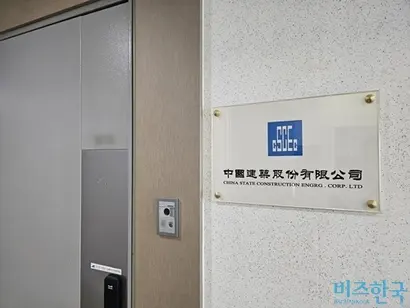
It appears that the CSCEC South Korean office is not currently undergoing formal corporate dissolution procedures. The corporate registry for the CSCEC South Korean office remains valid, and the company currently maintains an office in an office building near Gwanghwamun Station in Jongno-gu, Seoul. BizHankook visited the office on the 26th to inquire about the background of the business closure and future business plans, but the office was closed, and no company representatives were available.