

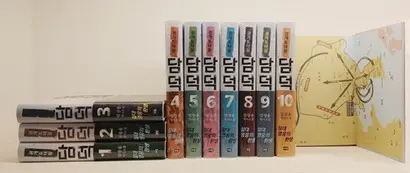
[비즈한국] Author Eom Gwang-yong’s epic novel series, ‘Gwanggaeto the Great, Damdeok,’ has been completed in 10 volumes. The final installment, ‘The Dream of the Great King,’ serves to conclude the life of Gwanggaeto the Great, Damdeok, while simultaneously summarizing the core significance of the entire novel. Centered on Damdeok, the figure who led Goguryeo to its golden age, this work reconstructs the historical period of upheaval from the late 4th to the early 5th century.
The story follows his life spanning about 40 years, from his birth and growth to his accession, military conquests, and the erection of the monument after his death. During his 22-year reign, he spearheaded massive territorial expansion and foreign wars, and is recognized as the figure who reorganized the geopolitical order of Northeast Asia at the time. ‘The Dream of the Great King,’ the final volume, covers this last journey, ranging from the ‘memorial rites for Jumong’ to the expedition against Eastern Buyeo.
The author’s prose is relatively plain yet harmoniously blends detailed descriptions and historical imagination upon a solid narrative structure. In particular, it demonstrates a high level of literary accomplishment in depicting natural landscapes, the tension of the battlefield, psychological warfare within the royal court, and diplomatic conflicts. The poetic expressions are never excessive while effectively conveying the emotional state of the situations, and the balance between dialogue and narration remains stable.
Literarily, this work follows the tradition of Korean epic novels. Rather than merely delivering historical facts, the author constructs the story around the underlying power structures, national consciousness, leadership, and survival strategies. In this process, readers gain indirect insights into the political system, international situation, and cultural characteristics of Goguryeo at the time. Although it is a work of fiction, the narrative flows harmoniously without clashes or disharmony between historical context and imagination.
The recurring imagery of ‘horses’ and ‘roads’ throughout the series is linked to Damdeok’s expansionist policy, and this symbolism continues consistently into the final volume. By utilizing these motifs, the work breaks free from a biography centered on a single individual and gains a broader perspective that encompasses the nation, the community, and the flow of the era. This flow reaches its climax in the final chapter, ‘The Dream of the Great King,’ where the leadership and vision of Damdeok are revealed in their entirety.
The merits of the work as a historical novel are also clear. While faithfully recreating major battles, diplomatic incidents, and relationships with neighboring countries, the author avoids excessive didacticism or ideological interpretation. Through this, the work maintains a relatively balanced attitude between fiction and non-fiction, providing the reader with information while maintaining narrative interest.
‘Gwanggaeto the Great, Damdeok’ uses hero narratives from Korean ancient history as its material, yet includes devices that allow for reflection on modern leadership, community spirit, and identity. It is worthy of praise for the fact that this series does not stop at describing the past but attempts to evoke contemporary significance. Furthermore, as an epic novel, it possesses a high level of literary quality and narrative density, and ‘The Dream of the Great King’ offers a convincing and complete conclusion. Through the narrativization of ancient history, it is a work that has achieved significant success in both literary and historical realms.