

[비즈한국] The 21st presidential election is now just a week away. Perhaps due to the rapid pace of this early election, constructive discussions on well-considered pledges or policies are hard to come by. With long-term low growth coupled with political instability making life difficult for the public, the crisis in local economies is becoming even more severe. We examined the local economic revitalization plans of the four party presidential candidates: Lee Jae-myung (Democratic Party of Korea), Kim Moon-soo (People Power Party), Lee Jun-seok (Reform Party), and Kwon Young-guk (Labor Party).
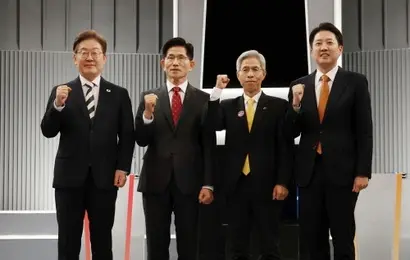
All four party candidates have set the strengthening of regional decentralization as a prerequisite. They proposed pledges involving large-scale investments tailored to local conditions, or the introduction of individual policies and organizations. The proportion of their top 10 pledges dedicated to regional issues varied significantly among the four, and there were differences in content depending on each candidate’s political platform.
Lee Jae-myung of the Democratic Party prioritized balanced regional development. In his pledge to "promote Sejong as an administrative capital and develop 5 megaregions and 3 special autonomous regions," the "5 megaregions" refer to the capital area, southeast, Daegu-Gyeongbuk, central, and Honam regions, while the "3 special regions" refer to Jeju, Gangwon, and North Jeolla provinces. His plan involves establishing a National Autonomy and Decentralization Council to strengthen the powers of local governments, expanding local shared taxes, and securing local fiscal revenue through the discovery of new tax sources. He cited the tourism industry as the foundation for reviving local economies, specifically promising to boost local tourism by expanding the worker vacation support program.
Lee has created separate pledges for each of the 17 administrative districts on his official website, detailing region-specific policies. Examples include developing Gwangju into a mobility hub, or relocating the Ministry of Oceans and Fisheries to Busan and attracting 100 major corporations there. For Sejong City, he aims to make it an administrative capital by constructing the National Assembly and the presidential office within the city.
In the top 10 pledges of Kim Moon-soo from the People Power Party, it is difficult to find detailed regional economic promises other than the expansion of the Great Train Express (GTX). His platform, "A Country Connected by GTX, a Republic of Korea Growing Together," specifies expanding the capital area's GTX model to five major national regions and delegating central government powers—such as urban planning, industry, personnel, taxation, legislation, and education—to local governments. Among his pledges for small business owners, he does mention promoting local consumption by vitalizing traditional markets.
Kim filled in the gaps by announcing 20 regional economic revitalization pledges on May 26. What stands out is the expansion of funding for regional development. He plans to increase the size of the Special Account for Balanced Development, which is 14.7 trillion won as of 2025, to 30 trillion won per year, and to raise the local consumption tax rate from 25.3% to 40% and the local income tax rate from 20.8% to 30%. He also proposed a plan to defer capital gains taxes for residents in the capital area who sell their homes and move to non-capital regions to live for at least 15 years. His pledges also include the enactment of a "Special Act on Fostering Regional Banks," a long-standing request from regional banks that financial authorities had previously rejected.
Many of his pledges were similar to Lee Jae-myung’s. These include plans to establish the National Assembly, presidential office, and central administrative agencies in Sejong to create an administrative capital, as well as utilizing the cultural industry as a driver for balanced development and providing support for non-capital national universities.
Lee Jun-seok of the Reform Party included two regional economic revitalization plans in his top 10 pledges: expanding the taxation autonomy of local governments regarding corporate tax, and delegating the power to determine the minimum wage to local governments.
The core of expanding corporate tax autonomy is to reduce the national tax portion by 30% and convert it into local tax, allowing local governments to apply a flexible tax rate of up to 50%. The intent is to allow local governments to autonomously provide tax incentives to attract businesses. As for the minimum wage system, his proposal is for local governments to adjust the rate determined by the central government’s Minimum Wage Commission within a range of 30%.
During the first debate on the economy held on the 18th, this pledge by Lee was criticized by Kwon Young-guk of the Labor Party, who stated, "Wage discrimination is already serious among large and small businesses, men and women, regular and irregular workers, and platform laborers. It is a dangerous idea to discriminate between the capital and non-capital areas as well," adding that "if wages are differentiated, talent will only flock to the capital area."
Kwon Young-guk, in his top 10 pledge titled "An Economic Structure Beyond Inequality to Live Together," proposed the establishment of regional public banks and the introduction of a system for local communities to invest in small and medium-sized enterprises (SMEs) and self-employed businesses. A regional public bank is an institution 100% funded and owned by a local government that acts as a public financial entity based on municipal budgets and citizen deposits. These banks would normalize struggling local SMEs or self-employed businesses through equity investment. Regarding decentralization, Kwon only proposed a constitutional amendment to rename "local autonomous entities" to "local governments."
The regional economic pledges of the four candidates show significant differences in their fundamental approaches. Lee Jae-myung and Kim Moon-soo drew pictures that expand into decentralization, administrative reform, and economic revitalization, centered on balanced national development and infrastructure construction led by the central government. Lee Jun-seok focused on taxation and wage-setting powers, while Kwon Young-guk sought to revive local economies through public finance.
Critics point out that instead of containing specific roadmaps, the regional pledges are either merely developmental plans or remain limited due to their reliance on the central government. On the 26th, the Citizens' Coalition for Economic Justice (CCEJ) evaluated the top 10 pledges on decentralization and autonomy, noting that "while regional autonomy pledges reveal each candidate's interest in balanced development and policy priorities, it is evident that the pledges presented in this election remain at the level of functional dispersion and have failed to lead to substantial decentralization reform."