

[비즈한국] The most striking characteristic of Mars is its vivid red color. Since ancient times, people have looked at the planet shining red like blood and associated it with Ares, the god of war. Consequently, the planet came to be called Ares, or Mars. There is also a star in the constellation Scorpius that shines with a redness rivaling Mars. It is a famous story that people thought of that star as the only worthy rival to the war god Ares, giving it the name Antares—"anti-Ares."
The images of the endless red desert landscapes sent back by exploration robots have made Mars feel even more alien to us. Interestingly, while the fact that Mars is red has been well-known long before the invention of the telescope, we still do not know exactly why Mars exhibits this red hue.
Some may believe that Mars is red because of oxidized iron, or rust. However, that is merely a presumption; we do not know the exact reason why the entire planet is stained red as it is now. Recently, however, a new hypothesis has emerged explaining why Mars is red. This hypothesis might be great news for Elon Musk, as it suggests that Mars was a much more habitable "heaven" for life than we had anticipated.
In 1976, the Viking landers touched down on Mars and confirmed the presence of abundant iron. When iron meets oxygen, it oxidizes and turns red—a color commonly seen in rusted iron. Astronomers naturally assumed that the red color of Mars was due to this rusted, oxidized iron. Moreover, the Martian sky was filled with dust. Martian dust is so lethal that it has occasionally covered probes, rendering them completely inoperable. Astronomers presumed that the abundant iron on Mars had oxidized over a long period, turning the planet red, and that this oxidized iron had since crumbled into dust, covering the entire planet in a red layer.
Later, the Mars Global Surveyor, which orbited the planet, and the Opportunity rover, which landed in 2004, both confirmed the presence of Fe2O3 (hematite) on the Martian surface. Hematite is a direct combination of iron and oxygen, appearing in a very vivid red color. In particular, the Opportunity rover, which traversed every corner of the Martian surface, and the subsequent Curiosity rover discovered very interesting stones scattered across the surface.
At first glance, they look like small beads. These stones, a few centimeters in size and resembling polished beads, are entirely composed of hematite. In photos taken by the rovers, these stones appear bluish. Thus, astronomers nicknamed them "blueberries." In reality, the actual color of these stones is closer to gray. However, because the entire Martian sky is filled with red dust, the photos were taken against a reddish background, making them appear bluer than they actually are. It is similar to the online controversy surrounding the color of a dress, which appeared different depending on the lighting.
The discovery of these "blueberry" stones, formed by rusted iron and hematite, bolstered the argument that Mars must be very rich in iron. However, this discovery also created another dilemma. Spherical rocks like these blueberries are typically created in environments rich in water. Even on Earth, one can see such round stones in deserts that are now dry but were once rich in water, such as in the deserts of Utah or Mongolia, known as Moqui Marbles. Sometimes these stones are found embedded in cliffs, appearing like black beans in a rice cake. Long ago, when water was abundant, chemical components seeped deep into the ground with the water, leaving round holes. As time passed, iron components filled those holes, creating round iron bead stones.
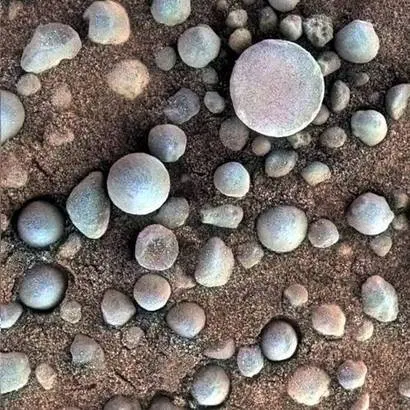
The blueberry stones found on Mars are accepted as remarkable geological evidence that Mars was once very rich in water. Yet, this has created a new contradiction. Hematite, the main component of these blueberry stones, is a chemical that forms in environments without water. It consists only of iron and oxygen and does not require water; in fact, it forms more readily in dry environments. This means that the presence of vast amounts of hematite implies that this region was without water for a long time. However, the presence of these masses of round stones simultaneously implies that water was very abundant. This feels like a deeply perplexing contradiction.
This contradiction led astronomers to suspect that the true reason for Mars' red color might not be simple hematite, which corresponds to rusted iron. Humans have not yet visited Mars in person. We only infer the state of Mars indirectly through Martian meteorites that occasionally fly to Earth. But thanks to the rovers that have traversed Mars over the past several decades, we are now able to simulate the Martian environment in laboratories to a certain extent.
Based on data from probes like MRO, ExoMars, and Mars Express, astronomers analyzed which mineral compositions best recreate the actual observational data of Mars. They created various "recipes" for producing iron-containing red components in laboratory settings and then analyzed them using the same equipment that the Mars landers used. The results were quite unexpected.
A new candidate emerged that describes the actual Martian data with a higher probability than hematite, the classic candidate long thought to be the culprit behind Mars' red color. That candidate is a different type of iron oxide called ferrihydrite. Astronomers discovered that a recipe combining basalt and ferrihydrite in a roughly 2:1 ratio best reproduces the actual data. Ferrihydrite has an important difference from hematite: it contains water (H2O) in addition to iron and oxygen. While hematite—the previous candidate—forms well in very dry and warm environments, ferrihydrite forms more easily in relatively low-temperature environments where water flows.
Interestingly, in this study, astronomers also showed that soil very similar to the samples created with this recipe already exists on Earth. Examples include the red components created where water droplets fall on the floor of a cave in Portugal, and red rocks formed in flowing streams on Block Island in the United States. These red rocks formed where water flowed, but they are not found in the areas right next to them where water did not flow.
This offers a decent alternative for those who want to go to Mars but are sadly trapped on Earth. You don't have to go far. Visit a corner of a cave in Portugal or a stream on Block Island in the U.S. and touch the red rocks. It is the same as touching the red rocks of Mars with your hands. Even if you went to the real Mars, you wouldn't be able to take off your spacesuit, so you couldn't touch the Martian surface with your bare hands anyway. In fact, these places might be where you can feel the texture of Mars most authentically!
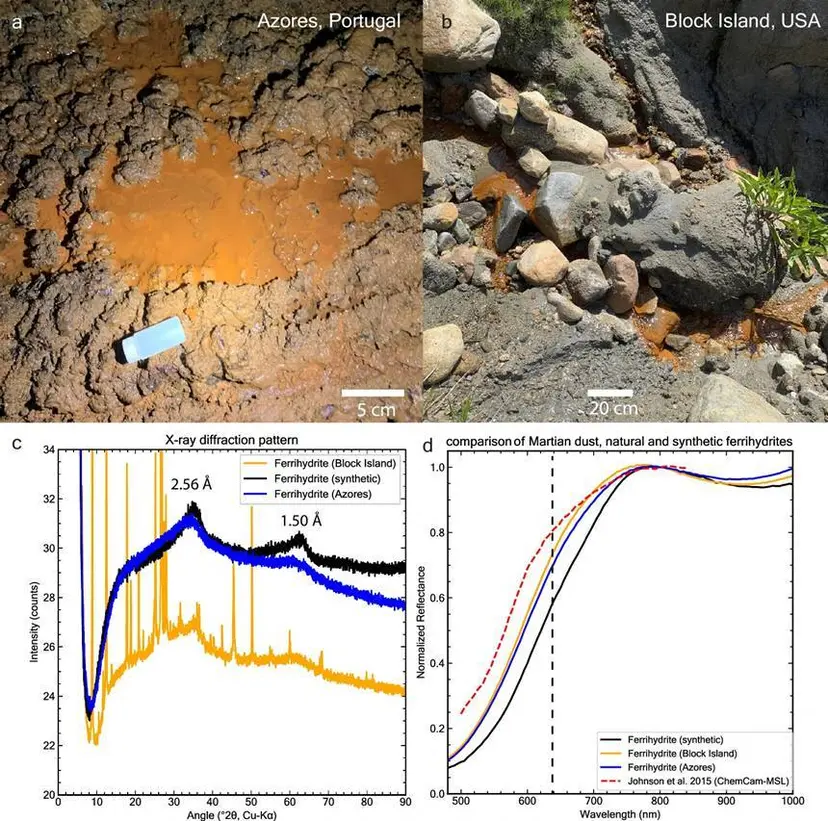
Ferrihydrite can only be formed when there is abundant water as well as oxygen in the air. Therefore, if the study's result—that Mars' red color is due to ferrihydrite rather than hematite—is true, Mars may have actually been much richer in water and oxygen than we had vaguely expected. This leads us to consider the possibility that until hundreds of millions of years ago, Mars may have harbored diverse life forms and an ecosystem comparable to Earth's.
Furthermore, if Mars was not a red, parched world from the moment of its birth but had a fertile period rich in water and oxygen, then the perspective on Mars terraforming must also change significantly. It should be viewed not as a massive development project to create a habitable environment for the first time on a planet that has never held water and oxygen, but as a massive restoration project to return Mars to its brilliant original state, having been temporarily parched.
Ultimately, to know the exact reason why Mars is red and whether we can truly go there to live, the only way is to go to Mars ourselves and bring back samples. Indeed, our understanding of the Moon took a great leap forward through the Apollo missions of the 1960s and 70s. It is no exaggeration to say that most of our current understanding of the Moon's origin comes from the precise analysis of various lunar rock samples brought back by astronauts themselves.
Likewise, astronomers are slowly preparing for a historic mission to bring samples back directly from Mars. An advance team has already been on Mars for a long time. The Perseverance rover is busy collecting Martian samples in small capsules while drilling holes all over the planet. Astronomers plan to send a follow-up team to Mars around 2030. Perseverance will hand over the collected capsules to the follow-up team, and those capsules will be loaded onto a small rocket, launched like a missile, and returned to Earth.
If this historic mission, "Mars Sample Return," is successful, although we may still be trapped on Earth, we will be able to hold in our hands the red soil and rock samples scooped up directly from Mars. Unfortunately, the mission is currently suspended due to budget issues, but I hope that all obstacles will be overcome and the Martian treasures collected by Perseverance will be recovered for Earth's laboratories. We just need to wait a little longer to see whether the capsules that arrive via "rocket delivery" through the Mars Sample Return mission will contain desperate news or new hope for those who dream of Mars terraforming.
Reference
https://www.nature.com/articles/s41467-025-56970-z
Who is the author, Woong-Bae Ji? He loves cats and space. After watching "Galaxy Express 999" as a child, he dreamed of making the beauty of the universe known to the world. He currently researches the evolution of galaxies through interactions at the Center for Galaxy Evolution Research and the Cosmology Lab at Yonsei University, and engages in various science communication activities including lectures and writing. He has authored books such as "The Observatory Where We Flirt," "Thinking About the Universe All Day," and "Stars, the Science of Light."