

[비즈한국] The Korea Art Promotion Project, which began as an initiative solely to support artists, has now spanned 10 years. Keeping true to our initial intentions, we have supported over 230 artists. This was a unique undertaking, one that no media outlet, cultural organization, or government agency in Korea had ever attempted. We take pride in the fact that this decade of persistence has become a value etched into the 21st-century Korean art scene. Thus, it is recognized that the '10-year history of the Korea Art Promotion Project has created a vantage point for observing the flow of contemporary Korean art.' Now, in Season 11, we aim to pave another path for Korean art.
One of the oldest philosophical themes in Eastern philosophy is the 'Butterfly Dream,' commonly referred to as 'Zhuangzi's Dream.'
Once upon a time, Zhuang Zhou dreamt he was a butterfly.
Flitting about, enjoying himself as a butterfly,
he was unaware that he was Zhuang Zhou.
But suddenly, he awoke, and there he was, undoubtedly Zhuang Zhou.
Was it Zhuang Zhou who dreamt he was a butterfly?
Or was it a butterfly now dreaming it is Zhuang Zhou?
Between Zhuang Zhou and the butterfly, there is, at first glance, a distinction,
but it is not an absolute transformation.
Such a transition is called the transformation of all things.
The question of where I am—in a dream or in reality—has been a long-standing theme in art. This is because while our bodies exist in reality, our minds often drift toward dreams. For this reason, it has served as a source of inspiration for many artists, and continues to do so today.
Dreams are, in a sense, virtual reality. Therefore, throughout history in both the East and West, dreams have been treated as important subject matter, giving birth to many masterpieces. Among works themed around virtual reality, An Gyeon’s ‘Mongyu Dowondo’ (Dream Journey to the Peach Blossom Land), which appears in the opening chapter of the history of Joseon painting, comes to mind as a familiar example.

An Gyeon, regarded as the greatest painter of the early Joseon period, is said to have painted this work in just three days after being asked by his patron, Prince Anpyeong, to depict a dream he had. What kind of dream was it? According to records, it went like this:
Prince Anpyeong, accompanied by friends, followed a stream where peach blossoms were floating upstream, leading to a path of rugged mountains and hills. After crossing high peaks and steep ridges formed by strange rocks, he discovered a cozy village in full peach blossom bloom. There were no people there, only empty houses and empty boats. He had seen the Peach Blossom Land (Shangri-La) in his dream.
Then, where was this Peach Blossom Land that Prince Anpyeong dreamed of? He was a tragic prince born as the third son of King Sejong who was sacrificed after clashing with his older brother, Prince Suyang (King Sejo). Could it have been that his political ambition, veiled by his love for the arts, was the true source?
In Western art, the use of dreams as an artistic subject in their own right began with Surrealism. It expanded the territory of contemporary art by unraveling the imaginary worlds impossible in reality into various virtual realities of dreams.
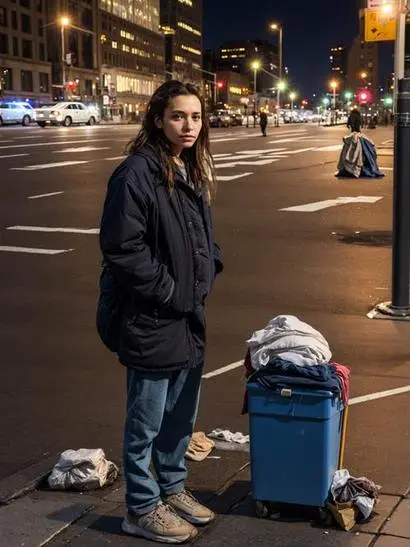
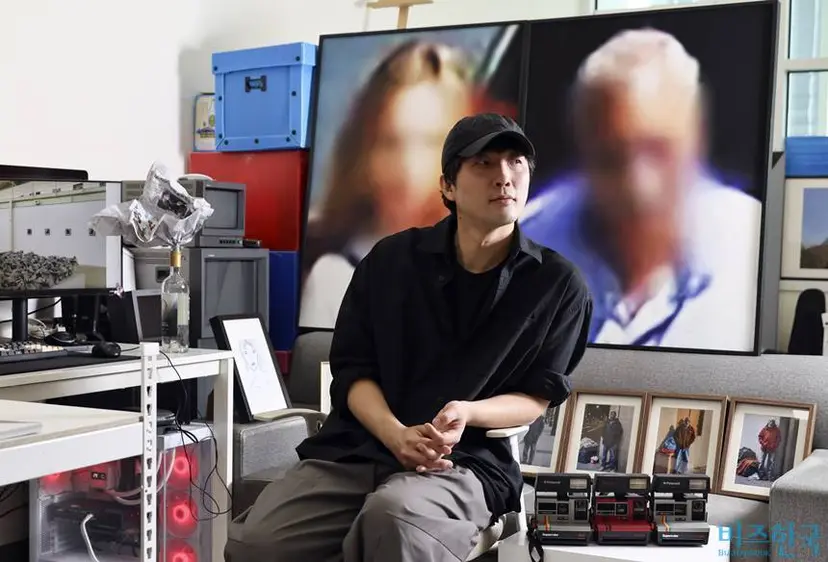
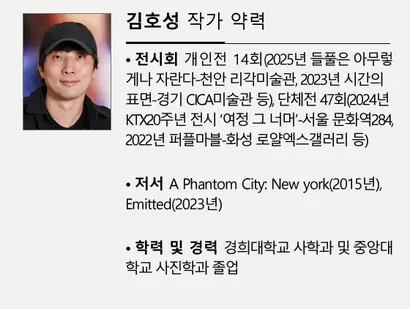
Artist Kim Ho-sung grafts the meaning of virtual reality onto reality through his photography. His subject is the internet world, which is composed of virtual reality. From the internet, filled with an infinite array of images, he collects and reinterprets images that fit his intentions.
He also assembles new images using artificial intelligence, which is being highlighted as a new artistic language of the 21st century. It is a process of infusing actual sense of reality into virtual reality; they look like the reality of Street View, but they are virtual images. At other times, he extracts figures from actual street images on the internet and recreates them as blurred, indistinct images.
Through this, he expresses actual reality as if it were virtual, and virtual reality as if it were actual. It is, in a sense, a conceptual body of work that translates ‘Zhuangzi’s Dream’ into the internet language of our era.