

[비즈한국] A playing partner’s ball lost its way and vanished into the woods. “Is that OB?” “Is it a hazard?” the golfer asks. “No, our course doesn’t have out-of-bounds,” the caddie replies. After confirming the existence of a designated penalty area tee (a 'special tee'), the golfer heads toward it.
In fact, the golf term “hazard” is an obsolete relic of the past. “Penalty area” and “penalty area special tee” are the correct terms, yet “hazard” remains more familiar and frequently used by many golfers. On a par 5 measuring roughly 460 meters, the “penalty area special tee” was located a little over 200 meters from the green.
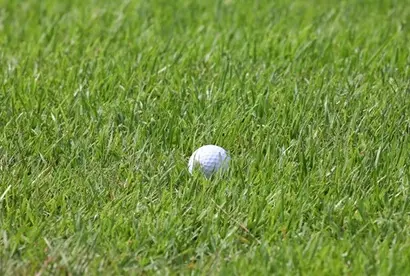
The playing partners chime in: “Why is the special tee so far forward?”, “It’s barely different from where my 3rd shot should be...” The golfer took a 1-stroke penalty and played their 3rd shot from the special tee. Unlike the tee shot, the 3rd shot hit with a satisfying sound, drew a beautiful arc, and landed on the green. It’s a birdie chance. The reaction of the partner shouting, “Nice shot, birdie chance!” feels somewhat bitter, given that the person who lost their tee shot is the one with the birdie chance. This is not a made-up story. It actually happened during a round at a golf course in Icheon.
In recent years, many “hotspots” have emerged on golf courses. These are the “OB hotspots” and “hazard hotspots.” Compared to the past, OB areas have noticeably decreased. White stakes are disappearing from courses, being replaced by red ones. Hasn’t there been a time when you were both baffled and relieved that what was an OB in your last round had been changed to a penalty area?
One recent trend in golf course design is shortening the length of the “Red Tee” for women golfers and converting areas where a ball cannot be found or played from OB to penalty areas. In reality, both OB and penalty areas incur a 1-stroke penalty, but for OB, you must play your 3rd shot from the original spot, while for a penalty area, you drop the ball according to options and play your 3rd shot. If you play from a special tee, the penalty perceived by the golfer could be considered 2 strokes for OB and 1 stroke for a penalty area.
Golf courses that don't produce good scores are unpopular with golfers. It’s no wonder people say the best season for golf is “when I’m playing my best” and the best golf course is “the course where I get the best score.” With the situation as it is, even if you lose about 10 balls, you can finish with a bogey by taking shots from a penalty area—where it’s often possible to hit a 3rd shot even with a wedge—and finishing with two putts. You can send your ball into a penalty area once every two holes and still play a “bogey round” despite the penalties. While it seemed obvious that the results would be vastly different between someone who sent their ball to the fairway with a tee shot and someone who sent it into a penalty area, they end up putting for the same number of strokes on the green.
The 17th hole at the TPC Sawgrass Stadium Course, home of the “Fifth Major” The Players Championship, is a roughly 140-yard island par 3. Because of the narrow green, players donate many balls to the water every year. And they head to the “drop zone,” or what we call a special tee. Even from the special tee, which is only about 80 meters away—not the spot where the ball entered—they still make mistakes. An Byeong-hun once hit an 8-over on this hole.
The par 3 penalty area special tee at a certain golf course in Gyeonggi-do is right next to the green. If you’re used to putting from off the green, you can even putt from there. Golfers sometimes use these special tees to save their scores, but there is a strong suspicion that they exist primarily for “pace of play.” To accommodate more golfers, rapid progress is necessary, and the “special tee” is a major contributor to this swift pace. Seeing that prestigious golf courses often operate without special tees makes that suspicion feel more like certainty.
If special tees are necessary to help golfers have an enjoyable and smooth round, they shouldn’t be placed excessively close to the green. Seeing a playing partner prepare for a shot from a special tee dozens of meters ahead—even after having hit a tee shot that landed well on the fairway before ending up in the water—makes me wonder if this game is truly “fair.” Whether it’s a white special tee or a red one, shouldn't they be placed based on the average distance of weekend golfers?
Golf courses are “hotspots” in many ways. They are sky hotspots and cloud hotspots. They are grass hotspots, tree hotspots, and photo hotspots. There are also many real restaurants around golf courses. Is it really necessary to have “OB hotspots” and “penalty area hotspots,” too?
Who is the author, Kang Chan-wook?
An advertiser and writer. He began his career as a copywriter at Cheil Worldwide and is currently the CEO of the video production company 'Era's Perspective' (Sidae-ui Siseon). A golf enthusiast, he holds a USGTF teaching professional certification. Driven by his love for writing, he has published golf books including 'The Joy of Golf', 'Bad Golf', 'Sincere Golf', and 'Golf Thoughts, Thinking Golf'. He runs the YouTube channel 'Bad Golf', where he shares various stories and reflections on golf with readers and viewers.