

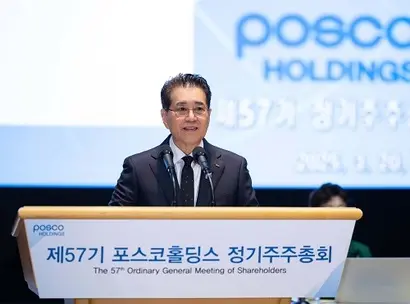
[비즈한국] It has been confirmed that a segment of POSCO Holdings005490 under the Future Technology Research Institute has undergone a name change. The term "energy" is now being used in place of "secondary battery." This has led to speculation that while the POSCO Group's secondary battery research may be concentrating under its dedicated subsidiary, POSCO Future M003670, POSCO Holdings might be pivoting to research a broader range of energy-related fields. However, POSCO Holdings maintains that this is merely a name change and that its roles remain the same. As POSCO Holdings is listed on the New York Stock Exchange and POSCO Future M on the KOSPI, any changes to research and business operations can be sensitive matters for shareholders.
Last year, the POSCO Holdings Future Technology Research Institute housed research organizations including the Secondary Battery Materials Research Institute, the AI & Robot Convergence Research Institute, and the Hydrogen & Low-Carbon Research Institute. Among these, it has been confirmed that the Secondary Battery Materials Research Institute was renamed the Energy Materials Research Institute starting this year. The existing Secondary Battery Materials Research Institute previously consisted of the Secondary Battery Research Planning Group, the LiB (Lithium-ion Battery) Materials Research Center, the LiB Raw Materials Research Center, the LiB Recycling Research Center, and the Research Infrastructure Group. However, since being changed to the Energy Materials Research Institute this year, its subordinate organizations have also been reorganized into the Energy Materials Research Planning Group, the LiB Materials Research Center, the LiB Recycling Research Center, and the Research Infrastructure Group.
A closer look at the changes reveals that "secondary battery materials" has been replaced with "energy materials." Since secondary battery materials fall under the umbrella of energy materials, "energy materials" is a broader concept. This has fueled projections that the POSCO Holdings Future Technology Research Institute may be moving away from a narrow focus on secondary battery research toward broader energy research. The LiB Raw Materials Research Center has also disappeared from the organizational chart.
Furthermore, there is talk of the possibility that POSCO Group may entrust secondary battery research entirely to POSCO Future M. POSCO Future M is responsible for the group's secondary battery business. In fact, starting this year, POSCO Future M has been reorganizing its research structure, including merging its Energy Materials Research Institute and Basic Materials Research Group to be placed directly under the CEO to secure technical prowess and strengthen R&D functions.
The POSCO Group maintains that the name change holds no special significance. A POSCO Holdings official explained, "It is a simple name change, and the functions remain the same. There is no particular reason for the change, and names are occasionally adjusted during organizational restructurings."
Separately, it is true that POSCO Holdings has recently been throwing its weight behind POSCO Future M. On May 13, POSCO Holdings announced a plan to provide a capital increase of 922.6 billion KRW to its subsidiaries in charge of the secondary battery business. Specifically, it plans to invest 525.6 billion KRW in POSCO Future M, 32.8 billion KRW in POSCO Pilbara Lithium Solution, and 6.9 billion KRW in POSCO GS Eco Materials. POSCO Future M intends to use the funds raised through this capital increase to complete investment projects and strengthen its manufacturing competitiveness in secondary battery materials.
This atmosphere stands in stark contrast to last year. Last year, POSCO Future M delayed or withdrew a number of secondary battery-related projects. POSCO Future M is currently building artificial graphite anode manufacturing facilities in Pohang. While the company initially planned to produce 18,000 tons (t) of anode materials annually at this facility, it disclosed in August last year that it had reduced the production scale to 13,000 tons. Subsequently, in September of last year, it withdrew plans for a joint venture precursor factory with China's Huayou Cobalt.
In 2022, POSCO Future M announced that it would establish a cathode material factory in the U.S. in partnership with GM. The joint venture factory was scheduled to be completed by September of last year. However, the factory has yet to be completed, and no expected completion date has been set. In September of last year, POSCO Future M disclosed that it was "adjusting the completion schedule due to local circumstances."
Additionally, in February this year, POSCO Future M sold its entire stake in P&O Chemical to OCI. P&O Chemical was a joint venture established by POSCO Future M and OCI in 2020, with POSCO Future M holding a 51% stake and OCI holding 49%. While P&O Chemical is a hydrogen peroxide manufacturer, it has also been pursuing pitch production. Pitch is a material used to coat the surface of anode materials.
Since taking office in March last year, POSCO Group Chairman Jang In-hwa has consistently mentioned secondary batteries as a future growth engine. At the time of his inauguration, Chairman Jang stated, "We will cultivate the secondary battery materials business into a definitive growth engine by securing fundamental competitiveness that meets market value." However, the group’s actions last year were far from strengthening the secondary battery business. Each time it delayed or withdrew secondary battery investment plans, the group explained it was "adjusting speed due to the EV chasm (a temporary demand slowdown)."
This year, the atmosphere is different as POSCO Future M reorganizes its research structure and proceeds with capital increases. Even for Chairman Jang, it seems difficult to further delay investments if he is to deliver results during his tenure. Chairman Jang’s term lasts until March 2027. POSCO Holdings stated, "We are pursuing participation in the capital increase to complete investment projects at our business entities in preparation for the full-scale growth of the market after the chasm, to secure the future competitiveness of the group's secondary battery materials business through financial structure improvement, and to strengthen responsible management for core businesses."
Despite support from POSCO Holdings, there are strong opinions that success for POSCO Future M cannot be guaranteed. Lee Yong-wook, an analyst at Hanwha Investment & Securities, analyzed, "POSCO Future M previously conducted a 1 trillion KRW capital increase in November 2020, and at that time, earnings forecasts were upgraded along with investment expansion. However, currently, earnings forecasts are being downgraded due to investment cutbacks and low utilization rates among automakers, battery manufacturers, and material companies."