

[비즈한국] An investigation by BizHankook has confirmed that in the month following the Seoul Metropolitan Government's expansion of land transaction permit zones, apartment trading volume in the affected areas has dropped significantly, while sale prices have actually risen. After lifting the land transaction permit zone status in the Gangnam area last February, the Seoul Metropolitan Government reversed its decision just one month later in March and expanded the permit zones after seeing a sharp spike in trading volume and housing prices. Since then, trading volume in these areas has plummeted by approximately 92%, effectively drying up the market, while average sale prices have continued an upward trend, rising by about 29%.
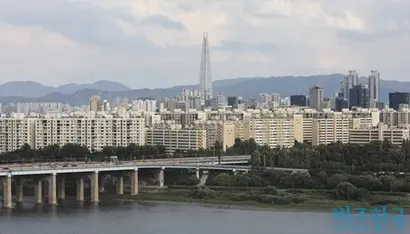
According to an analysis of Ministry of Land, Infrastructure and Transport real transaction data (as of the 24th) by BizHankook, apartment trading volume in Gangnam-gu, Seocho-gu, Songpa-gu, and Yongsan-gu totaled 234 transactions during the one-month period from March 24, when Seoul expanded the land transaction permit zones, to April 23. This marks a decrease of 2,780 transactions (92%) compared to the previous month. During this period, trading volume by district was 87 in Gangnam-gu (-849, -91%), 36 in Seocho-gu (-679, -95%), 89 in Songpa-gu (-970, -92%), and 22 in Yongsan-gu (-282, -93%), with Seocho-gu showing the largest rate of decline. The deadline for reporting real estate transactions is 30 days from the date of contract; therefore, transactions made on April 23 must be reported by the 23rd of this month.
Conversely, the average sale price of apartments in these areas rose by approximately 29% over the same period. In the month immediately following the expansion of the land transaction permit zones, the average apartment sale price in Gangnam-gu, Seocho-gu, Songpa-gu, and Yongsan-gu was 3.08468 billion KRW, an increase of 695.27 million KRW (29%) compared to the month immediately preceding the designation (2.38941 billion KRW). During this period, average sale prices by district were 2.21233 billion KRW in Seocho-gu (-22%), 2.08067 billion KRW in Songpa-gu (+12%), and 2.31 billion KRW in Yongsan-gu (-3%), with Gangnam-gu showing a particularly notable rise to 4.66863 billion KRW (+76%).
Seoul’s land transaction permit zones were expanded two months ago. On March 19, the Ministry of Land, Infrastructure and Transport and the Seoul Metropolitan Government announced a plan to stabilize the housing market, stating that they would expand the land transaction permit zone to include all apartments (110.65㎢) in Gangnam-gu, Seocho-gu, Songpa-gu, and Yongsan-gu for six months, from the 24th of that month until September 30. This included the areas of Jamsil, Samseong, Daechi, and Cheongdam-dong, which had been lifted from permit zone status just one month prior, and expanded the scope to include the entire Yongsan-gu district along with the autonomous districts previously exempted.
The expansion of the land transaction permit zones was effectively a policy reversal after only one month. Previously, the Seoul Metropolitan Government had lifted the land transaction permit zone status for the Gangnam area on February 13. This applied to 291 out of 305 apartment complexes in Daechi, Samseong, and Cheongdam-dong in Gangnam-gu and Jamsil-dong in Songpa-gu, near the International Exchange Complex. However, 14 apartment complexes currently undergoing reconstruction in these areas were excluded from the exemption due to the possibility of speculative activity. On that day, the Seoul Metropolitan Government also immediately lifted the permit zone status for 6 sites that had completed the approval for forming a housing association out of 123 projects under the Rapid Integrated Planning for reconstruction and redevelopment.
However, immediately following the lifting of the permit zones, trading volume and housing prices soared, particularly in the exempted areas. An analysis by BizHankook of apartment sales in the exempted areas of Samseong, Daechi, Cheongdam, and Jamsil-dong between February 13 and March 14 (based on reports completed by the 16th) showed that there were 162 transactions, an increase of 85 (110%) compared to the 30 days prior to the exemption. Transactions that set new record-high prices for the same complex and area accounted for 90 cases, or 49% of the total. Consequently, the Seoul Metropolitan Government expanded the land transaction permit zones, citing rising housing prices.
As housing prices continued their upward trend despite the expansion of the land transaction permit zones, the government is considering further designations. During the 16th Real Estate Market and Supply Situation Inspection Task Force (TF) meeting held on the 23rd, the government stated, "If necessary, we will devise market stabilization measures, such as additional designations of adjustment target areas, speculative districts, and land transaction permit zones." The meeting was attended by officials from the Ministry of Economy and Finance, the Ministry of Land, Infrastructure and Transport, the Financial Services Commission, the Seoul Metropolitan Government, the Bank of Korea, and the Financial Supervisory Service, who noted that volatility in housing prices has slightly increased in Seoul, including in Yongsan and the three Gangnam districts (Gangnam, Seocho, and Songpa).
The land transaction permit system requires permission from the head of a local government to trade land above a certain size in areas where speculative transactions are prevalent or land prices are rising rapidly, or where there is a concern for such issues. Since only purchases intended for actual residence for two years or more are permitted for housing, "gap investment"—buying a house while burdened with existing tenants—is effectively impossible. Currently, Seoul's land transaction permit zones cover a total of 164.06㎢ (27% of Seoul's area), including apartments in Gangnam, Seocho, Songpa, and Yongsan-gu (110.65㎢), 14 apartment complexes in the International Exchange Complex (1.36㎢), and major reconstruction/redevelopment sites such as Apgujeong-dong in Gangnam-gu, Yeouido-dong in Yeongdeungpo-gu, Mok-dong in Yangcheon-gu, and Seongsu-dong in Seongdong-gu (4.58㎢).