

[비즈한국] A review of the changes in investment properties held by major commercial and regional banks over the past nine years shows that KB Kookmin Bank, the leading bank, has significantly reduced its investment property portfolio. As banks accelerated the closure of physical branches, financial authorities eased regulations on the leasing of bank-owned properties through an amendment to the Enforcement Decree of the Banking Act in 2016. Some banks have taken advantage of this to increase their investment properties and generate steady rental income.
Bank investment properties refer to land and buildings held for the purpose of generating rental income or capital gains. When a building formerly used as a branch is repurposed due to closure or other reasons, it is classified as investment property for accounting purposes. Regulations on bank-owned properties (business and non-business) were significantly relaxed in 2016, during the tenure of Financial Services Commission Chairman Yim Jong-yong, who is currently the Chairman of Woori Financial Group.
Previously, banks were required to maintain a 50:50 ratio between branch operations and rental space in their branch buildings. At the end of 2014, regulations on business properties (branches, training facilities, welfare facilities, etc.) were eased once, allowing the leasable area to increase to up to nine times the area used directly for branch operations. Subsequently, with the amendment of the Banking Act Enforcement Decree on July 30, 2016, the clause limiting the leasable area was removed entirely.
Following the legal amendment, banks became able to reduce branch space and increase leasable space, or rent out additional space created through building expansions or renovations. As the number of bank branches decreased by 100 to 200 each year, financial authorities essentially paved the way for banks to use their real estate for profit, stating that "flexible and efficient branch operations and profitability enhancement are possible according to a bank's business strategy."
Regulations regarding the handling of properties after branch closures were also eased. Previously, if a branch became a non-business property due to closure, it could not be leased and had to be disposed of within one year. After the amendment, the disposal deadline was extended to three years, and leasing became permitted depending on market conditions.
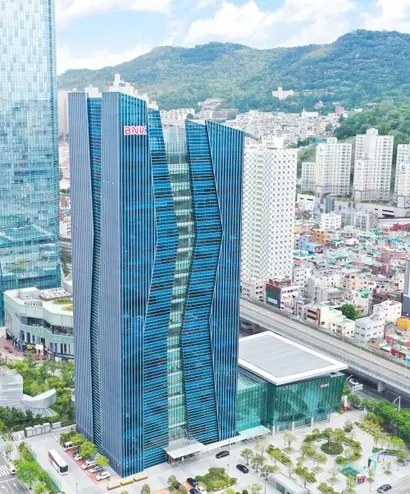
A review of the investment property status (on a consolidated basis) of 10 major commercial and regional banks (Kookmin, Nonghyup, Gwangju, Kyongnam, Busan, Shinhan, iM, Woori, Jeonbuk, and Hana Bank) from 2016, when regulations were eased, to last year shows that Busan Bank had the highest growth rate over nine years. Busan Bank's investment properties increased by 126.5% from 84 billion won in 2016 to 190.3 billion won in 2024. In particular, it surged from 80.4 billion won in 2016 to 133.5 billion won in 2017.
Along with this, rental income also grew. According to Busan Bank's business reports, investment property rental income increased from 900 million won in 2016 to 1.9 billion won in 2018, 2.4 billion won in 2020, 2.6 billion won in 2022, and reached 4.6 billion won last year.
On the other hand, despite being regional banks, the investment properties of Kyongnam Bank, Jeonbuk Bank, and Gwangju Bank actually decreased. Kyongnam Bank’s holdings rose from 21.8 billion won in 2016 to 30 billion won in 2019, then fell to 29.8 billion won in 2024. Jeonbuk Bank’s holdings fell continuously from 24.5 billion won in 2016 to 11.9 billion won in 2024, and Gwangju Bank’s from 12.6 billion won to 7.6 billion won.

The trend in investment property holdings among the major commercial banks (KB Kookmin, NH Nonghyup, Shinhan, Woori, and Hana Bank) is also noteworthy. While most hold investment properties in the range of 500 billion to 600 billion won, Kookmin Bank, the industry leader, shows a noticeably lower figure. As of the end of 2024, Kookmin Bank's investment properties stood at 125 billion won, a 64.0% decrease compared to the previous year (347.5 billion won). Even compared to 2016 (257.9 billion won), the figure has been cut by more than half. Kookmin Bank had increased its investment properties to 476 billion won in 2019 but has since maintained a level in the 300 billion won range.
According to Kookmin Bank's business report, it disposed of 172.9 billion won worth of land and 64.9 billion won worth of buildings in 2024. However, there was no major difference in rental income. Kookmin Bank stated in its business report that its rental income was 6.8 billion won in 2024 and 6.4 billion won in 2023.
As for the other four commercial banks, Hana Bank had the largest investment property portfolio in 2024 at 677 billion won, followed by Shinhan Bank (621.3 billion won), Nonghyup Bank (611.3 billion won), and Woori Bank (523.1 billion won). Nonghyup Bank and Shinhan Bank have held investment properties in the 600 billion won range (647.7 billion won and 675.1 billion won, respectively) since 2016, maintaining them without major fluctuations.
Woori Bank and Hana Bank have actively expanded their scale. Woori Bank, which had only 358.5 billion won in investment properties in 2016, began to increase them starting in 2019 (617.6 billion won). Hana Bank significantly increased its holdings from 555.2 billion won in 2016 to 786.2 billion won the following year, and even recorded nearly 800 billion won (790.7 billion won) in 2021.
Interestingly, Woori Bank surpassed Hana Bank in rental income. Woori Bank’s rental income grew steadily from 5.1 billion won in 2018 to 19.9 billion won in 2019, and 35.1 billion won in 2022. Conversely, Hana Bank’s rental income hit 17 billion won in 2018 but dropped to 8.5 billion won in 2020. In 2024, it remained at just 10.2 billion won.
It is noteworthy that while the scale of investment properties varies by bank, the speed of branch closures is similar. In the case of Busan Bank, which increased its investment properties, the number of branches decreased from 194 in 2016 to 138 in 2024. Conversely, even though Kookmin Bank reduced its investment property scale, its branches decreased from 1,005 to 703 during the same period. Here, "branches" refer to full-service branches, not small offices that only provide limited services like deposits. The banking sector is currently trending toward merging branches and downsizing some into smaller offices. An industry official said, "It appears that they are managing real estate with a focus on efficiency rather than profitability."