

[비즈한국] As deregulation of virtual assets and investor protection emerge as key agendas for the June 3 presidential election, discussions on introducing a "Won-based stablecoin" are gaining rapid momentum. Following a related debate during the first presidential candidate forum, the Democratic Party of Korea is preparing to propose a "Digital Asset Basic Act" to incorporate digital assets into the institutional framework. This bill focuses on establishing issuance standards for Won-pegged stablecoins, as well as criteria for exchanges and custody.
Concerns that the proliferation of Dollar-pegged stablecoins could lower the value of the Korean Won and undermine the effectiveness of monetary policy have strengthened the call for a legal framework. However, the market competitiveness of a Won-pegged stablecoin and the effectiveness of institutional mechanisms for user protection remain to be verified. There are also doubts about whether these campaign promises will actually be implemented after the election.

'Stablecoin' Takes Center Stage in Presidential Race
While the Trump administration in the U.S. seeks to strengthen the status of the dollar as a reserve currency through "Dollar-based stablecoins," domestic politicians in the presidential race are also taking steps to court investor votes.
Stablecoins moved to the center of the presidential campaign after Democratic Party candidate Lee Jae-myung proposed creating a Won-based stablecoin. In a live talk show with economic YouTubers on the 8th, candidate Lee said, "We must quickly enter the stablecoin market to avoid being marginalized and to prevent the outflow of national wealth."
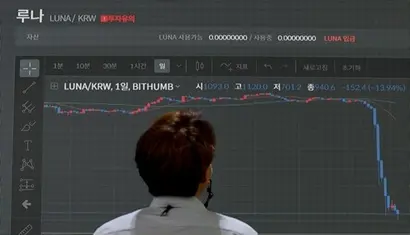
A stablecoin is a virtual asset issued at a fixed value tied to existing fiat currency. Because its value remains constant and it faces fewer regulatory burdens than traditional currency, it is used in the virtual asset market as a means of providing liquidity and avoiding risk. Prime examples include the Dollar-pegged Tether (USDT) and Circle (USDC), which are pegged at 1 dollar per coin. These are distinct from algorithmic stablecoins like Terra, which maintain value through token burning and issuance algorithms via Luna without holding actual dollar deposits.
At the first presidential candidate debate on the 18th, a war of nerves unfolded over the stablecoin pledge. Candidate Lee Jae-myung stated, "Creating a Won-based coin means we will allow the issuance of coins only if there is collateral deposited for that amount," adding, "It has stability." Reform Party presidential candidate Lee Jun-seok countered sharply, saying, "Talking about it without a concrete strategy for stablecoins only serves to stir up the market, much like pump-and-dump stock manipulation."
"Preventing Wealth Outflow": Democratic Party Puts Stablecoin Policy to the Forefront
The Democratic Party is strongly pushing for the incorporation of Won-pegged stablecoins into the institutional system. This stems from the view that it can overcome exchange rate uncertainty and secure competitiveness in the global virtual asset market. On the 21st, Representative Min Byung-duk held a policy seminar on stablecoins at the National Assembly, stating, "In this era of financial paradigm shift, a Won-pegged stablecoin can possess sufficient competitiveness. Whether we become a passive recipient or a leader of the global order depends on our current response." Representative Min, classified as a 'pro-Lee' figure, serves as the chairman of the Digital Asset Committee under the Democratic Party's election committee. He is preparing to propose the Digital Asset Basic Act, of which a draft was released last month.
The background to the Democratic Party's focus on stablecoins lies in the U.S. Trump administration's virtual asset policy. The Trump administration is putting stablecoins at the forefront based on a strategic judgment to maintain U.S. monetary hegemony even in the digital age. This is because the more Dollar-pegged stablecoins issued by the private sector are used for global transactions and settlements, the greater the influence of the dollar becomes in the digital sphere.
Here, concerns about the outflow of Korea's national wealth are raised. If Dollar-pegged stablecoins become the standard for global transactions, domestic investors and companies will also use the dollar for digital asset transactions. In this case, the demand for and influence of the Korean Won will weaken, and domestic capital will likely be converted into digitized dollars and flow overseas.
A Strategy to Protect Monetary Sovereignty? Policy Implementation and Systematic Frameworks Remain to be Seen
Such concerns cannot be dismissed as mere apprehension. As of the end of March this year, Tether directly holds $98.5 billion (approx. 137 trillion KRW) in U.S. Treasury bonds. Circle holds about $21 billion (approx. 29 trillion KRW); the combined direct holdings of the two issuers ($119.5 billion) are comparable to Korea's holdings of U.S. Treasuries ($125.8 billion, or approximately 173 trillion KRW).

Tether and others were initially used as trading tools in the virtual asset market, but their use has recently expanded to the realms of payments and remittances. Debit cards issued by U.S. card company Visa and Hong Kong virtual asset payment company RedotPay are already usable in Korea. They function by allowing users to top up with stablecoins, Bitcoin, or Ethereum.
Seo Byung-yoon, head of the Future Finance Research Institute at DSRV, a blockchain validator company, explained, "If stablecoins become used in daily life, there is an absolute need for fiat currency on-chain that can exchange these dollars on the other side. In Singapore and Hong Kong, stablecoins based on the Singapore Dollar and Hong Kong Dollar fulfill this role. Issuing a Won-pegged stablecoin is necessary if only to prevent the outflow of national wealth."
Experts explain that the vitalization of stablecoins is deeply related to monetary sovereignty. Kim Gap-lae, a senior research fellow at the Korea Capital Market Institute, pointed out, "A Won-pegged stablecoin could serve as a defensive shield against problems like the weakening of monetary policy and capital flight caused by Dollar-pegged stablecoins." Lee Seung-seok, a senior research fellow at the Korea Economic Research Institute, stated at the 'Digital Asset Expert Panel Seminar' held by the Korea Enterprises Federation on the 19th, "If Dollar-pegged stablecoins become established as a payment method in Korea, it could cause structural changes to the Won-Dollar exchange rate determination mechanism. This could lead to a surge in exchange rates due to decreased demand for domestic currency and increased demand for foreign currency."
The key is whether the pledges made during the presidential race can actually be implemented as policy. Some view the market competitiveness of a Won-pegged stablecoin in the global ecosystem with reservation.
It is assessed that issuing and properly operating a Won-pegged stablecoin involves significant tasks, including legislation, establishing clear regulatory frameworks by financial authorities, and ensuring the credibility of the issuers. Lee Jung-doo, a senior research fellow at the Korea Institute of Finance, suggested, "A supervisory system that considers issuer qualifications, issuance requirements, value stability, redeemability, foreign exchange monitoring, and regulatory enforceability needs to be established."
Researcher Lee added, "For virtual assets that are easy to distribute domestically after offshore issuance, it is difficult to secure regulatory enforcement against the issuer, making international cooperation systems essential for setting regulation levels and monitoring market conditions. Organic coordination between relevant laws is necessary to prevent regulatory gaps."