

[비즈한국] Amid rising raw material and labor costs that have led to conflicts between construction firms and redevelopment sites over construction price hikes, the Yongsan Maintenance Depot District 1—which recently successfully launched the third competitive bidding for a redevelopment project this year—has included measures in its bidding guidelines to prevent future construction cost disputes. This is interpreted as a clear intent to address potential issues—such as construction cost adjustments due to inflation before breaking ground, the timing of general sales, and payment methods—at the bidding stage to prevent future conflicts.
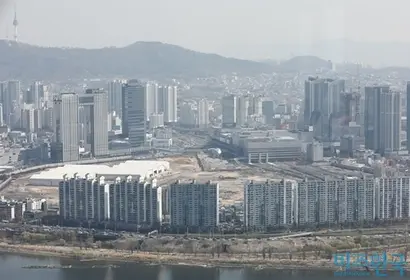
According to the maintenance industry, the union for the Yongsan Maintenance Depot Front District 1 (Yongsan Maintenance Depot District 1) in Yongsan-gu, Seoul, recently released a comparison table of bids from POSCO E&C and HDC Hyundai Development Company294870, which are participating in the selection process for the redevelopment contractor. Both companies had deposited 50 billion KRW as a bid bond by the deadline on the 15th of last month, setting the stage for a competitive bid. POSCO E&C proposed the complex name 'AUTHER Yongsan,' while HDC Hyundai Development Company proposed 'The Line 330.'
POSCO E&C holds an advantage in proposed construction costs, while HDC Hyundai Development Company has an edge in the construction timeline. POSCO E&C’s original design estimate is 861.4 billion KRW (8.65 million KRW per 3.3㎡), which is approximately 63.1 billion KRW (630,000 KRW per 3.3㎡) cheaper than HDC Hyundai Development Company's 924.4 billion KRW (9.29 million KRW per 3.3㎡). Based on the alternative designs proposed by the builders, the figures shift to 909.9 billion KRW (8.94 million KRW per 3.3㎡) for POSCO E&C and 924.4 billion KRW (8.59 million KRW per 3.3㎡) for HDC Hyundai Development Company, showing a split in superiority regarding total and unit construction costs. Conversely, regarding the construction period, POSCO E&C proposed 47 months, while HDC Hyundai Development Company proposed 42 months, which is 5 months shorter.
A notable aspect of the bidding process for the Yongsan Maintenance Depot District 1 redevelopment project is the focus on preventing construction cost disputes. The union required participating construction companies to propose detailed contract conditions, including whether construction costs would be adjusted for inflation, timing for sales and payment, whether the builder would take over unsold units, and whether design changes would be permitted due to geological condition changes. The intention is to identify potential friction points for future construction cost increases or settlement processes during the bidding stage.
Inflation-related construction cost adjustments are the most frequent cause of friction between redevelopment sites and construction firms recently. While many sites have included clauses in construction contracts prohibiting cost hikes due to inflation after the actual groundbreaking, disputes frequently arose when actual construction was delayed due to permit issues or force majeure, as there was no clear standard on how to reflect inflation. Even when both sides agreed to price increases, conflicts often occurred because they had not established which inflation index to use as a baseline.
In the Yongsan Maintenance Depot District 1 bid, POSCO E&C stated it would waive construction cost increases due to inflation for 20 months from the bidding deadline, while HDC Hyundai Development Company offered a 18-month grace period. After that, until the actual start of construction, both firms proposed applying the lower of various indices—POSCO E&C suggested the lower of the Consumer Price Index (CPI) or the Construction Cost Index, while HDC Hyundai Development Company suggested the lowest among the Construction Cost Index, the Consumer Price Index, and the adjustment index under the Act on Contracts to Which the State Is a Party.
The timing of general sales and the schedule for construction payments are also sources of dispute in redevelopment projects. Since the revenue for redevelopment unions in Korea effectively comes only from general sales, they rely on financial institution loans for a significant period until those sales occur. Depending on the timing of sales and payment, unions may have to borrow extensively to cover construction costs, which represent the largest portion of the project budget. Construction payment methods are categorized into: sales-based payment (paid as a percentage of sales revenue), progress-based payment (paid based on construction completion rate regardless of sales), and progress-based payment within sales revenue (paid based on construction progress as sales revenue is generated).
Both companies participating in the Yongsan Maintenance Depot District 1 project proposed allowing the union to choose between pre-sales (golden time sales) or post-sales. However, they differed on payment methods: POSCO E&C proposed "progress-based payment within sales revenue," while HDC Hyundai Development Company proposed "progress-based payment." Additionally, POSCO E&C offered to defer construction cost payments for 18 months after starting construction and to use its own funds to carry out the work, whereas HDC Hyundai Development Company stated it would allow 10% of the construction cost to be paid two months after completion to guarantee quality.
A representative for the Yongsan Maintenance Depot District 1 union stated, "The most frequent dispute in redevelopment sites today is the issue of construction cost hikes. Many sites are currently facing demands for increased costs from construction firms due to various factors, and the conflict is so severe that even the government and local authorities are struggling to mediate it," adding, "We intend to identify potential sources of construction cost disputes during the bidding stage to prevent them from occurring."