

[비즈한국] As Lee Jae-myung, the presidential candidate for the Democratic Party of Korea, announced his plan to push for the relocation of the headquarters of HMM011200, the nation's largest shipping company, to Busan, HMM has been drawing attention both within political circles and in the domestic stock market.
On the 14th, during a campaign rally in Seomyeon, Busan, Candidate Lee stated, "To prepare for the opening of the Arctic sea route, we need shipping companies to move in," adding, "I will ensure that HMM, the largest shipping company in the Republic of Korea, is moved to Busan." He further explained, "Of course, it won't be easy as it is a private company, but since the government holds a stake, it is not impossible if we set our minds to it. The biggest obstacle to moving the company is the employees, but it is said that the employees have agreed to it."
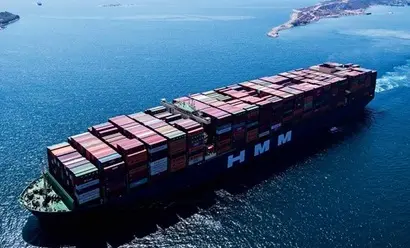
The Arctic route is a newly opening path as ice melts, and it is gaining attention because it can reach Europe ten days faster than the existing Suez Canal route. Candidate Lee emphasized that the relocation of HMM's headquarters is necessary to make Busan Port, the largest transshipment port in East Asia, the starting point for the Arctic route.
Immediately following these remarks, HMM's stock soared by as much as 3% during intraday trading, but eventually closed up 1.96% at 20,800 won.
The recent volatility in HMM’s stock price is not solely due to Candidate Lee’s remarks; rather, it is tied to the tariff war between the U.S. and China. Shipping stocks, including HMM, have fluctuated based on Trump's tariff policies. Concerns persist that tariff hikes and the imposition of port fees on Chinese-flagged vessels will lead to a slowdown in trade volume. Furthermore, predicting container shipping rates is difficult, as one cannot rule out the possibility of rate increases resulting from the reorganization of global maritime logistics networks.
Ahn Do-hyun, an analyst at Hana Securities, noted, "The forecast for annual trade volume growth this year is a mere 0%, and the global economic situation is not easy. The timing of the resumption of Suez Canal transit could also act as another variable, creating a phase where both supply and demand are difficult to predict."
HMM's stock price, which had been trending downward since March of this year, fell to an intraday low of 17,560 won on the 9th of last month as U.S.-China tariff rates rose to 125%. However, it rebounded after news broke on the 12th that the U.S.-China trade negotiations had concluded positively. The prospect of a significant reduction in high-rate tariffs mutually imposed by the U.S. and China for 90 days has led to positive outlooks for the global container shipping industry.
In addition, the performance for the first quarter of this year showed a positive trend. On the 14th, HMM announced that its first-quarter revenue was 2.8547 trillion won, up 524.8 billion won (23%) from the previous year, and its operating profit was 613.9 billion won, an increase of 206.9 billion won (51%).
However, mid- to long-term uncertainties remain. Yang Ji-hwan, an analyst at Daishin Securities, explained, "It is judged to have fared well despite the weakness in container freight rates caused by the U.S.-China tariff war. Future market conditions will be determined by U.S.-China tariff negotiations, the resulting changes in fleet deployment by global shipping lines for each route, and fluctuations in freight rates due to changes in U.S. supply." Analyst Yang added, "There are still many uncertainties to predict future market conditions, so the reliability of estimated earnings is not very high."
Lee Seo-yeon, an analyst at Sangsangin Securities, also forecasted, "Although tariffs on China have been reduced, they have not been completely resolved. The market is still keeping in mind the mid- to long-term uncertainty of tariff policies and the possibility of a slowdown in trade volume, so it is difficult to discuss a structural market rebound yet."
However, the expectation of a share buyback is acting as a factor preventing further stock price decline. HMM previously announced that it would promote a shareholder return policy worth 2.5 trillion won over the next year through dividends, share buybacks, and cancellations. Analyst Lee Seo-yeon stated, "Considering the possibility of a short-term rebound in freight rates along with expectations of HMM's share buyback, a short-term trading approach would be valid."
Hana Securities maintained a 'Neutral' investment opinion on HMM, while Daishin Securities maintained 'Market Perform' and Sangsangin Securities maintained 'Hold.' All express neutral opinions, which is effectively interpreted as a 'sell' rating in a stock market where 'buy' opinions are the majority. However, Hana Securities and Daishin Securities raised their target prices to 20,000 won and 23,000 won, respectively. As volatility due to uncertainty is expected, the opinion is that investment from a short-term trading perspective is valid.