

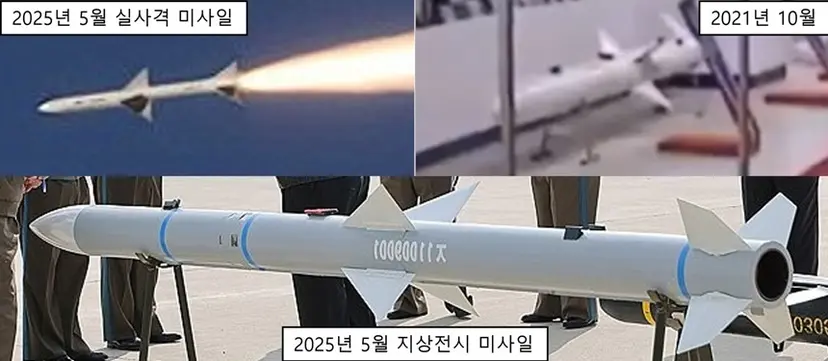
[비즈한국] On May 17, North Korea released photos of Chairman Kim Jong-un inspecting an air force air defense and strike drill. Notably, in this drill, North Korea showcased MiG-29 fighters equipped with new medium-range air-to-air missiles. Contrary to media reports, it has been confirmed that there is not just one type of missile, but two: an "older version" that was actually fired from an aircraft and a "newer version" that Kim Jong-un viewed on the ground. This reveals that North Korea has not only completed the development of medium-range air-to-air missiles—which South Korea is still in the process of developing—ahead of us, but is also producing subsequent upgraded variants.
The situation is as follows: Modern fighter jets use "short-range air-to-air missiles" to strike enemy aircraft at close range and "medium-range air-to-air missiles" to strike enemy aircraft beyond visual range. South Korea currently relies entirely on imported missiles from Germany, the UK, and the US. While domestic development is underway, both short and medium-range missiles are not expected to complete development and reach operational deployment until the 2030s.
In particular, only the United States, Russia, China, and Israel independently develop and produce medium-range air-to-air missiles, while Europe produces them through international joint development. Japan and Taiwan have developed and mass-produced them in the past but have since halted production. Turkey is the only country currently scheduled to begin development and mass production of a new medium-range air-to-air missile soon. This indicates that medium-range air-to-air missiles are considered a highly challenging technology in military science.
On May 17, when Chairman Kim Jong-un inspected an air force base at Sunchon Airfield, the North Korean Air Force showcased these medium-range air-to-air missiles. Rather than just displaying mock-ups, they conducted a live-fire interception drill using MiG-29s, where the targets were North Korea’s Geumsong-3 anti-ship missiles and unidentified target drones.
Medium-range air-to-air missiles must track targets autonomously by using their own onboard radar, much like a fighter jet. By successfully hitting small targets—which have a much lower Radar Cross Section (RCS) than aircraft—North Korea has effectively demonstrated the performance of its medium-range air-to-air missiles. With this, the North Korean Air Force has proven its capability to defend against weapons like the Hyunmoo-3 cruise missile and Haeryong ship-to-ground missiles.
There is a bigger issue—one not covered by domestic or international media—which is that the medium-range air-to-air missiles revealed by North Korea did not appear suddenly, and they are not a single type. I previously revealed in a column that North Korea first unveiled its new air-to-air missile at the "Self-Defense 2021" exhibition in October 2021, and the missile fired from the North Korean MiG-29 was identical in design to that 2021 model.
Conversely, the medium-range air-to-air missile displayed on the ground was different from the one actually fired. Missiles of this type generally feature four fins at the front and back; the missile actually fired resembled China’s "PL-11B" missile, while the one Kim Jong-un inspected on the ground resembled China’s "PL-12." The ground-displayed missile, in particular, has a structure connecting the fins to the fuselage and fin shapes very similar to the PL-12, but not identical. It is difficult to determine whether North Korea imported Chinese technology directly, or if they used Russian or third-party technology and mimicked a Chinese missile to disguise it.
Regardless, this proves that North Korea has not only had a medium-range air-to-air missile development program for at least five years, but it has now reached a level of maturity that allows for actual firing. Furthermore, they have proven the precision necessary to intercept small missiles and drones, which are even harder to hit than standard aircraft. It is now clear that they are not stopping at one missile but are also developing even higher-performing upgraded variants.
What is more concerning is the potential synergy between North Korea’s medium-range air-to-air missiles and its recently revealed early warning aircraft. The fact that they have developed both an early warning aircraft capable of detecting long-range aircraft and a medium-range air-to-air missile means that North Korean fighters now have the foundation to possess long-range strike capabilities that exceed the range of the MiG-29’s aging radar.
In conclusion, by unveiling his new missiles, Chairman Kim Jong-un is boasting of the ability to conduct swift surprise attacks against our Air Force fighters deployed in the capital and frontline areas using an early warning aircraft–medium-range missile combination, much like Pakistan did in their aerial engagements with India. It has become increasingly important not only to accelerate the practical application of our KF-21 next-generation fighter, but also to prioritize the development of domestic missiles and performance upgrades for the KF-21, specifically the early promotion of the NACS (Network-Centric Aircraft System).