

[비즈한국] The eyes and ears of military experts around the world are fixed on the air battles between India and Pakistan. The military operation, which unfolded from May 7 to May 11, 2025, was largely centered on air power. Among the events, claims that a French Dassault Rafale fighter was shot down by a Chinese-made PL-15E missile launched from a Chinese AVIC J-10CE fighter are receiving significant attention.
While time is needed to determine the exact truth, it is a confirmed fact that the wreckage of the Indian Air Force's first Rafale F3R was discovered, as was the wreckage of a Chinese-made PL-15E medium-range air-to-air missile. Although the exact number of shoot-downs or tactical details remains unclear, the 'Rafale shoot-down incident' itself appears to be true.
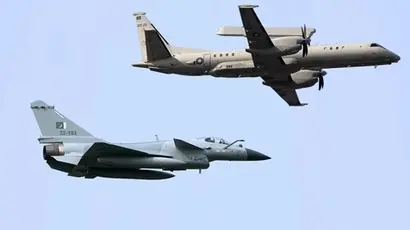
There are two main reasons why this incident is drawing global attention. One is that Chinese-made weapons have historically been underrated, and the other is that France's military science and technology has been evaluated as being among the world's best. With news that the world's most expensive fighter, costing over 150 billion won per unit, was shot down by a much cheaper Chinese-made fighter, social media is flooded with videos of Chinese netizens cheering.
However, the truth of this incident is more complex. The two confirmed facts we must pay attention to clearly demonstrate how complex modern air warfare is and that victory is not determined solely by fighter performance.
The first is that the intelligence gap determined the outcome of this battle. The Indian Air Force’s Rafale fighter is equipped with an integrated electronic warfare suite called Spectra, which could detect targeting by missiles or enemy fighters, but this time, it missed the timing for detection and evasion. It failed in early detection.
On the other hand, the Pakistan Air Force stated in a post-battle briefing that they had accurately singled out and attacked the Rafale from among the many aircraft launched by the Indian Air Force. They claim to have intercepted the Rafale pilot's voice communications and even identified the call sign they were using to launch the attack.
The second is that despite Pakistan's information advantage, a large number of PL-15E missiles malfunctioned or failed to hit their targets. At least two or more missiles crashed within Indian territory, and the exact number launched and hit rate have not yet been confirmed. This suggests that the Pakistani fighters made somewhat reckless predictive shots without securing the exact position of the Rafale.
Combining these two facts, the true protagonists of this air battle were the Airborne Early Warning and Control (AEW&C) aircraft and Tactical Data Links (TDL). Pakistan's J-10CE fighters proceeded with predictive firing based on information received from the outside without a certain guarantee of a hit; while many missiles missed, some functioned effectively.
The AEW&C aircraft used by Pakistan was not the Chinese ZDK-03, but the Swedish SAAB 2000 Erieye. This AEW&C aircraft is equipped with electronic intelligence collection and electronic support measure (ELINT/ESM) equipment called HES-21, which played a decisive role in analyzing the radio signals of enemy fighters and identifying the Rafale.
Even after detecting the enemy through an AEW&C aircraft, a fighter does not fire a missile immediately. This is because modern air force missiles are not launched by simple voice commands. It appears that Pakistan transmitted the information collected by the Erieye AEW&C aircraft to the fighters via a tactical data link without voice, which is a major differentiator from the Indian Air Force. Although the Indian Air Force also operates AEW&C aircraft, it is known that their tactical data link infrastructure is insufficient.
In fact, on May 10, India struck the Erieye AEW&C aircraft at Pakistan's Bholari Air Base with a BrahMos cruise missile launched from a Su-30MKI fighter. This implies that India judged the target for its retaliation for the Rafale shoot-down to be the Swedish-made AEW&C aircraft, rather than the Chinese-made fighter.
So, what preparations does our next-generation fighter, the KF-21, need?
Two directions are important. Fortunately, these are both matters we are already preparing for.
First is 'stealth' technology, or equipment and strategies to hide the KF-21 from enemy detection. If the KF-21 cannot be picked up by enemy radar, or if it can hide the fact that it is a KF-21 even if detected, its survivability will be greatly improved.
The 'NACS,' a future upgrade plan for the KF-21 currently being pursued by KAI, includes an AI drone called the AAP-150. This drone flies alongside the KF-21 or FA-50 and can also perform the role of a 'decoy' that mimics electromagnetic waves. Rapid deployment is urgent. Installing a Luneburg Lens, equipment that hides the KF-21's electromagnetic characteristics, is also necessary.
Second is securing a data link based on high-capacity satellite communication. The KF-21 is equipped with data links like Link-16 and Link-K, but since these are Time Division Multiple Access (TDMA) methods, there are limitations in sharing the real-time positions of fighters moving at supersonic speeds.
Fortunately, our government is developing high-capacity satellite communication technology through projects such as the 'Development of Low-Orbit Satellite Communication System Based on 6G International Standards.' Incorporating this technology into the KF-21 performance upgrade roadmap and pushing it forward without setbacks is more important than anything else.