

[비즈한국] Unless there is a specific movie you are dying to see, people usually don’t visit a movie theater just to enjoy their leisure time. They go to popular restaurants, visit cafes, and go for walks. This is even more true if they are on a date or out with their family. Nowadays, thanks to waiting apps, there is no need to trudge from shop to shop, waiting in long, exhausting lines.
Multiplexes, on the other hand, are designed to keep you doing everything inside. The buildings contain spaces for gaming during wait times, as well as areas to buy snacks and coffee. In fact, it is an unspoken rule that theater revenue comes not from tickets, but from popcorn and soda. If a ticket costs 15,000 won, the theater only keeps about 5,900 won of that. Popcorn and drinks are priced around 7,000–8,000 won for one person, or 15,000 won for a two-person set, and the entire sale amount goes directly to the theater as profit. The cost of ingredients is only about 10% of the retail price.
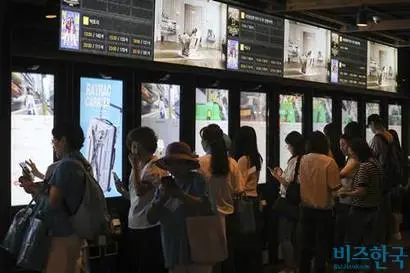
Audiences end up buying relatively expensive popcorn and soda that they often don't even finish. Do they buy it willingly? It’s hard to say. It’s not that outside food is strictly forbidden, but people feel self-conscious and find it too much of a hassle to leave the building. It is not entirely the audience's fault; the spatial structure was designed this way from the start.
Multiplexes are structured to make audiences choose a movie and then use their facilities to kill time. It is a business model that induces various consumption activities through the medium of film. You will never find a multiplex on the first floor; they are located high up in the building. While the first floor is convenient for coming and going, it is difficult to move around when you are high up. There aren't enough elevators, and on weekends, the crowds make it even more uncomfortable. Yet, ticket prices are more expensive on weekends, and there is no decent place to sit.
For office workers trying to relieve the stress accumulated during the week, multiplex theaters are no longer pleasant. It’s not just about going alone; if you go with your family, the discomfort is compounded. Once you leave the building, it's hard to get back in, so you are forced to endure the environment. Sitting on a hard chair in a dark, noisy room is a waste of time and wears you out both physically and mentally. Thus, they resort to filling up on fattening popcorn and soda as a desperate measure to relieve their fatigue. Before the COVID-19 pandemic, there was at least a sense of satisfaction in participating in cultural life, but that psychological motive or goal is nowhere to be found now.
After booking a movie, people want to visit good restaurants and cafes with their families, but the layout of a multiplex doesn’t fit this flow. Because multiplexes are located in high-rent city centers, the surrounding areas are filled with generic franchise cafes and restaurants. Furthermore, most movies can be watched on OTT platforms soon after release. There is no longer a compelling reason to watch a movie exclusively in a theater. Watching at home has become so comfortable that the term "Homeplex" has emerged. Moreover, OTT content like Netflix is often far more entertaining.
Above all, theater content doesn't necessarily provide a "living" experience. In fact, parents and older generations prefer live concerts or musical performances. For children, these vivid cultural experiences are also more beneficial than a movie. In these cases, price is not an issue. Audiences don't mind the cost if it satisfies the value they desire. The fact that movie tickets feel expensive today is because they fail to meet both "cost-effectiveness" (value for money) and "psychological satisfaction" (value for heart).

The Busan International Film Festival operates "roving theaters" that step outside specific venues. Under the name "Neighborhood BIFF," they screen films in unique, personality-filled spaces across Busan, including mountains and beaches. In these everyday spaces, filmmakers and audiences can interact. The Busan International Short Film Festival also operates a "Visiting BSIFF," screening movies at places like social welfare facilities. It is about abandoning the fixed idea that films must be shown only inside specific buildings and instead going to where the audience is. I believe this is the future of the Korean film industry. In the past, single-screen theaters were located on the first floor, allowing audiences to come and go freely and coexist with local shops. However, since the dominance of the multiplex, the diversity and vitality of surrounding commercial districts have withered.
The recent news of a potential merger between Megabox and Lotte Cinema has drawn significant attention. It highlights the crisis in the film industry, but I am not sure if a merger is the answer. While the goal is to create economies of scale and generate synergies through "selection and concentration," I am skeptical about how much the perspective of the consumer—the audience—will be reflected. If they do not screen films where the audience is and prioritize convenience, the film industry will remain in crisis, and the multiplex system itself will have no future.
The author, Kim Heon-sik, has been exploring and navigating the forest of pop culture phenomena since his 20s, driven by the belief that there is a way to make the world a better place through culture. He continues to pursue this same path in the 21st century, an era powered by artificial intelligence and quantum computing.