

[비즈한국] KORAIL Retail is folding its franchise business for its convenience store brand, 'Storyway.' KORAIL Retail is a subsidiary of the Korea Railroad Corporation (KORAIL) that engages in businesses including convenience stores, cafes, selling products from small and medium-sized enterprises (SMEs), advertising at stations, and logistics. While KORAIL Retail has operated Storyway stores through a mix of direct management and consignment (service) contracts, questions are being raised about the background behind its belated cancellation of the franchise business.
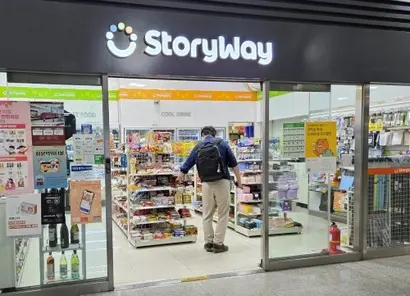
KORAIL Retail cancelled the registration of its information disclosure document for the Storyway convenience store on April 21. Under the Franchise Business Act, franchise headquarters are required to register information disclosure documents—which include operational status and franchise terms—with the Fair Trade Commission or local governments. Typically, franchise headquarters voluntarily cancel these registrations when they stop recruiting franchisees or close their franchise business. KORAIL Retail explained, "We decided to cancel the information disclosure document registration because we are no longer pursuing a franchise business."
Currently, KORAIL Retail operates all Storyway stores directly. Out of 234 locations, about 200 are operated through consignment contracts with individuals selected via open calls for commercial facility operators, while the rest are operated by headquarters staff.
Storyway is a convenience store located within railway and subway stations for the benefit of travelers. Due to the public nature of the railway, it is characterized by an emphasis on public service unlike general convenience stores. Operational methods, such as aligning business hours with train schedules, are also tailored to the characteristics of rail passengers. The stores are also equipped with emergency relief supplies in preparation for train breakdowns or accidents.
KORAIL Retail registered its information disclosure document for Storyway in late 2008 and sought to enter the franchise business. In August 2009, it opened its first store outside a train station near Seoul Station, entering the competitive franchise convenience store market. Lee Hak-bong, then-CEO of KORAIL Retail, stated, "Starting with the Seoul Station branch, we will continuously expand our external convenience store business this year and fully dive into the convenience store franchise market starting in 2010."
Looking at media reports from 2013 to 2015, one can find details noting that Storyway franchisees took 25–35% of the gross profit (total profit minus the cost of goods sold), and that there were around 20 franchisees. Although the company operated franchises alongside directly managed and consigned stores at the time, it appears the franchise business was eventually folded due to market conditions. KORAIL Retail stated, "The past franchise business was a pilot operation, and virtually no results were generated."
Storyway classifies even its consignment stores entirely as direct operations. Consignment operators receive a certain percentage of sales from KORAIL Retail in the form of a salary (commission). While the commission varies depending on the store's location or foot traffic, it typically ranges from 2 million to 4 million won. Since store merchandise is provided free of charge by KORAIL Retail, operators must pay a performance bond. The contract period is a base of 2 years, extendable up to 4 years, with a mandatory minimum operation period of 6 months. A penalty is imposed if the mandatory period is not fulfilled.
The qualification requirements for operators are also strict. Support is restricted for immediate family members of KORAIL or KORAIL Retail employees, or for former employees who have left the company within the last two years. Those who have violated the Food Sanitation Act multiple times or have low credit (a credit score below 665 based on NICE) are also ineligible to apply. New contractors must complete introductory training.
The convenience store business is considered one of KORAIL Retail's core revenue sources. According to its 2024 information disclosure document, the annual average sales of a directly managed store as of 2023 was 574.31 million won. KORAIL Retail's business divisions are divided into retail, advertising, resource distribution, win-win logistics support, and leasing. Among these, the retail business, which includes convenience stores, specialty stores (restaurants, cosmetics, etc.), cafes, and vending machines, generates the most revenue.
Looking at the settlement details for the retail business, it recorded 216.6 billion won in 2022, 262.6 billion won in 2023, and 290.8 billion won in 2024. The average annual growth rate reached 13.6%. The expected performance for 2025 is projected at 313.7 billion won. KORAIL Retail's total revenue (sales), including the retail business, increased from 496 billion won in 2022 to 599.2 billion won in 2023, and 679.9 billion won in 2024.
KORAIL Retail has faced criticism whenever it lost balance between public nature and the pursuit of profit. During the 2021 National Assembly audit, it was pointed out that it operated 21 of the top 22 highest-grossing stores in the country directly. It faced criticism that it was not cooperating with small business owners because it operated the high-revenue "cash cow" stores itself, even though consignment stores account for nearly 90% of its total outlets. Allegations were also raised that it converted profitable stores into directly managed ones.
In the 2019 National Assembly audit, it was pointed out that the company could not even guarantee the minimum wage for consignment operators. Because the stores were open 14–15 hours a day and the average monthly commission at the time was 3.72 million won, the hourly pay fell short of the 2019 minimum wage (8,590 won) when divided by operating hours.
Perhaps due to ongoing controversies, KORAIL Retail is in the trend of reducing the number of convenience stores. The number of stores, which was 313 in 2015, decreased to 268 in 2021, 249 in 2022, 239 in 2023, and stands at 234 now. The company has begun to emphasize its public nature even more. In February, KORAIL Retail released data stating, "We focus on public utility by operating stores even in small provincial cities and railway stations with low foot traffic, ensuring that all customers using the railway can enjoy equal services," and added, "We are striving to improve the profitability of small business owners by applying higher commission rates and various incentives for low-revenue stores."