

[비즈한국] The Korea Art Promotion Project, which began as an initiative solely to support artists, has continued for 10 years. Staying true to our original intent, we have supported over 230 artists. This was a unique undertaking never before attempted by any domestic media outlet, cultural organization, or government agency. We take pride in the fact that this decade of persistence has been etched into the 21st-century Korean art scene as a distinct value. Consequently, it is recognized that the 10-year history of the Korea Art Promotion Project has become a perspective from which to observe the flow of contemporary Korean art. Now, in Season 11, we aim to pave another path for Korean art.
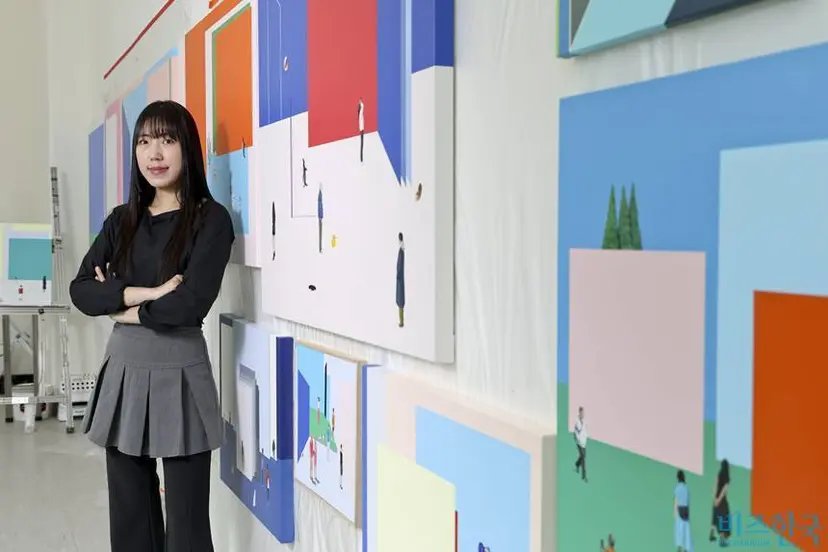
In painting, the meaning of space encompasses various characteristics. First, it demonstrates utility through the visual effects that compose the frame. Thus, the study of space has been an eternal topic that fuels painters' passion for their work.
The meaning of space in painting became clearly defined once landscape became a subject. In the case of Western art, various methods to express space have been developed over the last 600 years. The most representative is perspective. As a result, it became possible to create realistic spaces on a flat surface. Experts called this the "art of deception."
This is a method of maximizing optical illusions. It is about making things look a certain way even if they are not, which is the result of diligent effort focused on the visible world.
Thanks to this, Western painting was able to develop rapidly. The space appearing in Western landscape paintings thus deals with the world unfolding before one's eyes—a physical space, so to speak.
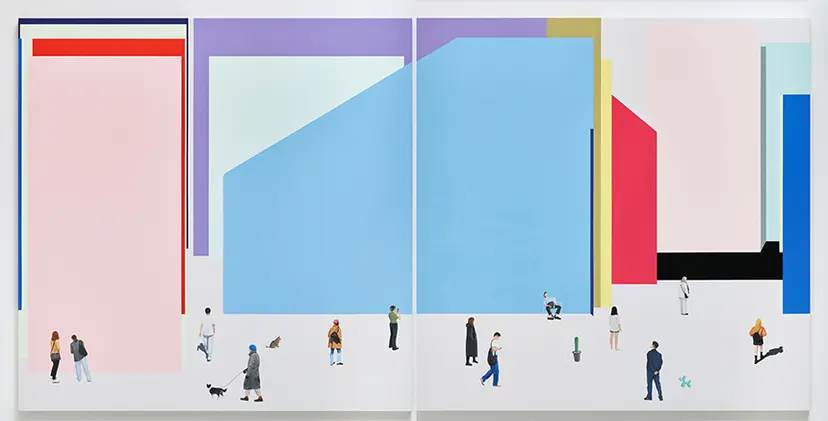
In contrast, the space that appears in Eastern painting, including that of Korea, is not literal. This was natural for Eastern people, who were more interested in the world hidden behind the visible than the visible world itself. They strived to express the invisible world by drawing parallels to the visible world.
Experts refer to this as 'Sa-ui' (painting the meaning). The space that appears in landscape paintings, which form the mainstream of Eastern art, has psychological or philosophical characteristics.
The nature of space also plays a very important role in the paintings of Kim Bo-min. The spaces appearing in the backgrounds of her canvases are reminiscent of geometric abstraction. They evoke the scene of an exhibition hall looking at monochrome paintings hanging on a wall.
In front of such spaces, very realistically depicted people, animals, plants, or everyday objects are lined up. Therefore, the traditional sense of spatial depth is entirely absent from her canvas. How does the artist intend to interpret the meaning of space?
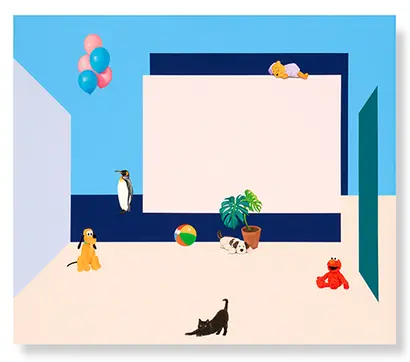
The space appearing in her paintings bears a 'Sa-ui' character. The geometric squares composed of intense colors are not actual, physical spaces. Therefore, the space she expresses has no three-dimensional depth. It is a psychological space. Through this, the artist is expressing what she wants to say.
Kim Bo-min's works feature a contradictory juxtaposition of abstract compositions in the background and realistic objects placed in front. She captures the dual structure of our lives on a single canvas.
The realistic objects represent the people and events we encounter as we live. Our lives are formed by the relationships between them. What acts as a lubricant, connecting these physical relationships of daily life, are psychological things—abstract elements such as emotions and thoughts. The artist captures these with intense, primary-colored geometric compositions. Therefore, Kim Bo-min's paintings express the dual structure of life.