

[비즈한국] It seems that many people really dislike the concept of dark matter. The bright stars visible to the eye alone could not explain the gravity of the universe, and astronomers were ultimately left with no choice but to conclude that something must exist in the universe that does not interact with light but clearly possesses mass and exerts gravity.
Dark matter is estimated to account for 80% of the total mass of the universe. According to current standard cosmology, nothing in the universe could have formed without dark matter. Without it, the gravity of galaxies would be overwhelmingly weak, and stars rapidly orbiting the galaxy would have long since escaped the galaxy's gravity and scattered into the outer reaches of space. It is because dark matter has played its part that galaxies, galaxy clusters, and our universe have remained intact and maintained stable structures to this day, and that matter has gathered over billions of years to create the current vast cosmic web.
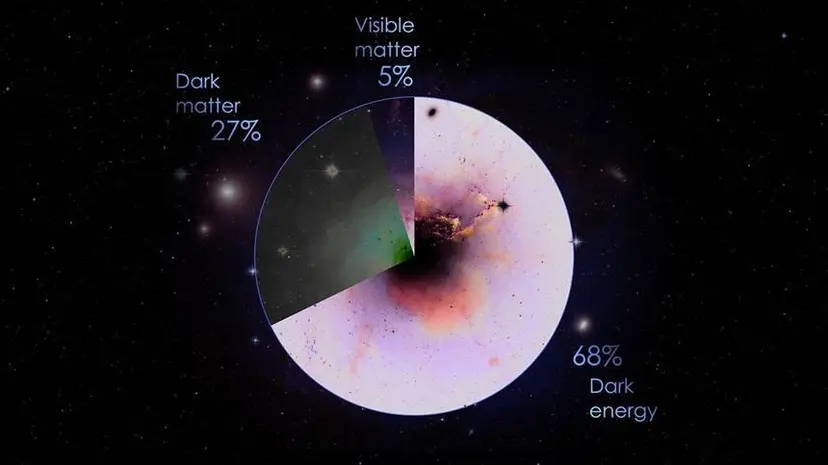
Nevertheless, the reason many people are not welcoming of the dark matter concept likely stems from our unfortunate reality of not yet knowing exactly what dark matter is or what it is made of. There are even quite a few who argue that dark matter itself does not exist in the universe at all, and that everything astronomers consider indirect evidence of dark matter is merely our own misunderstanding. As an astronomer, it is difficult to accept such blind criticism. This is because the existence of dark matter is the single most reasonable conclusion pointed to by a variety of independent observational data accumulated over the past half-century.
If dark matter really exists in the universe and makes up such a large part of it as astronomers claim, why have we never captured it properly? Perhaps we may have already captured the most definitive evidence of dark matter without even knowing it. A very interesting analysis was recently published. According to this study, we captured evidence of dark matter existing exactly as we expected 15 years ago. It is just that we lacked confidence and were overly cautious, failing to properly accept the evidence. What exactly is the evidence we captured 15 years ago?
Let’s take a time machine back 15 years. In June 2008, the Fermi Gamma-ray Space Telescope was launched into orbit. The Large Area Telescope (LAT) mounted on this space telescope has steadily detected gamma-ray light from across the universe for many years. Gamma rays often appear in superhero movies as rays that cause mutations after accidentally hitting the protagonist. This is because gamma rays are light with a much shorter wavelength and much stronger energy than X-rays. Gamma rays are released when a nuclear bomb explodes.
Gamma rays emerge from the most extreme and violent moments in the universe. For example, gamma rays pour out the moment a massive star at the end of its life explodes as a supernova. Gamma rays are also captured when debris ejected at very high speeds during a supernova explosion collides with surrounding interstellar matter. They are also detected from pulsars when a neutron star left over from such a death rotates at very high speeds and forms a powerful magnetic field. Very powerful gamma rays are also captured at the scenes where supermassive black holes living in the centers of galaxies are hungrily devouring matter, especially in extreme phenomena like quasars that only existed in the early universe.
The Fermi telescope's LAT can scan a wide area covering about 20% of the entire sky at once. Thanks to this, it was able to capture in an instant various extreme phenomena occurring ceaselessly across the universe. However, a new controversy began in 2009 when a gamma-ray map of the region near the center of our galaxy, scanned by the Fermi telescope, was released.
The Fermi telescope discovered that unusually bright gamma-ray flashes were intensively leaking from the center of our galaxy. The center of our galaxy has a very high density of stars and gas material. Consequently, heavy stars with fast evolution are densely packed together, and supernova explosions and stellar deaths occur very frequently. A supermassive black hole with 4 million times the mass of the Sun likely contributes to the intense gamma rays at the center of our galaxy. Astronomers have already grasped how densely supernovas and pulsars exist in the galactic center, and how violently the galactic central black hole spews out energy.
The problem is that even after accounting for all the phenomena we already know well that could create gamma rays, the intensity of the intense gamma rays actually captured by the Fermi telescope cannot be fully explained. Compared to calculations reflecting all known sources of gamma rays, our galaxy is emitting extremely intense gamma rays at a level nearly double that. This clearly implies that something else we have yet to understand is hidden in the center of our galaxy, pouring out gamma rays. This mystery of the galactic center revealed through Fermi telescope observations is called the "GeV Excess" at the galactic center. And we still have not figured out exactly what is causing stronger-than-expected gamma rays to leak from the center of our galaxy.
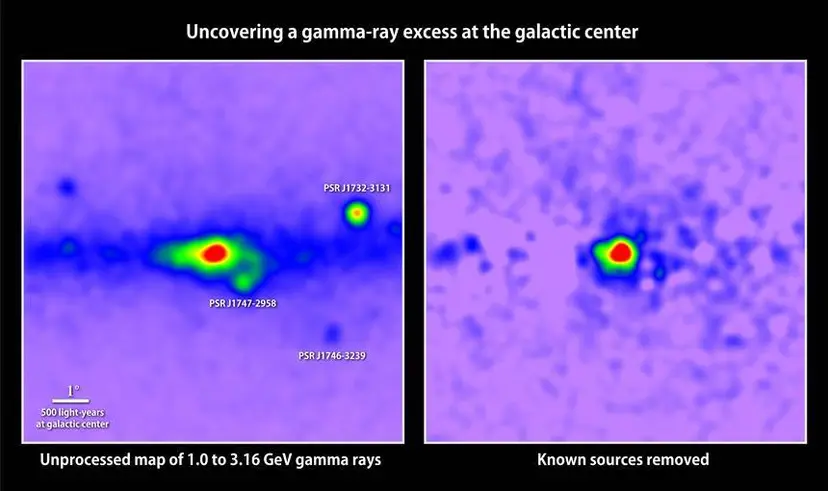
However, as the galactic center gamma-ray excess became known, an interesting hypothesis began to be raised among some astronomers: that this is due to dark matter. Dark matter basically does not interact with light in any way. It not only does not shine, but it also does not absorb light. Therefore, no traces can be found through general image observations or spectral observations.
But we can make this assumption: if dark matter is also made of unknown fundamental particles, then there should also be corresponding anti-particles for them, just like electrons and positrons. Particles and anti-particles collide, and their entire mass is converted into energy, releasing massive amounts of energy in the process. Consider that even a massive star like the Sun shines for billions of years just through nuclear fusion, where only a tiny fraction of the mass of atomic nuclei is converted into energy. If so, how much massive energy would be released if it were not just a tiny fraction of a particle's mass, but the entire mass of two particles being converted into energy through annihilation! Similarly, if the fundamental particles that make up dark matter collide with corresponding anti-dark matter particles and experience annihilation, they could release massive energy in an instant.
A point that shouldn't be confusing here is that while dark matter does not interact with other light that exists separately, it means that when dark matter particles collide with each other and disappear, it can release massive energy, and that energy can be captured as strong gamma rays at the GeV level.
In fact, considering the density distribution at the galactic center according to classic dark matter models, this is a very plausible speculation. Dark matter is not hindered by temperature, heat, or pressure. It gathers solely by being drawn by gravity. In astronomy, this dark matter is called "cold dark matter," and it is the model that best explains our universe to date. According to this model, as dark matter gathers by gravity and completes the galactic halo, the density increases very steeply toward the center of the galaxy. This density distribution is called the Navarro-Frenk-White (NFW) profile. Our galaxy must also have been shaped by this process. Therefore, we can think that dark matter particles are gathered in very high density at the center of our galaxy, even if they are invisible.
The higher the density, the higher the probability that dark matter particles will collide with each other. The annihilation where dark matter particles and anti-particles collide and disappear will also happen very frequently. Ultimately, the source of the excess gamma rays at the center of our galaxy may be the annihilation of high-density dark matter clusters. Interestingly, looking at the distribution of the gamma-ray excess captured by the Fermi telescope at the time, it is distributed very symmetrically around the very center of the galaxy. This fits well with the prediction that a clump of dark matter would be gathered in a high-density, round shape at the center of the galaxy. Then, has the existence of dark matter been clearly proven? Not necessarily.
Even in 2007, before the Fermi telescope scanned the center of our galaxy, other astronomers put forward negative analyses that searching for gamma-ray excesses alone would not yield "smoking gun" evidence of dark matter. They raised the problem that in addition to supernovas and black holes, pulsars rotating at very short intervals, so-called millisecond pulsars, could also fill in the additional gamma rays.
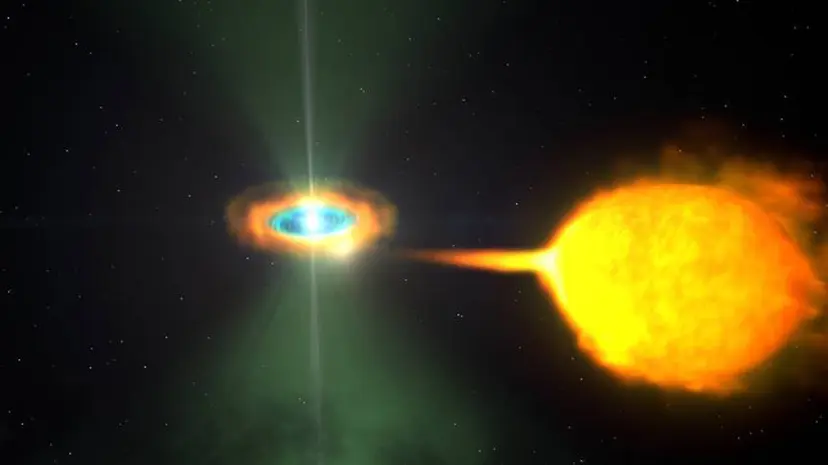
When a star that was originally rotating collapses and its volume shrinks rapidly, a pulsar that rotates at a very high speed is created to conserve angular momentum. Especially in areas like the galactic center where the density of stars is very high, stars are frequently formed in pairs rather than as single stars. Once one of the stars forming the binary system becomes a pulsar, it steals matter from its companion star. As it does so, the pulsar begins to rotate faster and can become a millisecond pulsar.
Millisecond pulsars created this way can survive for billions of years without dying, and if this has happened frequently at the center of our galaxy over the past ages, it is possible that numerous millisecond pulsars are currently gathered at the center of our galaxy in very high density. And they emit not only very powerful radio waves but also gamma rays.
In a 2007 paper, astronomers raised the issue that there is a high possibility of confusing gamma rays leaking from millisecond pulsars with traces of dark matter, and criticized the attempt to find traces of dark matter in the galactic center based on the gamma-ray excess as meaningless. The reason why the intense radio waves that should have been observed along with millisecond pulsars were not observed can be explained. This is because the galactic center is filled with gas clouds at such high density that radio waves could be scattered in all directions, making observation difficult.
In the end, the gamma-ray excess at the center of our galaxy has become a situation where both explanations—that it could be because of dark matter or because of millisecond pulsars—are plausible. As this controversy continues, the exact source of the highly symmetrical gamma-ray excess phenomenon captured by the Fermi telescope has yet to be determined with certainty.
However, a very hopeful analysis result has recently been published for astronomers who expect the gamma-ray excess to prove dark matter. This time, the clue came from infrared observations, not gamma-ray ones. When viewed with gamma rays, the center of our galaxy looked nearly twice as bright as expected, but when viewed with infrared, it looks much darker. Clearly, many stars must be exploding in the Central Molecular Zone (CMZ) at the center of the galaxy, emitting various types of light, and the heated dust clouds should be emitting strong infrared rays. Yet, when actual observations are made, infrared light is detected very weakly in the very center of our galaxy. The center of our galaxy, which caused problems due to the excess of gamma rays, now shows a new problem: the lack or disappearance of infrared rays.
Usually, hydrogen molecules existing in outer space and interstellar matter exist in the form of H₂, where two identical hydrogen atoms are bonded. Because this structure is symmetrical, the electric dipole moment does not change easily through vibration or rotation within the molecule. However, for a molecule to absorb long-wavelength infrared rays, the dipole moment must be able to change rapidly through vibrations or rotational motions within the molecule. Symmetrical diatomic molecules like nitrogen molecules and oxygen molecules (N₂, O₂), as well as hydrogen molecules, have negligible changes in this electric dipole moment. Therefore, they generally cannot produce significant infrared absorption on their own. On the other hand, polyatomic molecules consisting of three or more atoms, such as carbon dioxide or water, are not symmetrical. Because asymmetric vibrations and rotational movements are possible, they can absorb infrared rays much more efficiently.
To explain the problem of missing infrared rays confirmed at the center of our galaxy, there must ultimately exist molecules in the form of trihydrogen cations (H₃⁺) at the galactic center, consisting of three hydrogens instead of two. This is in the form of three hydrogen atoms bonded with one electron missing, and because it has an asymmetric structure, vibrations and rotations within the molecule are possible. Thanks to this, the electric dipole moment can change easily, and it can act as a very efficient infrared absorber. In fact, this component is a major molecule that strongly absorbs infrared rays in Jupiter's atmosphere. To explain all the missing infrared rays at the center of our galaxy, the conclusion is reached that there must be, surprisingly, nearly 100 times more H₃⁺ at the center of our galaxy than expected. The researchers claim that new evidence of dark matter is hidden right here.
This study assumed that the dark matter particles gathered at the center of our galaxy are intermediate-mass dark matter particles with a mass of about several MeV, which is a bit lighter than originally expected. These dark matter particle-antiparticles of this scale collide with each other and undergo annihilation and decay, causing electrons and positrons to pop out. The additionally generated electrons and positrons can ionize ordinary hydrogen, creating H₃⁺, which is made by three hydrogens attaching together.
In short, the dark matter concentrated in the center of our galaxy collides with itself to create new electrons and positrons, which in turn ionize the ordinary hydrogen in the interstellar medium, eventually creating asymmetric molecules with three hydrogens.
This electron-positron annihilation also emits gamma rays with energy of exactly 511 keV. This fact can explain a significant phenomenon that has been unresolved since the 1970s, long before the Fermi space telescope went up. Astronomers have long discovered the problem that gamma rays with an energy of 511 keV are intensively captured only in a very narrow region at the center of our galaxy. If we accept the hypothesis presented by this paper, this mystery is explained naturally. It feels exciting, as if the puzzle pieces proving the existence of dark matter are fitting perfectly and all problems are being solved at once.
If the claims made this time are true, we have been looking directly at the traces shown by dark matter for a long time, but failed to notice that it was because of dark matter. Even though dark matter was showing off its existence with high-energy light—the most intense gamma rays in the universe. The possibility that a truly ghost-like existence that cannot be photographed or captured by detectors because it does not interact with light at all might have actually been showing its traces through the highest-energy light feels very ironic.
When the gamma-ray excess phenomenon was first discovered through the Fermi telescope 15 years ago, perhaps we were being too humble and thorough. Perhaps we prematurely gave up that it was too early to capture definitive evidence of dark matter, and instead stubbornly found other alternatives like millisecond pulsars, turning away from the truth right in front of our eyes.
Reference
https://journals.aps.org/prl/abstract/10.1103/PhysRevLett.134.101001
https://www.sciencedirect.com/science/article/pii/S0370269311001742
Who is the author, Ji Woong-bae? He loves cats and the universe. After watching 'Galaxy Express 999' as a child, he dreamed of spreading the beauty of the universe. He is currently researching the evolution of galaxies through their interactions at the Center for Galaxy Evolution Research and the Near-Cosmology Laboratory at Yonsei University, and is engaged in various science communication activities such as giving lectures and writing. He has written books such as 'Galaxy Dating', 'Thinking about the Universe All Day', and 'Stars, the Science of Light'.