

[비즈한국] A golf course in Gyeonggi-do recently raised its cart fee from 90,000 won to 120,000 won, citing an increase in the cost of cart parts. Can golfers believe this reason? The profit margin on golf carts is higher than almost any other business in the world. A 5-seater golf cart costs approximately 15 million won. It runs on a battery and doesn't require any special repairs or maintenance to keep it running. This means the purchase cost is recouped in just a few months.
In short, it’s a cart that lays golden eggs, and its profit margin only grows as time passes. Just as the entire price of a book becomes profit once production costs are surpassed, or a movie's revenue becomes profit after breaking even, a cart that has paid for itself keeps laying golden eggs even as it gets old and worn out. It lays golden eggs as long as it keeps rolling. That is how golf courses earn 1.2 trillion won a year from carts. Perhaps this is why the golf cart business is often spun off independently, frequently run by the golf course owner's relatives or acquaintances, with rumors circulating that it serves as a lucrative business for influential local figures.
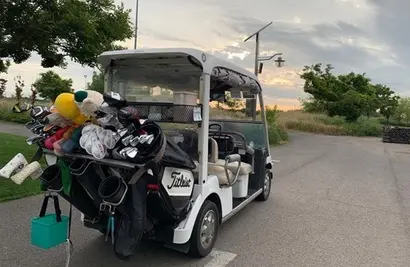
To be precise, it’s not a 5-seater golf cart; it’s a cart where 5 people are forced to squeeze into very cramped back seats. It’s reached the point where people make advance agreements that the player with the best score on the previous hole gets the front seat, or someone says, "I got a birdie, so I'm taking the front." That’s right. In a car, the back seat is the seat of honor, but in a Korean golf cart, the front seat is the seat of honor. In a round with three men and one woman, it is quite common to give the front seat to the female golfer, leaving the three men in the back, but the cart is woefully cramped for three full-sized men.
That cart costs over 100,000 won, even 120,000 won. Because the back seat is said to be cramped, "luxury limousine carts" have also appeared. The cart fee is more than double. Golfers only wanted a slightly wider cart, but the golf courses rolled out much more expensive ones. The "limousine cart," which costs over 200,000 won, is a sight you won't find at any other golf course in the world.
Korean golfers pay the highest fees in the world for golf carts that they ride for 4 to 5 hours. If you factor in the time, it’s more expensive than renting a German luxury sedan for an entire day. Some places even charge a 20,000 won "cart cleaning fee" for no-caddie rounds. How much could we possibly dirty the cart in 4 hours that they need to charge us for cleaning such a small vehicle?
In foreign golf courses, golfers choose whether to ride a golf cart or push a pull-cart and walk the round. Some golfers even carry their bags without a cart. Unfortunately, Korean golfers have no choice. When breaking down golf course costs into green fees, cart fees, caddie fees, and food and beverage costs, golfers say the most unreasonable, and frankly unfair, one is the cart fee. I think so, too. In Southeast Asia, there is one caddie per person, and the caddie and one golfer ride in a cart. You could even call it a "1-person, 1-cart" system. Of course, it’s cheaper than the per-person cart fee in Korea, where four people split the cost. And these carts are allowed to drive onto the fairway.
If we approach the cart as a means of transport to make the round more comfortable by walking less, then the carts in Korea, which only go back and forth on cart paths, are not "door-to-door" taxis, but more like public transportation—buses or subways—that carry many people.
If that’s the case, shouldn’t we pay bus or subway fares? Why do golf carts charge golfers luxury taxi fares? Golfers cannot understand this. It is said that member-based golf courses raise cart fees when they have trouble raising green fees due to pressure from members. In short, the cart is the best tool for generating or covering up losses in profit.
Occasionally, during mid-winter or mid-summer, golfers receive texts saying "Free Cart Fee," as if the golf course were granting a massive favor. In reality, just not paying the cart fee significantly reduces the cost of golf. However, the term "Free Cart Fee" paradoxically proves that it is something they "don't actually need to charge." It may seem like a huge act of generosity, but perhaps the golfers who pay these fees have been the ones granting favors to the golf courses all along.
Personally, I believe a golf cart fee of 10,000 to 15,000 won per person is appropriate. Even if cart fees aren't included in the green fee like in Japan, just because green fees are expensive doesn't mean cart fees should be high as well. While caddie fees are a significant burden among golf costs, meeting a good caddie results in a better score and a more enjoyable round. I've played countless rounds, but I have never once thought that I had a good round because I met a "good cart." A cart is just a small means of transportation made with very simple technology. There is no reason for it to be expensive.
About the author, Kang Chan-wook?
An advertiser and writer. He started as a copywriter at Cheil Worldwide and is currently the CEO of the video production company ‘Sidae-ui Siseon’ (The Gaze of the Times). A golf enthusiast, he obtained a USGTF teaching professional certification. With a passion for writing, he has published golf-related books such as ‘The Joy of Golf’, ‘Bad Golf’, ‘Sincere Golf’, and ‘Golf Thoughts, Thoughtful Golf’. He runs the YouTube channel ‘Bad Golf’, where he shares various stories and thoughts about golf with readers and viewers.