

[비즈한국] Financial authorities will announce the results of the preliminary license for the fourth internet-only bank this coming June. While there were predictions that the selection might be delayed due to an early presidential election and a change in administration, Financial Services Commission Chairman Kim Byung-hwan stated on the 7th that he intends to "proceed with the license announcement as scheduled." As the three existing internet-only banks (K-Bank, KakaoBank323410, and Toss Bank) prepare to face a new competitor for the first time in four years, the expansion strategy of the nation's first-ever internet-only bank into offline touchpoints is drawing attention.
K-Bank is preparing to open its second face-to-face customer support center in Gangnam, Seoul. The first customer support center was established in Euljiro, Seoul, where K-Bank’s headquarters are located. This indicates a move to establish bases in both the northern and southern parts of Seoul. According to the bank, there are a significant number of customers who visit these in-person centers for matters such as handling the estates of deceased individuals.
Under the relevant law (Special Act on the Establishment and Operation of Internet-only Banks), the purpose of in-person operations for internet-only banks is restricted. These restrictions, based on Article 7 of the Enforcement Decree regarding the "protection and convenience of financial consumers," apply only to cases where electronic financial transactions are difficult due to reasons such as being a member of a financially vulnerable group (the disabled, the elderly, etc.), death, or device failure. According to the administrative rules of the same law, in-person services are also permitted when corporate loan handling requires guarantees or on-site inspections.
KakaoBank and Toss Bank each operate one face-to-face customer support center. KakaoBank’s is located at its office in Yeouido, Seoul, while Toss Bank has set up a center near Yeoksam Station in Gangnam-gu, Seoul, under the name "Lounge."
K-Bank is also actively using ATMs for promotional purposes. Among the three internet-only banks, it is the only one to operate "brand ATMs" bearing its own logo. K-Bank renewed its brand ATM units late last year and significantly increased the number in operation. Previously, they were only available in five locations, including Gangnam Station and Seolleung Station, but with the renewal, the goal is to expand to 43 locations, focusing on major subway stations in Seoul.
Since April 1st, the bank has expanded its fee-waiver coverage to all automated teller machines (ATMs/CDs) nationwide. K-Bank’s fee-exempt machine count has grown from approximately 49,000 to 60,000. In the case of brand ATMs, there is no limit to the number of free transactions, while regular machines offer fee waivers up to 30 times per month.
Brand ATMs are machines operated in partnership with Value Added Network (VAN) providers, where the bank’s logo is attached to the VAN company's hardware. This is why K-Bank states in its business reports that it "does not own any of its own ATMs," despite operating dozens of brand ATMs. For these units, the bank entrusts operations to the VAN company while paying a set fee, which includes customer transaction fees. The VAN companies retain the transaction fee revenue.
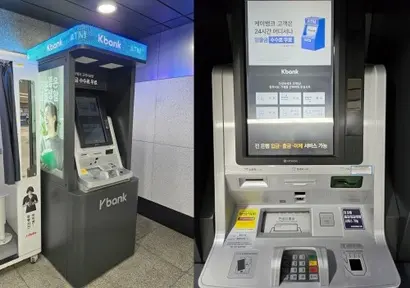
Unlike commercial banks, internet-only banks without physical branches do not own their own ATM networks. Instead, they use machines from other banks and VAN partners. According to each company, KakaoBank and Toss Bank partner with all major domestic VAN providers (NICE Infrastructure, ATM Plus, Korea Seven, Hannet, Hyosung TNS), while K-Bank partners with Hyosung TNS and Hannet. K-Bank’s brand ATMs are operated by Hyosung TNS. Unlike K-Bank, KakaoBank and Toss Bank offer unlimited fee waivers at all ATMs.
An official from an automated machine provider noted, "Brand ATMs like the ones K-Bank has renewed have high visibility, making them very effective for advertising," adding, "I understand that other internet-only banks have expressed interest in brand ATMs, but it hasn't gone beyond the review stage." KakaoBank and Toss Bank are not considering adopting brand ATMs as they already maintain a policy of full fee waivers at all bank and convenience store ATMs.
Perhaps for this reason, K-Bank’s net fee income has turned to a deficit. According to K-Bank’s 2024 business report, net fee income recorded a loss of 349 million KRW. This occurred as fee revenue reached 52.7 billion KRW, while fee expenses hit 53.1 billion KRW. K-Bank’s fee expenses have surged annually, from 29 billion KRW in 2022 to 33.2 billion KRW in 2023, and 53.1 billion KRW in 2024. In contrast, while KakaoBank saw an increase in overall fee expenses in 2024 compared to 2023 (from 269.8 billion KRW to 279.1 billion KRW), its actual payout for automated machine fees decreased (from 64.7 billion KRW to 64.6 billion KRW).
K-Bank’s current strategy appears aimed at expanding its scale and raising brand awareness ahead of an initial public offering (IPO). It has been aggressive in business expansion, such as launching loan products for individual business owners and declaring its evolution into a "corporate finance platform." K-Bank has attempted to go public twice, but failed both times due to unfavorable market conditions, and is currently preparing for a third attempt.
Regarding the reason for increasing brand ATMs, K-Bank previously stated, "We are expanding ATMs in subway stations with high accessibility and high foot traffic to strengthen support for essential daily financial transactions like deposits and withdrawals," adding, "We will review plans for further ATM expansion by analyzing customer feedback and demand." A K-Bank official commented on the expansion of customer support centers, saying, "Please view this as a proactive measure to address customer support needs during the process of business expansion."