

[비즈한국] LIG Nex1079550 has unveiled a new concept unmanned surface vehicle (USV) currently under development through in-house research. The 'Swarm Loitering Munition USV' is the world's first to combine swarm attack capabilities with autonomous striking power in a suicide attack boat. By neutralizing the self-defense systems of naval vessels, it is expected to become an asymmetric weapon to counter North Korea's new 'Choe Hyon-ho' class warships once it is operational.
Recently, the most significant issue in maritime security and naval warfare is the loitering munition USV, often referred to as a "kamikaze boat." While the concept of a small boat attacking a large ship dates back to the October 2000 al-Qaeda suicide boat attack on the USS Cole (DDG-67), that attack involved manned boats targeting a docked ship rather than a moving one. However, over 20 years later, the offensive power of suicide USVs has evolved drastically. This is because the unmanned technology used for aerial drones (UAVs) has now been applied to watercraft.
The Ukrainian Navy has made the most effective use of such suicide USVs, achieving significant results in the Ukraine war. Starting with attacks on Sevastopol, the core naval base of the Russian Black Sea Fleet, they successfully attacked and sank structures like the Crimean Bridge and various oil tankers. Furthermore, the Ukrainian military's suicide USVs have sunk one corvette and one patrol ship, while rendering several others combat-ineffective.
Because of this, countries around the world are rushing to develop loitering munition USVs. Since 2021, LIG Nex1 and Hanwha Systems272210 have announced their independent development of such platforms.
However, as these suicide USVs gain attention, countermeasures are also being actively researched. The problem is that North Korea is quite advanced in technologies to counter these platforms. The new missile destroyer 'Choe Hyon,' unveiled by North Korea on April 25, carries a significant load of cruise, ballistic, and anti-aircraft missiles, including 16 new missiles across four 4-cell launchers on the port and starboard sides.
The missiles carried are referred to as the "North Korean version of Spike NLOS." The Spike NLOS is a multipurpose missile developed in Israel, which our Marine Corps currently operates from Baengnyeong Island and the Northwestern Islands to strike North Korean hovercraft. Since the North Korean version is also well-suited for attacking high-speed, small naval vessels, the North Korean 'Choe Hyon' destroyer effectively possesses a counter-measure to suicide USVs—a capability our own Navy has yet to field.
Coincidentally, a new concept suicide USV that surpasses the functions of existing models has been unveiled. This is the 'Swarm Loitering Munition USV' from LIG Nex1, introduced at the 'Maritime Space Power-Integrated Manned and Unmanned System Development Conference' held on May 8. LIG Nex1 has already developed an 'Autonomous Unmanned Conversion Kit' that transforms manned vessels into USVs, proposing a design where standard boats are equipped with the kit and explosives. The platform is 1.5 tons and capable of a top speed of 42 knots. Hanwha Systems has also researched a similar level of suicide USV.
The newly unveiled Swarm Loitering Munition USV boasts several further advancements. First, its size and shape have been optimized for suicide attacks: the hull has been extended to 6.5 meters in length and 2.4 tons in weight, equipped with a 320-horsepower engine, allowing it to travel over 926 km at speeds exceeding 40 knots. By simple calculation, it can independently attack the Nampo shipyard, where the North Korean 'Choe Hyon' was built, from Incheon Port, and has the performance to track and pursue enemy warships moving at high speed on the ocean.
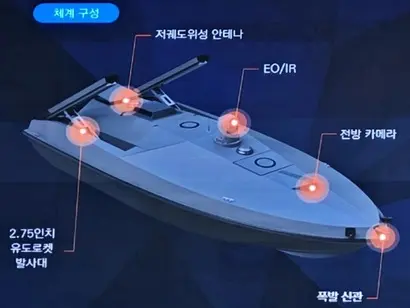
It is equipped with a forward-facing camera for autonomous navigation and an Electro-Optical/Infrared (EO/IR) camera for target detection. It is also designed to enable remote control using a low-earth orbit satellite antenna, allowing it to pursue enemies even in GPS-jammed environments.
LIG Nex1’s swarm loitering munition USV applies its proprietary swarm maneuvering technology, allowing multiple units to operate in formation. Furthermore, the inclusion of two of LIG Nex1’s acclaimed 'Bigung' guided rockets will maximize the operational capability of these units.
Until now, all suicide USVs developed or under research were essentially just "bomb boats" without their own armament. In contrast, LIG Nex1's swarm loitering munition USV significantly increases survivability by carrying two guided rockets, which allow for strikes before the final suicide run. For example, it can strike harbor defense facilities or target defensive equipment on the North Korean destroyer 'Choe Hyon-ho,' such as missile launchers or radar systems, while closing in, thereby greatly increasing the probability of a successful suicide attack.
As the loitering munition USV charges at an enemy ship while aiming and firing its Bigung rockets, it can be detonated via a remote command or upon impact with the enemy ship using the explosive fuze mounted in the bow. The 250kg of high-performance explosives used is equivalent in power to the Haeseong anti-ship missile produced by LIG Nex1.
Once the Swarm Loitering Munition USV is put into practical use and deployed, it will not only be able to attack North Korea's new destroyers—which threaten our Kill Chain—without risking friendly casualties, but it could also serve as a strong deterrent by using its long-range maneuverability to blockade North Korean naval bases and military port facilities of neighboring countries. Another advantage is that it is cheaper than expensive attack drones or ballistic missiles, making mass production easier.
Currently, while the South Korean Navy has identified requirements for various USVs, such as reconnaissance, combat, and mine-clearing models, a formal requirement for the cost-effective suicide USV has not yet been issued. Now that an industry-led, in-house research project has produced a Swarm Loitering Munition USV capable of neutralizing enemy defenses, if the Navy incorporates this requirement, it is expected to not only strengthen our military's capabilities but also achieve significant results in the export market, as it provides a competitive advantage over the suicide USVs of rival nations.