

[비즈한국] As spring fades and summer approaches, the constellation Leo rises in the night sky. It may look like an ordinary constellation, but it might appear entirely different after tonight. Recently, a signal suspected to be the most definitive evidence of extraterrestrial life has been discovered there. As far as we know, at least on Earth, two substances were detected at very high concentrations that simply cannot be explained by anything other than biological activity. Unless there is some completely different, unknown type of chemical reaction occurring, there is a very high probability that something "scheming" by extraterrestrial life is truly taking place.
Unfortunately, while the findings in this paper did not cross the 5-sigma threshold—the "unassailable" standard in science—the analysis shows the signal exceeds 3-sigma. This means there is only a 1 in 1,000 chance that this signal is a mere coincidence or a statistical error. Of course, since it fell short of 5-sigma, it is difficult to make hasty claims, but it is a sufficiently intriguing result. What exactly does the signal detected here mean? Will we really be able to confirm the existence of the extraterrestrial life we have waited so long for?
Thanks to the Kepler Space Telescope launched in 2009 and its successor, TESS, we have already identified over 10,000 exoplanets and candidates. For life to exist on an exoplanet, it first needs a moderate temperature—not too hot or too cold. To achieve this, it must be in an orbit at an appropriate distance from its host star, known as the "Goldilocks zone." Only about 1% of the exoplanets known to date have passed this difficult first test.
K2-18b, which has been the subject of recent controversy, is one of them. It is a planet discovered orbiting a star 124 light-years away in the direction of the constellation Leo. The "K2" indicates it was discovered during Kepler's second mission. Originally, Kepler focused only on a specific direction near the constellation Cygnus, but after two of its attitude control wheels failed in 2013, astronomers had to devise a new strategy. They ultimately employed a novel technique using solar wind to stabilize the telescope's posture, which allowed Kepler to move beyond the Cygnus region and scan multiple directions, leading to the discovery of this planet in the Leo region during the K2 mission.
The star K2-18 is a much smaller, dwarf star with about 49.5% the mass of the Sun—roughly half the size. Consequently, the star itself is much cooler than the Sun. It is a red dwarf that emits more infrared light. Kepler hunted for planets by observing the "transit" phenomenon, where a planet periodically blocks the light of its host star, causing a minute dip in brightness. K2-18b was discovered using this method. The orbital period of this planet is about 33 days—roughly one month. If we define one "year" as the time it takes for the planet to complete one revolution around its host star, a year there lasts only 33 days. While we might eat tteokguk (rice cake soup) once on Earth, inhabitants there would have to eat it ten times.
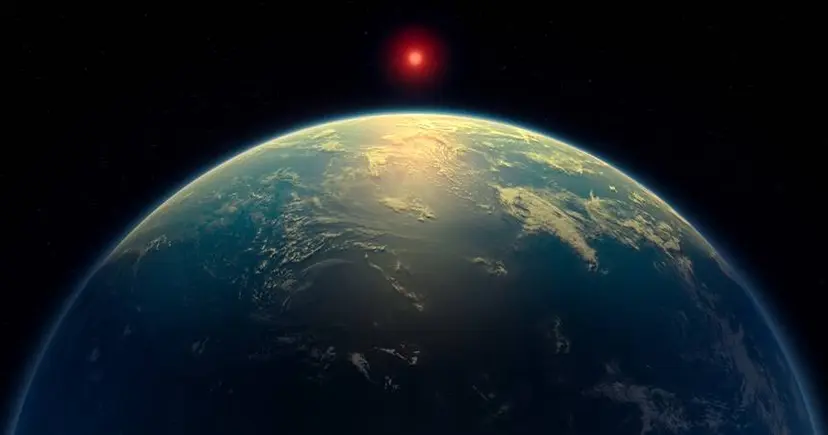
In fact, K2-18b had already been a subject of debate among astronomers for different reasons. The planet's mass is about 8.6 times that of Earth, and its diameter is 2.6 times larger. Its density is lower than that of a purely rocky planet, suggesting it is not composed entirely of rock. There are three prominent models to explain this. The first is the possibility of a "mini-Neptune": slightly smaller than Neptune, with a rocky core surrounded by a layer of ice compressed under high pressure. Second, it could be a rocky core wrapped in a thick atmosphere filled with hydrogen, without an ice layer. Finally, there is a more unique possibility: a rocky core surrounded by a massive ocean, capped with a thin hydrogen atmosphere. This could be thought of as a mantle made entirely of water. Such a planet, consisting of a thin hydrogen atmosphere and an ocean, is called a "Hycean" planet.
Until then, the Hycean planet was just one of many hypotheses, and its actual existence had never been confirmed. So, how could we know what kind of world K2-18b is? Astronomers realized that the chemical composition detected in a planet's atmosphere should vary significantly depending on the scenario. If it were a world with a thick hydrogen atmosphere but no ocean, its atmospheric composition should be similar to Neptune—rich in methane and ammonia, with high levels of carbon monoxide. On the other hand, if the planet were covered entirely in an ocean, the result would be vastly different. Because water effectively dissolves these chemical components, the atmospheric chemistry would change significantly: specifically, ammonia and carbon monoxide should disappear, while methane and carbon dioxide should be abundant.
Last year, James Webb observations confirmed a signal that matches this model perfectly. Through this, astronomers concluded that K2-18b is likely the legendary Hycean planet—a world covered in an ocean with a thin hydrogen atmosphere.
A planet-wide ocean? The research team went a step further. Could there be an ecosystem like plankton living in that ocean? The most definitive way to confirm if there is life on an exoplanet is to go there and take a photo. However, it is too far away for that to be possible. All we can do is sit on Earth and analyze the faint light of distant exoplanets to see if signs of life are hidden within.
The most common method astronomers use is to identify which chemical components exist in the atmosphere or sky of an exoplanet. In fact, James Webb has already used this method to detect clear signs of oxygen, carbon dioxide, and water vapor in the atmospheres of several exoplanets. But this is not enough. Oxygen, carbon dioxide, and water vapor are quite common in space. While they are essential ingredients for life, their presence does not guarantee 100% that life exists there. However, if we confirm components that can only be explained by biological activity, the story changes. And that is exactly what astronomers have attempted to do with K2-18b.
Last year, astronomers used infrared spectrum analysis equipment like James Webb's NIRSpec to analyze chemical components. This instrument can perform spectral analysis in the 0.6 to 5.3 μm range. The study at the time claimed to have detected a signal for a chemical called dimethyl sulfide (DMS). This is a representative substance produced by phytoplankton through biological activity. To detect a major component produced by plankton on an exoplanet covered entirely by an ocean! If this is true, one could expect that we have discovered alien plankton.
However, the significance of this signal in last year's analysis was only at the 2.4-sigma level. Statistically, this means there is about a 1 in 60 chance it is a coincidence. It was an uncertain signal that fell far short of the 5-sigma standard. Furthermore, since the results varied greatly depending on how the spectrum was analyzed, it left many questions unanswered.
Ultimately, the research team conducted additional observations with other instruments on James Webb. This is the result announced this time. In this observation, the team used the MIRI instrument, which observes the mid-infrared spectrum at much longer wavelengths, in the 6–12 μm range. As a result, they detected not only DMS but also dimethyl disulfide (DMDS) more clearly. Both molecules are highly associated with biological activity on Earth. DMS is produced by marine microorganisms and plankton. DMDS is produced by a wider variety of life forms, including bacteria, fungi, animals, and plants. DMDS is the molecule that gives garlic its smell and is also used in food flavoring.
According to these additional observations, the significance of the signal reaches the 3-sigma level. It is certainly clearer than last year's analysis, but there are limitations. In James Webb's observation range, the spectral features of DMS and DMDS are very similar. Therefore, it is difficult to precisely and quantitatively distinguish the content of the two.
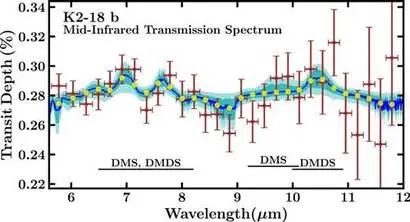
What is particularly surprising about this discovery is that the levels of both molecules were found to be extremely high. Although DMS exists on Earth through biological activity, it is very unstable and breaks down and disappears quickly. Therefore, the concentration of DMS in Earth's atmosphere is not that high. However, according to this paper, DMS was detected in the atmosphere of K2-18b at levels thousands of times higher than on Earth. Considering that DMS is a highly reactive component that disappears quickly, one must assume that some mechanism is constantly and tirelessly replenishing DMS on the planet K2-18b.
However, to maintain levels of DMS thousands of times higher than those on Earth, the planet's ocean would need to be teeming with explosively reproducing plankton. If another alien astronomer in the distant universe were observing both our Earth and the planet K2-18b, they might see K2-18b as a much more likely place for the existence of life than our own Earth. In comparison, they might dismiss Earth as a lifeless world because its signal is thousands of times weaker.
Following the first observation, the fact that the significance of the signal has risen to 3-sigma through this second observation is very interesting. However, we cannot be 100% certain yet. Ultimately, a stronger signal exceeding 5-sigma must be confirmed before it can be accepted by everyone. To this end, the research team plans to borrow more of James Webb's time. They intend to conduct observations for at least 1–3 more sessions in the mid-infrared range using MIRI, over an additional period exceeding a full day.
Of course, there is no shortage of skeptical views regarding this discovery. Some astronomers point to results showing that DMS has also been detected in comets or interstellar dust. This deviates significantly from the existing view that DMS can only be produced through complex biological activity requiring microorganisms, as on Earth. Certainly, it is difficult to expect biological activity in places like comets or dust clouds.
However, in response to such criticism, the research team stated that comet surfaces and dust clouds are fundamentally different environments from an ocean planet and cannot be considered fair comparisons. Because comet surfaces and interstellar dust clouds are exposed to intense ultraviolet radiation and cosmic rays, they can be exposed to more extreme high-energy light, raising the possibility of non-biological chemical reactions that would not occur in the oceans of an exoplanet. In contrast, it might be difficult to expect such extreme chemical reactions on an ocean planet with gravity much stronger than Earth's and covered by a hydrogen atmosphere. The research team argues that it is more reasonable to view the DMS as being replenished by the activity of alien plankton.
Others point out that the host star of this exoplanet itself being smaller and more dwarf-like than the Sun could be an issue. To receive adequate starlight from such a small star, the planet must be much closer to it. That is why the orbital period of this planet is only 33 days. But this means it is likely exposed to the danger of flares exploding from the star's surface. Small stars, in particular, evolve more violently and noisily, making them even more dangerous. Ultimately, one flare could strip away the planet's atmosphere, making it difficult for life to exist. However, the research team argues that multiple observations have already verified that this planet has survived even in that difficult environment and is indeed a Hycean planet—an ocean world covered by a hydrogen atmosphere.
Based on the results so far, K2-18b appears to be in the Goldilocks zone at an appropriate distance from its host star, and the entire planet seems to be covered in an ocean. Furthermore, very high levels of DMS and DMDS have been detected in its atmosphere. As far as we know, the only way to create these molecules currently is through microbial life. Interestingly, no oxygen has been detected on this exoplanet, which suggests the possibility that the state of this exoplanet is very similar to that of Earth billions of years ago. The absence of oxygen might be because photosynthesis has not yet begun on this planet. Even on Earth, long before photosynthesis by plants began in earnest, there was almost no oxygen, and only DMS from microorganisms was being released. In other words, K2-18b might be going through the very early stages of life's birth, where life is just beginning to sprout explosively.
And it is precisely in this respect that this discovery is even more appealing. When we talk about discovering extraterrestrial life, we often expect a complex alien ecosystem evolved to a level beyond humanity. But even if we do discover extraterrestrial life in the near future, the possibility of finding such complex life is very low. Instead, the universe is likely filled with life that remains at a much simpler level. Our own Earth is the same.
On Earth, microorganisms are an overwhelming absolute majority in terms of sheer numbers compared to humans. If an alien scientist were to make an emergency landing anywhere on Earth and scoop up a cup of terrestrial material, it would contain only microorganisms. The aliens might conclude that Earth is a world dominated by microorganisms. Could the same logic apply to the universe? If we were to randomly scoop up matter anywhere in the universe and life were accidentally captured within it, the chances are very high that it would be in a primitive form, like microorganisms. In other words, from a strictly scientific perspective, this discovery feels like it is following the exact expected course, in that the form of life we are most likely to encounter first would be close to a microorganism. That is precisely why this discovery makes us even more excited.
The most important reason we have had to keep the existence of extraterrestrial life as an "open ending" is that there has been no consensus on the criteria for judging whether life exists in the first place. We must first define a biosignature that can be seen as an indicator of biological activity before we can analyze whether that signal exists on an exoplanet. And at last, we have reached the stage where we can have meaningful discussions about what should be defined as a biosignature. Finally, we are entering an era of true astrobiology, where we can discuss the possibility of extraterrestrial life not as simple sci-fi imagination, but based on scientific data.
Reference
https://iopscience.iop.org/article/10.3847/2041-8213/adc1c8
Who is the author, Ji Woong-bae? He loves cats and the universe. After watching "Galaxy Express 999" as a child, he dreamed of sharing the beauty of the universe. Currently, he researches evolution through galaxy interactions at the Yonsei University Galaxy Evolution Center and the Near-field Cosmology Laboratory, and engages in various science communication activities, including lectures and writing. He has written books such as "The Observatory Where We Have a Flirtation," "Thinking About the Universe All Day," and "Stars, the Science of Light."