

[비즈한국] POSCO E&C, ranked 7th in domestic construction capability, and HDC Hyundai Development Company, ranked 10th294870, are competing for the construction rights of the redevelopment project in Zone 1 in front of the Yongsan Maintenance Depot (Yongsan Maintenance Depot Zone 1) in Yongsan-gu, Seoul, which has a total project cost of 1 trillion won. As the construction industry continues its trend of selective bidding for maintenance projects due to rising raw material costs and labor expenses, the number of competitive bidding wars has shrunk to just a handful this year. However, in "prime locations" where profitability is guaranteed, companies are still jumping into bidding wars, willing to risk sunk costs.
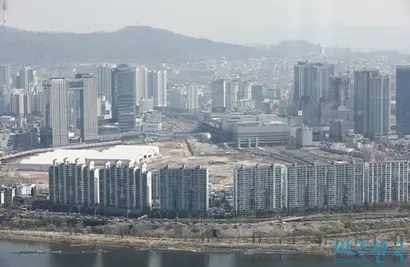
According to the maintenance industry, POSCO E&C and HDC Hyundai Development Company participated in the tender for the selection of the contractor for Yongsan Maintenance Depot Zone 1, which closed on the 15th of last month. By that day, both companies had paid the 50 billion won bid bond, officially setting the stage for a competition. POSCO E&C proposed the complex name "O'Theere Yongsan," while HDC Hyundai Development Company proposed "The Line 330." Both companies are distributing promotional materials to the media, expressing their determination to create a "Yongsan landmark." The association is reportedly preparing to distribute a comparison table of the bidding proposals.
The Yongsan Maintenance Depot Zone 1 redevelopment is an urban maintenance project to build 12 high-rise buildings, ranging from 6 basement levels to 38 floors above ground, on a 71,901-square-meter site at 40-641 Hangang-ro 3-ga, Yongsan-gu, Seoul. Located in a core area adjacent to the Yongsan International Business District, it will create a large-scale mixed-use complex consisting of 777 apartment units (678 for general sale), 894 officetel units, and commercial and business facilities. The estimated construction cost is 955.8 billion won (9.6 million won per 3.3 square meters). The association plans to hold a general meeting of members this coming June to select the contractor.
An official from the Yongsan Maintenance Depot Zone 1 redevelopment association stated, "Many construction companies showed interest due to the expectation that Yongsan is the only place capable of surpassing Gangnam in the future and its excellent location that lives up to that expectation, which eventually led to a bidding war between large construction firms." They added, "Once the promotional centers are set up, each construction company is expected to provide full explanations of their proposals. We will strive to ensure that the participating bidders can compete fairly."
Most maintenance project sites that set out to select a contractor this year failed to generate competitive bidding. Following an analysis by BizHankook of the results of redevelopment and reconstruction site tenders—where bids were opened by the 7th after being posted on the electronic procurement system (Nuri Market)—out of 44 total tender processes for selecting contractors, 42 (95%) ended up as failed bids due to no participants or only a single bidder. The only sites that managed to foster competition were the aforementioned Maintenance Depot Zone 1 and the Guseo Zone 1 redevelopment project in Geumjeong-gu, Busan (bids by Ssangyong E&C and Dongbu Corporation005960), which opened bids on the 24th of last month.
Maintenance project sites that selected contractors through competitive bidding this year were only two, excluding those that had issued bid notices last year. Previously, Samsung C&T028260 won the redevelopment project for Hannam Zone 4 in Yongsan-gu, Seoul (1.6 trillion won) after a competition with Hyundai E&C in January, and POSCO E&C won the reconstruction project for Eunhaeng Jugong Apartments in Seongnam, Gyeonggi-do (1.3 trillion won) by competing against Doosan E&C. Including the aforementioned Maintenance Depot Zone 1 and Guseo Zone 1, the number of project sites selecting contractors through competitive bidding this year rises to four. These project sites are all evaluated as having large scales and excellent business potential.
The polarization in bidding for maintenance project contractors is expected to continue into the second half of the year. The selection of a contractor for the reconstruction project in Apgujeong Zone 2, Gangnam-gu, Seoul (project cost of 2.4 trillion won)—considered the biggest prize in maintenance projects this year—is scheduled for this September, and Samsung C&T and Hyundai E&C, the top two domestic builders by construction capability, are already expressing strong intentions to win. Samsung C&T recently opened a promotional center for residents near the complex, and Hyundai E&C had previously registered the name of the Apgujeong Hyundai Apartment complex as a trademark. In addition, competition is anticipated for projects such as the reconstruction of Daegyo Apartments in Yeouido, Yeongdeungpo-gu, Seoul, and the redevelopment of Districts 1 and 2 of the Seongsu Strategic Maintenance Zone in Seongdong-gu in the second half of the year.
An official from a large construction company said, "As cost ratios rise and profitability worsens due to increased raw material prices and labor costs, construction companies are selectively bidding for maintenance projects, which are relatively stable income sources, by carefully considering their profitability. Typically, when companies engage in a bidding war, they use up to 1% of the expected sales revenue as bidding costs. The smaller the construction company, the more they avoid bidding wars to prevent sunk costs in case of defeat. Nevertheless, for sites where profitability is secured, companies jump into bidding wars even while accepting these sunk costs."
Meanwhile, 97% of the maintenance projects won by the top 10 domestic construction companies last year were private contracts. Out of 63 maintenance project sites that selected one of the top 10 construction companies as their contractor in 2024, 61 chose them through private contracts. The only projects that successfully fostered a bidding war were the reconstruction of Hanyang Apartments in Yeongdeungpo-gu, Seoul (774 billion won), which was won by Hyundai E&C, and the reconstruction of Dogok Gaepo Hanshin Apartments in Gangnam-gu, Seoul (438.5 billion won), won by DL E&C. Although the selection of a maintenance project contractor is based on the principle of competitive bidding, a contractor can be selected through a private contract if the bidding process repeatedly fails.