

[비즈한국] To address the low birth rate, the government has set out to improve childbirth and childcare policies. Starting this year, publicly traded companies are required to disclose their parental leave usage rates in their business reports, creating an atmosphere that actively encourages employees to take parental leave. What is the current status of parental leave usage in the retail and food industries, which have long emphasized family-friendly management? We examined the parental leave status of retail and food companies included in the top 500 KOSPI-listed companies by market capitalization (as of May 3, 2025).

67% Male Parental Leave Usage at Lotte Shopping023530, Effectiveness of ‘Automatic Parental Leave System’
Starting this year, the government mandated the disclosure of parental leave usage rates in the business reports of publicly traded companies. While disclosure had previously been limited to public institutions, a revision to corporate disclosure forms last November expanded this requirement to private companies. The parental leave usage rate is calculated as the percentage of employees who took parental leave within one year after childbirth among all employees who have a child under the age of one at the time of birth within that year.
There are a total of 8 retail companies included in the top 500 KOSPI-listed companies by market capitalization (E-mart139480, Lotte Shopping, BGF Retail282330, Hotel Shilla008770, Shinsegae004170, Hyundai Department Store, GS Retail, and GS P&L). Among them, Lotte Shopping stands out most prominently.
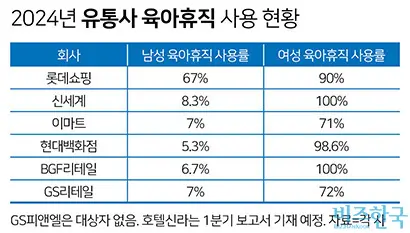
Lotte Shopping recorded a male parental leave usage rate of 67% last year. It is the only company in the retail industry to surpass 10% in male parental leave usage. Lotte Shopping has maintained a 60–70% range annually, with rates of 70% in 2022 and 77% in 2023. As the male usage rate increased, the total parental leave usage rate for all employees also reached 80% last year, the highest figure in the retail industry.
Lotte Shopping’s male parental leave usage rate surged significantly after it became the first major corporation to introduce a "1-month automatic parental leave system" for male employees in 2017. Under this system, male employees are automatically granted parental leave upon their spouse's childbirth. Starting this year, the leave period has been expanded from one month to three months.
Among retailers, GS Retail has the lowest parental leave usage rate. In 2024, the total usage rate for GS Retail employees was 24%. The breakdown showed 7% for men and 72% for women. GS Retail's usage rates remained low at 23% in 2022 and 24% in 2023. Notably, last year, the usage rate for female employees fell compared to the previous year (87%).
The company with the lowest male parental leave usage rate is Hyundai Department Store, which recorded 5.3% last year. This contrasts sharply with its female parental leave usage rate of 98.6%. Hyundai Department Store’s total parental leave usage rate for all employees last year was 65.4%.

‘Family-Friendly Certified’ Companies Like Binggrae and Pulmuone at 0% Male Parental Leave
In the food industry, male parental leave usage rates vary starkly from company to company. Out of 18 food companies in the top 500, six recorded double-digit male parental leave usage rates, while five companies recorded 0%.
Samyang Corp., Dongsuh, Orion, Namyang Dairy Products, Dongwon F&B, and Ottogi are among the top companies for male parental leave usage. Last year, Samyang Corp. recorded 57%, Dongsuh 50%, Orion 31.6%, Namyang Dairy Products 22%, Dongwon F&B 19.1%, and Ottogi 12.3%.
It is noteworthy that, excluding Namyang Dairy Products, all four companies showed an upward trend in male parental leave usage compared to the previous year. Orion’s rate increased from 14.3% in the previous year to 31.6% last year. Dongsuh’s rate jumped from 0% in 2023 to 50% last year, and Ottogi’s rose from 4.5% to 12.3% during the same period. Dongwon F&B increased from 5% to 19.1%, and Samyang Corp. grew from 27% to 57%.
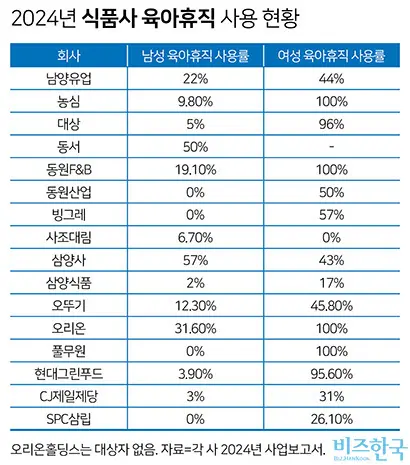
While the use of male parental leave is spreading, particularly among large conglomerates, a rigid organizational culture persists in some areas. Dongwon Industries, Binggrae, Pulmuone, SPC Samlip, and Daesang Holdings reported male parental leave usage rates at the 0% level. Among these, Binggrae and Pulmuone have received "Family-Friendly Certification" multiple times. This certification, overseen by the Ministry of Gender Equality and Family, is awarded to companies and public institutions that exemplify workplace cultures supporting a work-life balance.
A Binggrae official stated, "We did have male employees who used parental leave (4 people), but the rate likely appeared as 0% because decimals were omitted during the calculation. The low usage rate is likely a personal matter. There is no organizational culture that penalizes employees for taking it."
There is still a significant gap in parental leave usage between men and women. For retail companies, the average female parental leave usage rate was 89% last year, while the male rate was 17%. In the food industry, the average female rate was 63%, while the male rate was a mere 13%.
The government expects that with the mandatory disclosure of parental leave usage, the rates for men will gradually improve. This is based on the significant effects observed in Japan, which implemented a similar system ahead of South Korea.
Japan mandated the disclosure of parental leave usage for companies with 1,000 or more employees starting in 2022, and the rate for male employees nearly doubled following the implementation. Determining that the disclosure system contributed to the increase, the Japanese government expanded the mandate to companies with 300 or more employees starting this April.
The Financial Supervisory Service (FSS) plans to manage the situation by conducting annual inspections to identify instances of poor or inadequate reporting in business reports. However, some worry that because parental leave usage is not considered a "critical" item in these reports, inadequate reporting might increase.
An FSS official noted, "If critical information is omitted, measures such as corporate guidance are taken. While parental leave usage is not strictly considered critical, once the disclosure forms are revised, we will designate related items as key points for inspection. We will not overlook omissions. We will periodically inspect them and require companies to provide supplements."