

[비즈한국] The so-called "firsts" recorded at the 61st Baeksang Arts Awards in 2025 were certainly noteworthy. Cinematographer Hong Kyung-pyo and the variety show ‘Culinary Class Wars’ received the Grand Prize in the film and television categories, respectively. This confirms the public perception that the awards do not discriminate against variety programs. Even a production from the global OTT platform Netflix, rather than a domestic broadcaster, was not excluded. Although fans expressed dissatisfaction that the fellow Netflix drama ‘When Life Gives You Tangerines’ (Pokssak Sogatsuda) and stars IU and Park Bo-gum did not win the Grand Prize, it is not a major disappointment as it still secured awards for Best Screenplay and Best Drama.
However, there was not much debate over whether ‘Culinary Class Wars’ was truly worthy of the Grand Prize. This is notable considering that the day after the Baeksang ceremony, Baek Jong-won, one of the show's judges, announced he would quit all broadcasting activities, and ‘Culinary Class Wars Season 2’ is already scheduled for release. Perhaps this highlights both the identity and the limitations of the Baeksang Arts Awards. The very distinctiveness it has cultivated may now be trapping it.

While terrestrial broadcasting awards have lost significant credibility and authority due to being too numerous and acting like "participation trophies," cable and OTT platforms still lack proper awards ceremonies. This has inadvertently increased the perceived credibility of the Baeksang Arts Awards. However, increased credibility and authority do not necessarily translate into greater public attention. Nor is this status guaranteed by fierce competition. The Baeksang Arts Awards are defined by infinite competition, yet only one final award is granted—whether to a project or an individual. This year alone, one Grand Prize went to an individual and the other to a program.
In fact, ‘Culinary Class Wars’ and the Baeksang Arts Awards share a commonality: an infinite competition format that disregards conditions or circumstances. The television category, which changed its name for this edition, makes no distinction between terrestrial, general programming, cable, or OTT. In entertainment, all platforms—be it the internet, YouTube, terrestrial, or cable—compete on equal footing. It resembles ‘Culinary Class Wars’ in its premise of stripping away titles and labels to compete, whether one is a famous or unknown chef.
‘Culinary Class Wars’ put forward the core evaluation principle of winning solely through taste. The Baeksang Arts Awards prioritize popular outcomes. Ultimately, it is like asking who makes the most appetizing dish. That dish is food sold in a restaurant, falling squarely into the restaurant business. However, a chef is not necessarily a restaurateur. In terms of results and performance, Baek Jong-won was the most suitable fit. This is likely why he was included as a judge.
However, viewers do not only want delicious food. Processes and operations, such as fair trade and ESG management, are also important. It matters not only that the ingredients are healthy, but also that the producer fulfills social responsibilities, manages the restaurant fairly, and treats customers properly. Furthermore, the consumption patterns of viewers who visit restaurants featured on television cannot be overlooked or ignored. In reality, issues later emerged regarding some of the restaurants featured in ‘Culinary Class Wars.’ Yet, these aspects were not subject to evaluation in the show.
Looking closely, ‘Culinary Class Wars’ is a hit product from a massive global restaurant known as Netflix. It is highly valued because of its global success, and it seems the dramatic narrative of an unknown chef winning through skill added to the entertainment value. However, using skill as the sole criteria for final evaluation is insufficient.
‘Culinary Class Wars’ overlooked the paradox inherent in a format that judges based solely on results. This is the background against which Baek Jong-won became a mythical figure in Korea through broadcasting, while various illegal or opportunistic practices related to his octopus-like, monopolistic management were overlooked. Although Baek Jong-won the restaurateur was hailed as a skilled chef on various broadcasts, the scandals and criminal allegations he faced led to the current serious crisis. The crisis occurred because the victory and myth portrayed in the broadcast program were vastly different from reality.
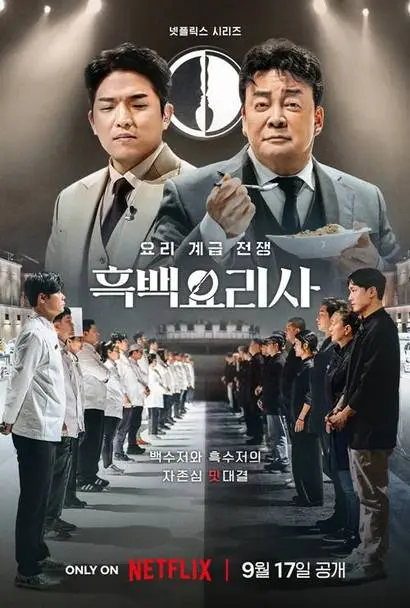
In that vein, doubts have also been raised about whether Baek Jong-won possessed the necessary credibility to serve as a judge for ‘Culinary Class Wars.’ Examining the show's specific details, the final winner reached the final round based on a Gekukji (traditional kimchi soup) dish; it is doubtful if he actually knew the dish properly. None of the judges caught it, likely because none of them had ever tasted the authentic version. The judging should have been done by someone who has actually made or eaten real Gekukji. It is absurd for only two judges, including Baek, to critique every dish. Moreover, it is questionable how much a restaurant business expert can truly evaluate cooking itself. All evaluation criteria were captured by the result of being #1 in global viewing time, and the Baeksang Arts Awards are in the same boat.
The Baeksang Arts Awards effectively demonstrated the side effects of selecting content based on infinite competition. Just as the process of making food and how it is delivered are crucial, broadcast content should be the same. A public broadcaster cannot completely ignore the tears of franchise owners while featuring the representative of 25 franchise restaurant brands. While Baek Jong-won and the production team visited numerous other restaurants, no one analyzed or visited Baek’s own establishments. ‘Culinary Class Wars’ lacked such a process entirely. Evaluation took place only within the studio set, despite the fact that most of the participants are restaurant operators themselves. If the Michelin guide did this, there would be an outcry, and it would be difficult to maintain its current credibility and authority.
Fundamentally, the Baeksang Arts Awards do not consider it a "tilted playing field" when they treat public, commercial, local, and global OTT content equally to select the best program. Furthermore, an awards ceremony is only meaningful if it reflects dynamic situations, but this was not a premise here. Each situation and condition is different. This is why relative evaluation, rather than absolute evaluation, is important. Achieving the best possible result within one's specific circumstances is what matters to ordinary people. This is the universality and popularity of our time that an award should embody.
The Baeksang Arts Awards are increasingly becoming subordinated to the power of capital and systems. The production cost of the Korean film ‘Harbin’ was 30 billion won, while the Netflix drama ‘When Life Gives You Tangerines’ cost 60 billion won. Moreover, in the 21st-century smart mobile environment, the reciprocity of pop culture—where fans help create the culture—is growing. A method that ignores those fans and only selects one person or project for the Grand Prize is no longer fitting. It only shows that it is trapped in the 20th-century mass media frame and 19th-century artistic dogma. Now, becoming a celebratory space shared with fans would be our way—that is, a "glocal" approach.
The author, Kim Heon-sik, has walked through and explored the forest of popular culture phenomena since his 20s, with the expectation that there is a way to make the world a better place through culture. He continues on this path with the same belief even in the 21st century, where artificial intelligence and quantum computers are at the forefront.