

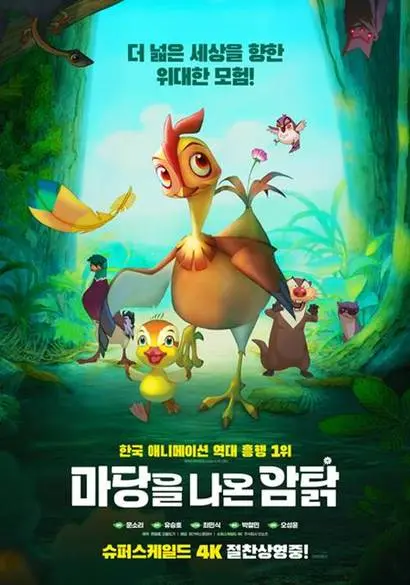
[비즈한국] On January 23, 2025, the animated film 'Leafie, A Hen into the Wild' attracted attention by being re-released in a 4K remastered version using AI super-scaler technology. Since 'Leafie, A Hen into the Wild' was originally released in July 2011, it marked a return to high-definition digital content after a staggering 14 years.
At the time of its release, the animation 'Leafie, A Hen into the Wild' drew 2.2 million viewers, setting the record for the highest number of viewers for a Korean animation, a record that remains unbroken to this day. This was possible because the work contained themes that resonated deeply not only with children but also with adults.

'Lovely Hachupin,' which broke the 1.05 million viewer record held by the second highest-grossing Korean animation 'Speckles: The Tarbosaurus 3D (2012),' was watched by 1.2 million people. This is also because it had elements that attracted not only teenagers but also adults in their 20s and older. However, 'Lovely Hachupin' is no different from other Korean animations in that it is strongly oriented as children's content intended for viewers aged 7 and up.
The animation genre is notably the weakest point for K-content, which otherwise dominates the world in video media. It differs from Japan and the United States, which have nurtured animation as a cultural content genre that can be enjoyed by both children and adults. Moreover, in the face of low birth rates, the scalability of children's content is inevitably limited. The animation 'Kkoma,' currently in development by Myung Films—the producers of 'Leafie, A Hen into the Wild'—has struggled to raise investment, but its direction toward being a family film that can be enjoyed by both children and adults is the right approach. This work is a creative animation based on the 2010 escape of an Asiatic black bear from the Seoul Grand Park.
Animation must now move toward becoming a cross-generational genre. To achieve this, production methods must diversify risk. First, attention should be paid to the strategy of expanding short films into feature-length works.
This year's 78th Cannes Film Festival came as a shock to the Korean film industry. This is because there were zero Korean films in either the competition or non-competition sections. Later, the fact that director Jung Yu-mi's short animation 'The Glass' was invited to the Short Film Competition at Critics' Week served as a consolation.
Director Jung Yu-mi has been invited to world-renowned film festivals multiple times, but she has never received support for a feature-length animation. This is her second invitation to Cannes, following her 2009 work 'Dust Kid,' which was invited to the Directors' Fortnight. 'Math Test' (2010), 'Love Games' (2013), 'House of Existence' (2022), and 'Circle' (2024) all entered the Short Film Competition at the Berlin International Film Festival. 'Love Games' was the first Korean animation to win the Grand Prix at the Animafest Zagreb. In 2023, 'The Waves' was officially invited to the Short Film Competition at the Locarno Film Festival.
'Dust Kid' was published as a picture book in 2014 and won the Bologna Ragazzi Award, a first for a Korean illustrator. In 2015, she received the Bologna Ragazzi Award again for 'My Little Doll’s House.' It was a two-year consecutive win that stunned the world. She has achieved great success in both video and publishing. It is clear that Director Jung Yu-mi's works possess both public appeal and artistic merit that encompass both children and adults. Now is the time to consider scalability.
In this context, let us look at the case of the animation 'Flow.' In a major upset at the 2025 Golden Globe Awards, 'Flow' won the Best Animated Feature Film award, beating out 'Inside Out 2' and 'The Wild Robot,' which were created by major US studios. It also won the Best Animated Feature award at the 97th Academy Awards. This animation is a work expanded from a short film directed by Latvian director Gints Zilbalodis during his high school years into an 85-minute feature film.
It is standard practice for our film industry to suddenly produce and release feature films. It is common for these projects to fail even after injecting massive production budgets by relying on famous directors, actors, or writers. Thanks to the multiplex system, it became possible to dominate screens through massive volume and aggressive marketing. The "high-risk, high-return" model was taken for granted. The current crisis in the film industry stems in part from this production method, which is vulnerable to risk management.
However, that approach is no longer sustainable. The media content consumption environment has become highly driven by individual preferences and fandom. Fandom and audience feedback must be reflected in the content. For example, even OTT platforms that emphasize original content now prefer works based on webtoons. This is to diversify risk to reduce the likelihood of failure while securing content based on existing fan bases.
For the future of the film industry, it is crucial to discover new directors and writers, and the same applies to animation. Not only is active interest in short animation creators necessary, but creators of webtoons, picture books, and children's literature are also important. 'Leafie, A Hen into the Wild' was also based on a children's book. We need to pay attention to so-called "childlike" content. However, in Korea, which has emerged as a powerhouse in webtoons and picture books, we do not expand children's literature into animation. The animation 'Al-Satang,' based on author Baek Hee-na's children's book 'Magic Candies,' was produced by a Japanese crew and reached the Academy Awards.
Fortunately, the Ministry of Culture, Sports and Tourism recently announced its ambition to make animation a genre that can be enjoyed by all generations, from children to adults. Animation is a field where government support is crucial. More attention should also be paid to events like the Seoul Indie-AniFest, the only independent animation film festival in the country. 'Lost in Starlight,' an animation directed by Han Ji-won, who won the Grand Prix at this festival, will be released on Netflix at the end of May. It is the first original Korean animation to be presented on Netflix. It is worth watching to see the results.
The author, Kim Heon-sik, has walked through or navigated the forests of pop culture phenomena since his 20s, driven by the expectation that there is a way to make the world a better place through culture. He continues on the same path with the same belief, even in the 21st century where artificial intelligence and quantum computers are at play.