

[비즈한국] It has been confirmed that Coupang is testing a new type of 'Fresh Bag' delivery through select logistics camps. Photos of the new design are circulating quickly among delivery drivers, with some suggesting that if officially adopted, it would make the retrieval process easier than the current model. However, some critics argue that instead of introducing new designs, Coupang should first address the issue of the "low-paid labor" required for collecting these bags.
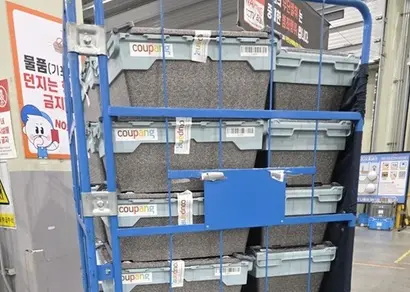
Testing in select camps: 'Will the Velcro disappear?'
According to industry sources, Coupang has recently been testing a new Fresh Bag in several logistics camps in the metropolitan area. The version being tested is believed to be a compressed Styrofoam box of a similar size to the existing one. Unlike current Fresh Bags, which are secured with Velcro on the top, front, and sides, the new model features a lid that fully detaches from the base. It is designed with a shipping label on the top of the lid and the Coupang logo and barcode on the side.
Notably, the design replaces Velcro with a side locking mechanism, making it easier to open and close. Customers have frequently complained that the existing Velcro-secured bags are difficult to open. For delivery drivers, the process of collecting and collapsing these bags requires ripping off all the Velcro, which has often led to physical injuries during the workflow.
The pilot test is reportedly being conducted by Coupang's headquarters packaging team. The goal is to address issues where chilled or frozen products are damaged when packed together in a single Fresh Bag with dry ice.
However, some predict that the current prototype may not reach full-scale adoption. An industry insider stated, "There is feedback that the test boxes are a bit heavy, so there is talk that it might be difficult to move toward an official rollout."
Rumors about the new Fresh Bag are spreading rapidly among drivers. Given how strenuous the process of peeling off Velcro has been, there is significant anticipation for the new design. One driver noted, "Ripping off the Velcro is really tough. It’s better now that the weather has warmed up, but in winter, it’s even harder to pull apart. If the lid and box can be separated like the one currently being tested, the retrieval work would likely be much easier."
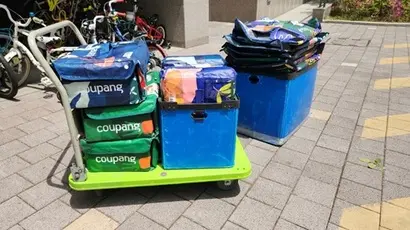
Drivers demand: "Fresh Bag retrieval fees should match standard collection rates"
Some drivers argue that Coupang’s move is a "trick" to avoid addressing the issue of inadequate retrieval fees. One driver pointed out, "Drivers have long complained that ripping Velcro is labor-intensive. Isn't this just a ploy to say, 'We won't raise your fees because the labor intensity has decreased,' after introducing a Velcro-free bag?"
Currently, Coupang delivery drivers (Quick Flex) receive a fee of 100 to 200 won per collected Fresh Bag. Drivers receive 100 won when picking up a bag from a household while making a delivery (linked), and 200 won when visiting specifically for the retrieval (independent).
Quick Flex workers have long expressed frustration that these fees are ridiculously low compared to the labor required. A driver named 'A' said, "It’s not just about ripping off Velcro. The bags still have shipping labels attached, and they contain ice packs and insulation inside. When we return to the camp, we have to drop off the bags and then manually separate the ice packs, labels, and insulation for recycling."
"In particular, each bag often contains two or three ice packs, making them very heavy to carry around. Most of us end up cutting the ice packs open ourselves to dump the water and ice out to reduce the weight. We do all this work just to get paid a mere 100 won," the driver pointed out.
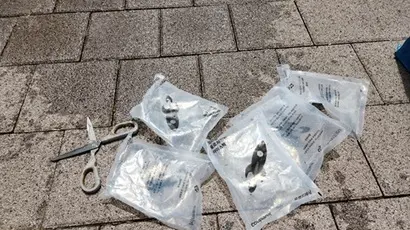
Because of the low fees, many drivers avoid Fresh Bag retrieval, leading to an increase in customer complaints about bags not being picked up. Despite this, Coupang has not adjusted the retrieval fees and maintains the stance that there are no plans to change the fee structure.
Coupang appears to be pressuring logistics agencies to increase the retrieval rate. Early this year, the company introduced the 'SLA (Service Level Agreement)' system, an agency evaluation program. Performance is judged based on four metrics: non-delivery rate, non-return rate, customer complaints, and customer satisfaction indices. The results will be applied during contract renewals next year, and agencies with poor ratings risk losing their contracts.
Driver 'B' explained, "Fresh Bag retrieval performance accounts for 50 out of the 100 total points in the SLA. If the retrieval rate drops, the agency's contract renewal is at risk. Ultimately, agencies have no choice but to pressure the drivers. Some agencies have even added clauses to driver contracts stating that failure to meet Fresh Bag retrieval targets will result in non-renewal."
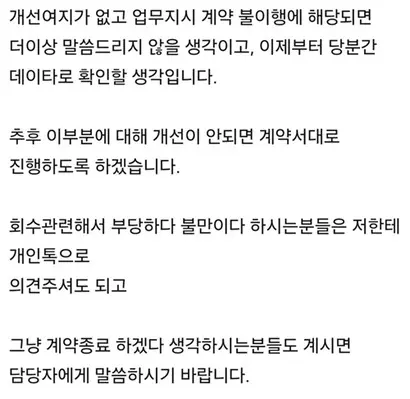
Driver 'B' added, "Agencies send messages saying, 'If you don't maintain Fresh Bag performance (over 90% for linked, over 70% for independent), renewal will be difficult. Even if you've finished your deliveries, go back and collect them.' Some drivers even perform a 'fourth round' of work after finishing their triple-rotation shifts just to collect the bags. Coupang lowers delivery unit prices every year, and the working conditions for drivers are becoming increasingly dire."
Drivers are demanding fair fees for Fresh Bag collection. One driver said, "If a proper fee were paid, we could set up dedicated teams to handle this. The problem exists only because they aren't paying the costs. Since collecting Fresh Bags is essentially a form of package collection, we want a fair collection fee. The return fee (for collecting returned items) is the same as a regular collection fee—I don't understand why Fresh Bag retrieval is only paid at 100 to 200 won." Typical collection fees for other items are usually around 700 won per package.