

[비즈한국] The features and composition of the new destroyer 'Choe Hyon-ho,' unveiled by North Korea on the 25th, are unusual. The 'Choe Hyon-ho' is North Korea's first combat vessel in the 5,000-ton class and the first in its navy to incorporate modern technologies such as a phased array radar, surface-to-air missiles, and a vertical launching system (VLS).
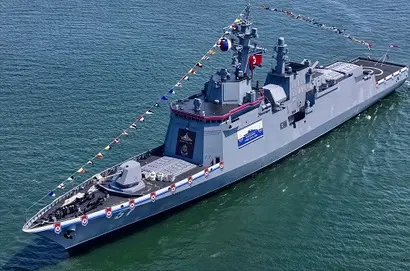
To the general public, its exterior looks much more similar to destroyers operated by the South Korean or U.S. Navy than those of Russia or previous North Korean vessels. North Korea even designated the ship's hull number as DDG-51, the same as the Arleigh Burke-class destroyers that serve as the core power of the U.S. Navy.
How threatening is North Korea's new destroyer, the Choe Hyon-ho? It is true that some experts criticize the ship as being a "show" vessel that lacks substance or is essentially an "empty shell," and they have their reasons for doing so.
Looking at the photos of the Choe Hyon-ho released by North Korea's Korean Central News Agency (KCNA), there are traces of paint touch-ups visible across the hull, leaving uneven spots. This may stem from issues during the ship's construction, assembly, and welding, or simply from manual repainting.
The ship's design also has many problems. While the shape resembles the South Korean Navy's Daegu-class frigate or a U.S. Aegis destroyer, it features round portholes below the bridge. Modern warships are equipped with complete internal air circulation systems to counter chemical weapons, so these portholes suggest an outdated design meant to compensate for poor performance or potential failure of such systems.
The ship's configuration is also problematic. The Choe Hyon-ho carries a 127mm main gun, a 30mm autocannon, and up to 106 missiles in vertical and inclined launch systems. This is six times that of the similarly sized Japanese Mogami-class destroyer and 1.8 times that of the Chungmugong Yi Sun-sin-class destroyer. It is equipped with eight types of missiles capable of attacking enemy aircraft, missiles, ships, ground targets, and submarines.
One might mistakenly assume that more weapons and missiles on a ship are inherently better, but North Korean warships are also subject to the laws of physics, which creates a fatal flaw. Specifically, the ship's essential 'operational capability'—simply put, the ability to sustain continuous operations once deployed—is severely lacking. By filling most of the ship with VLS cells and carrying a crew of around 250, the Choe Hyon-ho is highly likely to have significantly less capacity for fuel and supplies than other warships of similar size.
Considering that the Japanese Mogami-class frigate has a range of 8,000 nautical miles and the Russian Admiral Gorshkov-class has 4,800, the Choe Hyon-ho's range and operational endurance are likely around 2,000 nautical miles, comparable to our Navy's PKG (Patrol Killer Guided-missile) craft. In other words, its performance is likely so poor that it is doubtful it could even remain at sea for a month.
This does not mean the Choe Hyon-ho is completely useless. While its abnormal functionality and backward manufacturing technology make standard missions impossible, it is an undeniable fact that it possesses several lethal features that threaten South Korea.
The most concerning aspect is that it is equipped with 22 missiles capable of carrying North Korea's 'Hwasan-31' tactical nuclear warhead. It carries 10 Hwasong-11-D derivative surface-to-surface ballistic missiles in the large rear vertical launch system, and 12 'Hwasal'-series cruise missiles in the front. Both types of missiles are ones North Korea is preparing to deploy on submarines like the 'Hero Kim Kun Ok'.
Why deploy tactical nuclear missiles on a surface combatant instead of a submarine? North Korea's intentions can be summarized in two points. First, surface combatants can solve the "difficulty of command and control," which is a fatal weakness of nuclear strike capabilities using submarines. While submarine-launched missiles are lethal because they enable surprise attacks, it is not easy to transmit nuclear strike orders to a submerged submarine.
To relay real-time attack orders to a submarine, one must use Very Low Frequency (VLF) communications, which only work for submarines at very shallow depths. Furthermore, VLF antennas are too large and easily destroyed in wartime. In contrast, surface combatants can maintain constant communication with headquarters, making them advantageous for receiving orders and conducting operations.
Another advantage is the "demonstration effect," where our military and the ROK-U.S. Combined Forces Command must remain alert whenever the Choe Hyon-ho departs. In fact, General Secretary Kim Jong Un's speech at the launch ceremony included mentions of expectations for the Choe Hyon-ho’s role in easing the pressure from ROK-U.S. combined exercises.
Can our military easily block a tactical nuclear attack from the Choe Hyon-ho? Currently, it is not easy. This is because the Choe Hyon-ho's defensive capabilities are significant. For anti-aircraft, it has 32 'North Korean version of Tor' missiles in the front VLS, and one 'North Korean version of Pantsir-ME' Close-In Weapon System (CIWS) in the rear. Both have the capability to intercept enemy aircraft or missiles 20km away. Additionally, it is equipped with 12 new surface-to-air missiles, providing long-range interception capabilities against aircraft over 40km away, making its air defense relatively strong.
The Choe Hyon-ho also has 16 'North Korean version of Spike NLOS' missiles on the port and starboard sides, along with two 30mm autocannons. These missiles are fiber-optically guided and can attack small vessels approaching within 20km; they are particularly effective against unmanned surface vehicles (USV) conducting "swarm attacks." Essentially, North Korea has given the Choe Hyon-ho the ability to defend against the very same suicide drone boat attacks that have been active in the Ukraine war.
How should our military respond to the Choe Hyon-ho? The best approach is to secure new swarm, AI-equipped, and high-speed weapons with excellent cost-to-performance ratios, providing anti-ship attack capabilities that the Choe Hyon-ho cannot defend against. This is known as a "swarm attack" or "saturation attack."
To this end, it is necessary to secure AI-equipped medium-sized anti-ship strike drones—similar in size and performance to the medium-sized ground strike drones currently under development, but featuring AI capabilities and anti-ship seekers. Because AI drones can be produced in large numbers at a much lower cost than anti-ship missiles, they could overwhelm the Choe Hyon-ho’s air defense system.
Additionally, we must pursue the acquisition of affordable, high-speed, anti-ship weapons. The CTM-MR, an anti-ship missile for the Chunmoo multiple launch rocket system currently being proposed as an export weapon system in the European market, possesses both high-speed flight capabilities and a low cost.
We should consider equipping our military's ships and fighter jets with air-to-ship and ship-to-ship versions of the CTM-MR. In particular, if the CTM-MR missile is modified to be carried by fighter jets—similar to the Rampage missile from Israel's IAI—it is expected that the export competitiveness of our KF-21 will also be significantly enhanced.