

[비즈한국] In tennis, players face each other. The court on the other side is called the opponent's court, and the player facing me there is called the opponent. In sports that involve a ball rather than recorded events, you compete against a rival team or side to see who wins. This applies to volleyball and table tennis as well. In soccer and basketball, the team that puts more balls into the opponent's goal wins. There are two goals; someone attacks, and someone else defends that attack.
In golf, all players use the same hole. It is not a game of who puts more in, but a competition to see who reaches the hole in the fewest strokes. In that sense, while there are many sports involving balls, golf is more unique than we think. One thing that sets golf apart from other sports is that we call our competitors 'companions' (dong-ban-ja).
Only golf uses that term. In a cold and fierce world of sports, what does 'companion' even mean? Even in a casual weekend round, golf is a sport where a hidden desire to win inevitably creeps in. When describing golf gracefully, people say, 'Golf is a battle with oneself and a battle with nature.' However, no matter how much we say that, we know all too well that it is ultimately a battle against the golfer standing next to us.
Nevertheless, why do we call our competitors 'companions,' especially in weekend golf? It is because even though we compete against each other, we must at times 'cooperate.' When someone hits their ball to an ambiguous spot, golfers go together to help find it. Perhaps in this universe, golf is the only sport where you go to find your opponent's ball, not your own.
We tell each other about the line of flight for a ball that has gone into a penalty area, and even if it’s not their turn, a player who is ready asks for permission and plays first. Playing out of a bunker and smoothing it over, or repairing pitch marks on the green, are all gestures of consideration and cooperation for others.
In golf, when a companion hits a good shot, we cheer "Nice shot," give a thumbs up for an incredible ultra-putt, and react with exaggerated enthusiasm for a fantastic bunker shot. In soccer, when a fantastic mid-range shot from the opposing team leads to a goal, the goalkeeper who failed to stop it does not give a thumbs up. Only in golf do competitors acknowledge, cooperate with, and consider each other. At least, that is how it looks on the surface.
We call our spouses 'life companions.' 'Companion' is an expression heard time and time again in wedding congratulatory speeches. If a couple lives together for a hundred years, it means they share about 50 or more years of life. However, calling someone a companion just because you spent four or five hours together on the grass is because those five hours are different from other five hours.
If you have a meal before or after the round, those five hours turn into six or seven. If you carpool or play an extra round of screen golf because you're not ready to part ways, you might end up spending the whole day together. Even if you have a company dinner for a few hours, you might wake up the next morning and barely remember what you talked about, not even trying to recall it—but a golf round is different.
Once you move past being a beginner and build up experience, it is rare for any other time to be remembered as vividly as golf: what the other person wore, what conversations were shared in the car, how their shots were, and what mannerly—or, conversely, rude—actions they displayed during the round. Although they are only five-hour companions, those memories stay with me for a long time.
Golf is a sport that hides rough and intense competitive desire behind a refined attitude and behavior called manners and etiquette. That does not mean manners and etiquette are mere formalities or superficiality. Even that is the essence of golf. It means that cooperating, being considerate, cherishing, and congratulating each other are just as much the essence of golf as concentrating, focusing, and achieving.
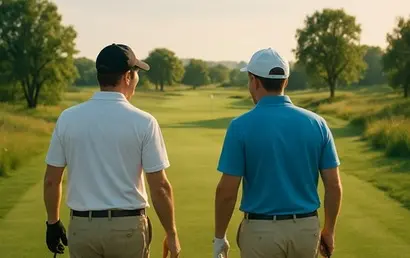
Golf is not a sport where you stare each other down and fight; it is a sport where you walk side-by-side, looking at the same place, and heading toward the same hole. Sometimes, I take photos of the backs of two golfers walking side-by-side on the grass. Looking at those photos, I understand why they are called 'companions.' They are companions for those five hours of life. They are fellow travelers.
Who is the author Kang Chan-wook?
An advertiser and writer. He began his career as a copywriter at Cheil Worldwide and is currently the CEO of the video production company 'Era's Gaze.' Fond of golf, he obtained a USGTF teaching professional certification, and out of his love for writing, he published books on golf such as 'The Joy of Golf,' 'Bad Golf,' 'Sincere Golf,' and 'Golf Thoughts, Thinking Golf.' He runs the YouTube channel 'Bad Golf,' sharing various stories and thoughts surrounding golf with readers and viewers.